
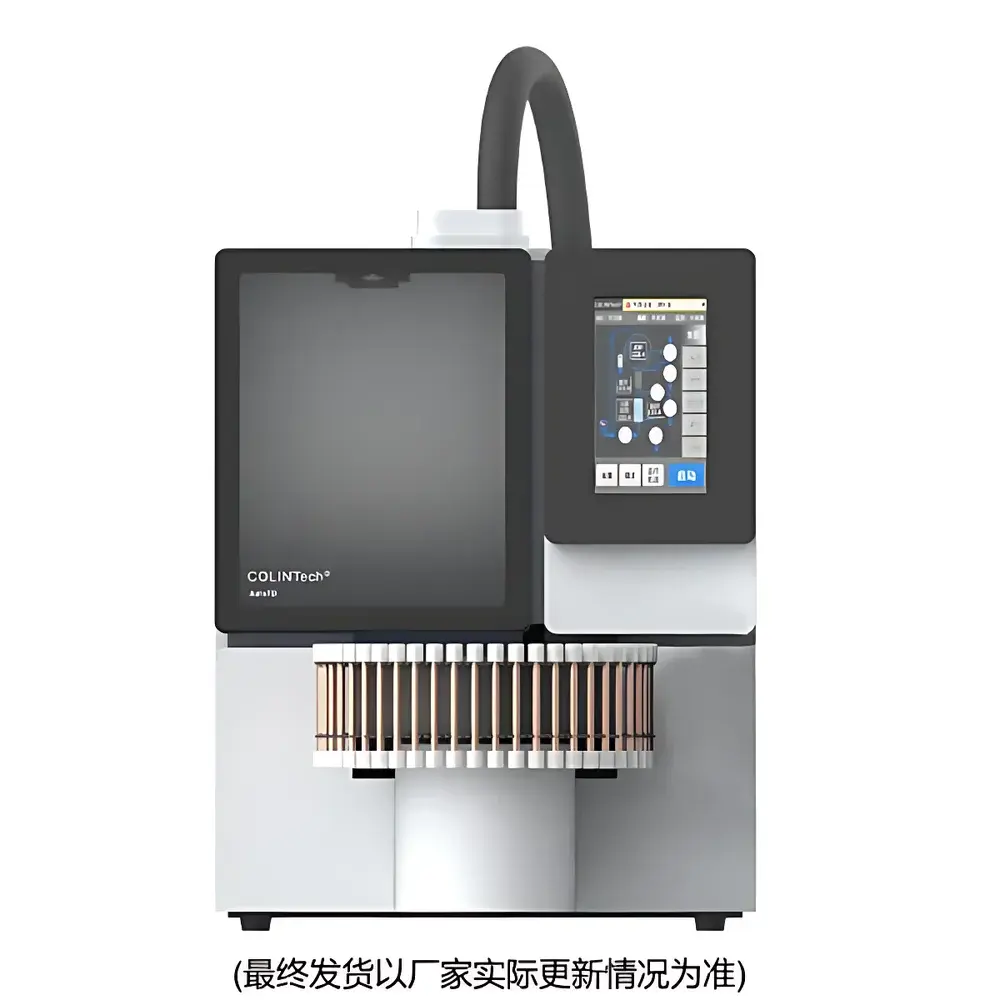
ColinTech AutoTD Advanced Automated Thermal Desorber
| Brand | ColinTech |
|---|---|
| Origin | Sichuan, China |
| Manufacturer Type | Direct Manufacturer |
| Instrument Type | Dual-Stage Thermal Desorber |
| Automation Level | Fully Automatic |
| Primary Desorption Temperature Range | 50–400 °C |
| Secondary Desorption (Cold Trap) Temperature Range | −40–400 °C |
| Valve & Transfer Line Temperature Range | 50–300 °C |
| Cold Trap Temperature Control Accuracy | < ±0.1 °C |
| Desorption Recovery Rate | 99.5% |
| Sample Capacity | 50 positions |
| Method Storage | 10 user-defined methods |
Overview
The ColinTech AutoTD Advanced Automated Thermal Desorber is a dual-stage, fully automated thermal desorption system engineered for high-fidelity volatile and semi-volatile organic compound (VOC/SVOC) analysis in environmental, occupational health, and materials testing laboratories. It operates on the principle of two-stage thermal desorption—first releasing analytes from sorbent tubes under controlled heating (primary desorption), then refocusing them onto a cryogenically cooled trap (cold trap), followed by rapid thermal desorption into the gas chromatograph (GC) or GC/MS inlet. This architecture eliminates cold-spot losses, minimizes band broadening, and ensures quantitative transfer of analytes across a wide concentration range—from sub-ng to µg levels—without carryover or memory effects. Designed for compliance with ISO 16017-1, EPA TO-17, and ASTM D6196 methodologies, the AutoTD supports validated workflows in regulated environments requiring trace-level detection and reproducible calibration.
Key Features
- Patented 360° circumferential heating technology for primary desorption—ensures uniform thermal energy distribution around the entire sorbent tube surface, eliminating axial temperature gradients and promoting complete, residue-free analyte release.
- Secondary desorption via rapid hot-gas flash elution from a cryogenically cooled trap—enables sharp, symmetrical chromatographic peaks with enhanced signal-to-noise ratios and improved low-level detection limits.
- Precision temperature control across all critical zones: cold trap (−40 to 400 °C), valves and transfer lines (50–300 °C), and primary furnace (50–400 °C), with stability maintained at < ±0.1 °C—critical for method robustness and inter-laboratory reproducibility.
- Integrated 50-position autosampler with robotic cap handling—fully automates tube loading, cap removal, desorption sequence execution, and post-run re-capping, enabling unattended 24-hour operation.
- Two-stage flow splitting capability—provides flexible dilution and concentration adjustment during transfer, extending dynamic linear range without hardware modification.
- Onboard method management supporting up to 10 stored protocols—each configurable for temperature ramp rates, hold times, purge flows, trap cooling/heating profiles, and GC trigger logic.
Sample Compatibility & Compliance
The AutoTD accommodates standard 6 mm OD × 89 mm length sorbent tubes (e.g., Tenax TA, Carbopack B/C, Carboxen series) and is compatible with both single- and multi-bed configurations. It meets essential requirements for GLP/GMP-aligned laboratories, including full audit trail logging of all temperature setpoints, valve actuation events, and method execution timestamps. While not inherently 21 CFR Part 11 compliant out-of-the-box, its firmware architecture supports integration with validated LIMS or CDS platforms that provide electronic signature, user access control, and data integrity safeguards per FDA and EMA guidance. The system adheres to ISO/IEC 17025 documentation standards for instrument qualification (IQ/OQ/PQ) and is routinely deployed in accredited labs performing indoor air quality (IAQ), workplace exposure monitoring, and polymer off-gassing assessments.
Software & Data Management
Controlled via a dedicated Windows-based application, the AutoTD software provides real-time monitoring of all thermal zones, pressure readings, and valve status indicators. Sequence files define sample order, method assignment, and auto-recovery logic for interrupted runs. All operational parameters—including actual vs. setpoint temperatures, desorption efficiency metrics, and cold trap equilibration curves—are logged in CSV and XML formats for traceability. Raw log files are immutable and timestamped; export functionality supports direct ingestion into chromatography data systems (CDS) such as Thermo Chromeleon, Agilent OpenLab, or Waters Empower. Optional API integration enables remote scheduling and status polling in centralized lab automation networks.
Applications
- Regulatory environmental monitoring: VOC analysis in ambient air, stack emissions, and soil vapor using EPA Method TO-17 and ISO 16017-1.
- Occupational hygiene: Quantification of benzene, toluene, xylene (BTX), aldehydes, and other workplace contaminants per OSHA and NIOSH sampling protocols.
- Materials emission testing: Determination of formaldehyde, styrene, and plasticizer volatiles from automotive interiors, building products, and packaging films (ASTM D5116, D6886).
- Forensic and failure analysis: Identification of residual solvents in pharmaceutical excipients or counterfeit product characterization.
- Research applications: Kinetic studies of adsorption/desorption behavior on novel sorbent materials under programmable thermal gradients.
FAQ
Is the AutoTD compatible with third-party GC and GC/MS systems?
Yes—the AutoTD features universal pneumatic and electrical interfaces (including TTL triggers and analog voltage outputs) and is routinely coupled with instruments from Agilent, Thermo Fisher, Shimadzu, and PerkinElmer without proprietary lock-in.
What maintenance intervals are recommended for long-term reliability?
Sorbent tube o-rings and transfer line ferrules should be inspected every 200 runs; cold trap cryo-cooling elements require annual calibration verification; primary furnace thermocouples are certified annually per ISO/IEC 17025.
Can the system perform splitless desorption for trace analysis?
Yes—by configuring the secondary desorption flow path and disabling the split vent, the system delivers 100% transfer to the GC column, optimized for sub-ng detection limits.
Does it support dynamic headspace or direct thermal desorption of solid samples?
No—the AutoTD is designed exclusively for sorbent tube-based sampling; direct solid-phase desorption requires a separate furnace module not included in this configuration.
How is data integrity ensured during unattended overnight operation?
All run metadata—including timestamps, temperature deviations >±0.2 °C, and unexpected valve timeouts—are logged to non-volatile memory with checksum validation; corrupted sequences automatically halt and alert via email/SNMP trap.
Related Products






