
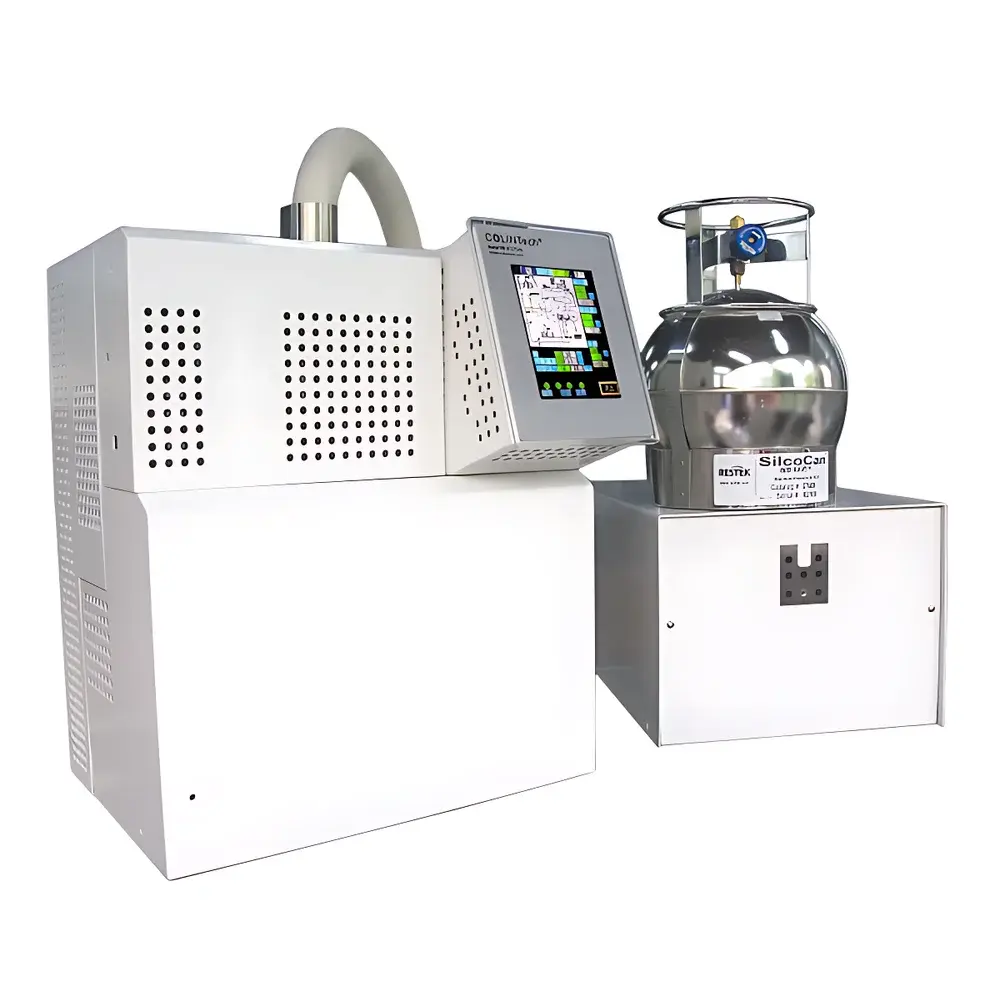
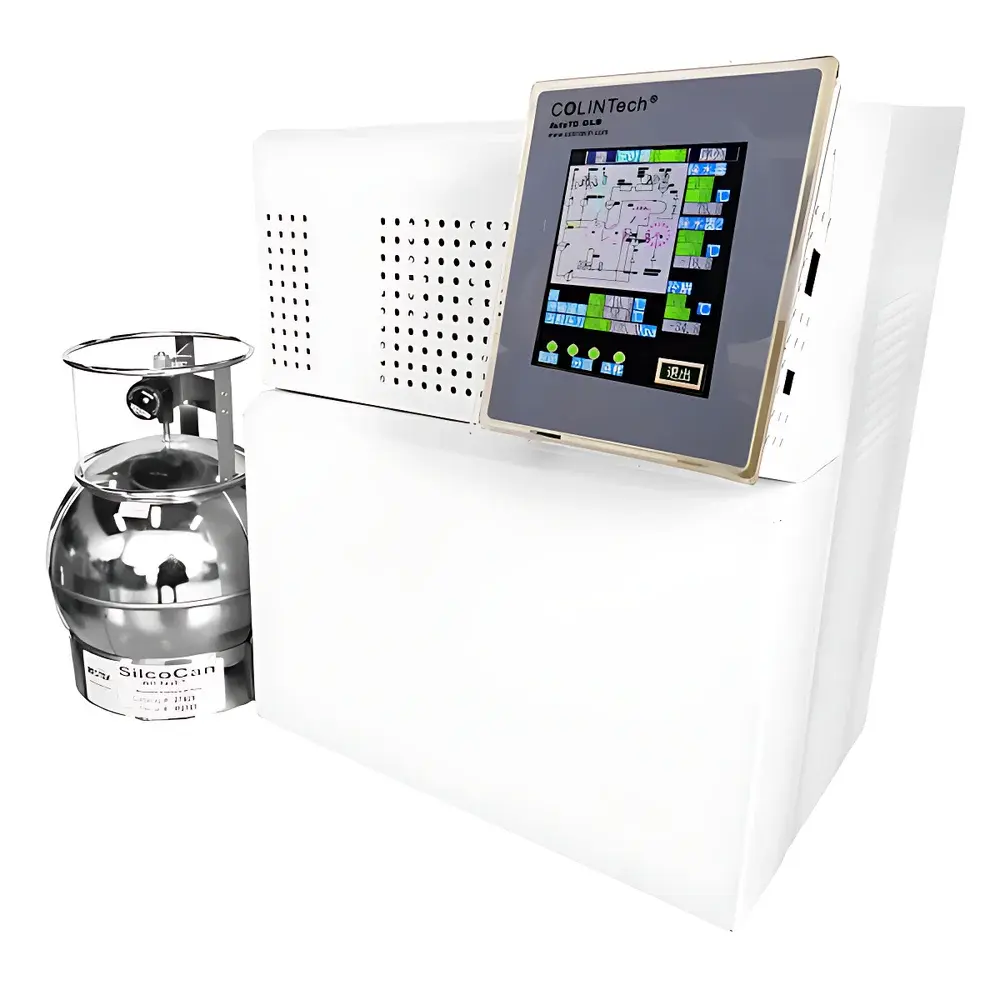
ColinTech AutoTD OLS Online Thermal Desorber
| Brand | ColinTech |
|---|---|
| Origin | Sichuan, China |
| Manufacturer Type | Direct Manufacturer |
| Region of Origin | Domestic (China) |
| Model | AutoTD OLS |
| Instrument Type | Dual-Stage Thermal Desorber |
| Desorption Temperature Range | −40 °C to 425 °C |
| Cold Trap Temperature Range | −40 °C |
| Desorption Recovery Rate | 92% |
| Sample Positions | 50 |
| Flow Control Range | 1–200 mL/min |
| Compatible Analyzers | GC, GC-MS |
| Water Removal | Multi-stage, patented |
| Remote Operation | Web- and mobile-enabled (optional) |
| Application Mode | Online continuous monitoring, canister/bag analysis, tube desorption |
Overview
The ColinTech AutoTD OLS Online Thermal Desorber is an engineered solution for real-time, unattended volatile organic compound (VOC) monitoring in ambient air, industrial stack emissions, and indoor environments. Based on dual-stage thermal desorption (TDS) principle—comprising primary thermal desorption from sorbent tubes followed by cryo-focusing and secondary desorption into the gas chromatograph—the system delivers high-fidelity VOC profiling across a broad volatility range (C2–C44). Unlike offline methods requiring manual sample handling and delayed analysis, the AutoTD OLS integrates directly with GC or GC-MS platforms to enable continuous, automated sampling, trapping, desorption, and injection—meeting the operational demands of regulatory compliance, process control, and atmospheric research.
Key Features
- Dual-stage thermal desorption architecture with precise temperature control: primary desorption zone adjustable from −40 °C to 425 °C; cryogenic cold trap stabilized at −40 °C for efficient analyte focusing and sharp band formation.
- Patented multi-stage water removal system: selectively removes moisture without compromising recovery of polar VOCs (e.g., aldehydes, ketones, low-boiling alcohols), ensuring robust performance under high-humidity conditions.
- 50-position auto-sampler carousel with programmable sequence logic, supporting unattended operation for up to 72 hours at typical environmental sampling intervals (e.g., 30-min cycles).
- Wide-flow sampling module (1–200 mL/min) with mass flow controller (MFC)-based regulation—enabling quantitative uptake across trace-level (pptv) to elevated (ppmv) concentration ranges.
- No liquid nitrogen dependency: integrated mechanical cryo-cooling eliminates logistical constraints and operational downtime associated with cryogen supply chains.
- Modular expansion capability: optional center-cutting valve configuration allows parallel or sequential routing of desorbed fractions to multiple detectors (e.g., FID and MS), enhancing speciation resolution.
- Remote operation via secure web interface or mobile application: supports real-time status monitoring, method editing, alarm notification, and audit log access—fully compatible with IT infrastructure in centralized environmental monitoring networks.
Sample Compatibility & Compliance
The AutoTD OLS accommodates standard 6-mm OD stainless steel or quartz sorbent tubes (e.g., Tenax TA, Carbopack B/C, Carboxen 1000), as well as SUMMA®-electropolished canisters and Tedlar®/FlexFoil® sampling bags. Its analytical workflow aligns with internationally recognized standards including U.S. EPA Methods TO-14A, TO-15, and TO-17; Chinese national standards HJ 584–2010, HJ 644–2013, and HJ 645–2013; and ISO 16017-1 for indoor air VOC analysis. The system’s hardware design and software architecture support GLP-compliant data integrity requirements—including electronic signatures, user-access controls, and full audit trail generation per FDA 21 CFR Part 11 guidelines when deployed in regulated QA/QC laboratories.
Software & Data Management
The embedded control software provides method-driven automation with configurable parameters for sampling duration, desorption ramp rates, cold trap hold time, and transfer line temperature profiles. All acquisition events—including pressure transients, temperature deviations, and valve actuation timestamps—are logged with microsecond precision. Raw data export conforms to ASTM E1947-compliant .cdf format, enabling seamless import into third-party chromatography data systems (CDS) such as OpenLab CDS, Chromeleon, or MassHunter. Optional cloud-based dashboard integration enables centralized fleet management, predictive maintenance alerts, and cross-site correlation analytics for regional air quality networks.
Applications
- Continuous ambient air monitoring: ozone precursor tracking (e.g., isoprene, xylenes, ethylbenzene), PM2.5 formation potential assessment, and odorant profiling (e.g., hydrogen sulfide, mercaptans, dimethyl sulfide).
- Industrial fence-line and stack emission surveillance: real-time detection of fugitive VOC releases from petrochemical, pharmaceutical, and coating manufacturing facilities.
- Indoor air quality (IAQ) studies: longitudinal monitoring of building ventilation efficiency, material off-gassing kinetics, and HVAC system performance validation.
- Biogenic VOC research: dynamic flux measurement from vegetation chambers or eddy-covariance towers using synchronized canister collection and online desorption.
- Method development and reference material verification: compatibility with certified reference standards (e.g., NIST SRM 1849a) and participation in interlaboratory comparison exercises under ILAC-G13 frameworks.
FAQ
Does the AutoTD OLS require liquid nitrogen for cold trapping?
No. It utilizes a closed-cycle mechanical refrigeration system capable of sustaining −40 °C cold trap temperatures without cryogens.
Can it be interfaced with legacy GC systems lacking digital I/O?
Yes. Analog trigger outputs and TTL-compatible relay signals are provided for synchronization with older GC models.
Is method validation documentation available for regulatory submissions?
Yes. ColinTech supplies IQ/OQ documentation templates, system suitability test protocols, and recovery validation reports aligned with ISO/IEC 17025 requirements.
What maintenance intervals are recommended for routine operation?
Sorbent tube conditioning every 100 runs; cold trap liner cleaning every 500 cycles; MFC calibration annually or per 2,000 operating hours—whichever occurs first.
How is data security managed during remote access?
All remote sessions employ TLS 1.2+ encryption, role-based authentication, and session timeout enforcement; no data is stored on client devices.




