
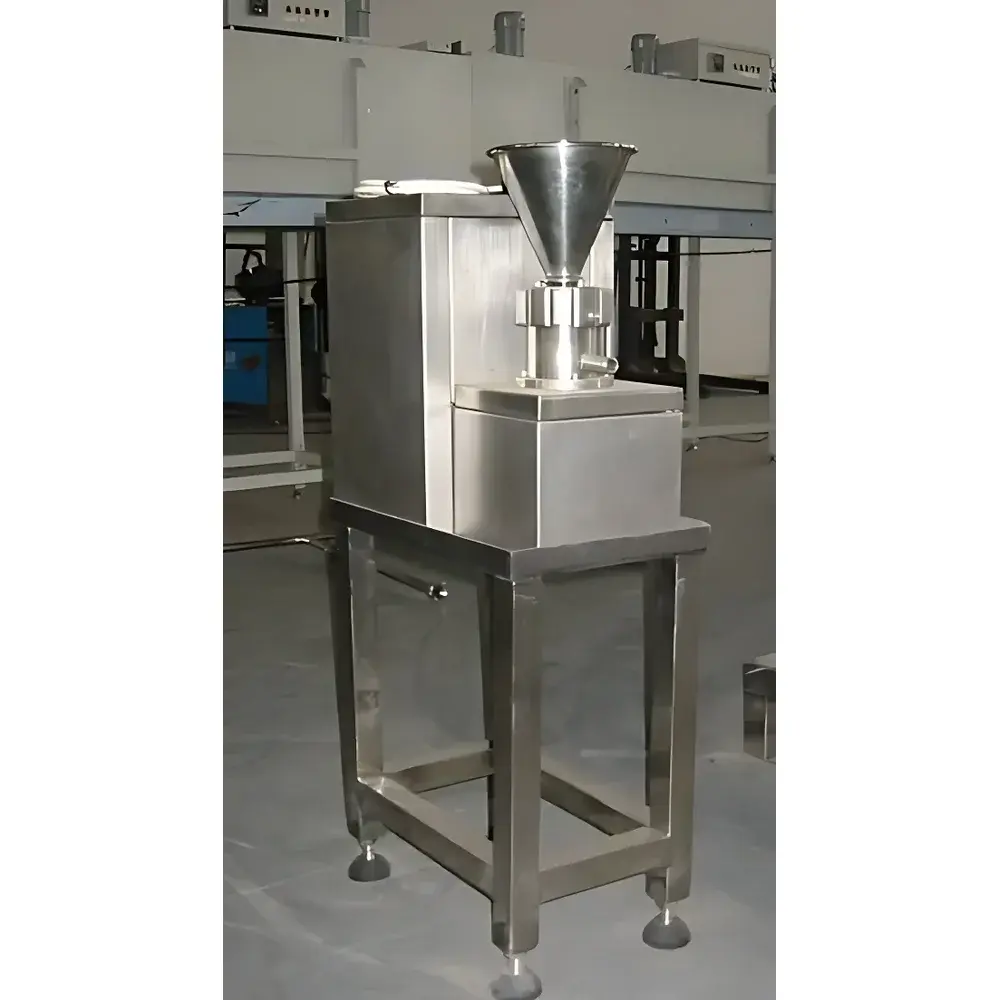
Colloid Mill JTM-50 – Laboratory-Scale Wet Grinding and Homogenization System
| Origin | Shanghai, China |
|---|---|
| Manufacturer Type | Authorized Distributor |
| Origin Category | Domestic (PRC) |
| Model | JTM-50 |
| Pricing | Available Upon Request |
| Motor Configuration | Side-Mounted |
| Contact-Wetted Materials | AISI 304 Stainless Steel |
| Production Capacity | 0.1–0.3 t/h |
| Particle Size Reduction Range | 2–20 µm |
| Rotor Speed | 6000 rpm |
| Motor Power | 0.75 kW, 220 V, 50 Hz |
| Unit Weight | 100 kg |
| Dimensions (L×W×H) | 350 × 200 × 400 mm |
| Cooling | Integrated Water-Cooling Jacket |
| Optional Accessory | Stainless Steel Support Frame (AISI 304) |
Overview
The Colloid Mill JTM-50 is a precision-engineered laboratory-scale wet grinding and homogenization system designed for continuous or batch processing of suspensions, emulsions, pastes, and colloidal dispersions. Operating on the principle of high-shear rotor-stator interaction—where fluid is subjected to intense mechanical shearing, cavitation, and hydraulic impact between a rapidly rotating rotor and a fixed stator—the JTM-50 achieves consistent particle size reduction down to 2 µm with narrow distribution profiles. Its compact footprint, side-mounted motor architecture, and integrated water-cooling jacket ensure thermal stability during extended operation, minimizing heat-induced degradation of thermolabile compounds. Engineered for reproducibility in R&D and pilot-scale process development, the JTM-50 supports method transfer to industrial colloid mill systems and serves as a critical tool for formulation optimization in regulated and non-regulated environments.
Key Features
- Side-mounted motor configuration enables rapid access for maintenance, belt tensioning, and rotor inspection without disassembling the grinding chamber.
- All product-contact surfaces—including rotor, stator, feed chamber, and discharge housing—are fabricated from AISI 304 stainless steel, providing proven resistance to corrosion and abrasion in acidic, alkaline, and saline media.
- Adjustable stator-rotor gap (factory-set; field-adjustable via calibrated micrometer ring) allows fine-tuning of shear intensity to match material rheology and target particle size distribution.
- Integrated water-cooling jacket maintains jacket inlet/outlet ports compatible with standard laboratory chillers (recommended coolant flow: 1.5–2.5 L/min at ΔT ≤ 8°C), ensuring stable operating temperature below 45°C under continuous load.
- Compact monoblock design (350 × 200 × 400 mm) facilitates placement on standard lab benches or integration into modular process skids; optional AISI 304 stainless steel support frame enhances structural rigidity and operator ergonomics.
- Rated for continuous duty at 6000 rpm with a 0.75 kW induction motor (220 V / 50 Hz), delivering stable torque output across viscosity ranges up to 50,000 mPa·s (measured at 25°C).
Sample Compatibility & Compliance
The JTM-50 accommodates aqueous, organic, and mixed-solvent systems with solids loading up to 40% w/w, including but not limited to polymer dispersions, pigment slurries, pharmaceutical nanoemulsions, functional food matrices (e.g., plant protein isolates), and ceramic precursors. It complies with general machinery safety requirements per ISO 12100 and electrical safety standards IEC 60335-1. While not certified for GMP manufacturing, its fully drainable, crevice-free wetted path and smooth surface finish (Ra ≤ 0.8 µm) align with GLP-aligned cleaning validation protocols. Documentation packages—including FAT/SAT reports, material certificates (EN 10204 3.1), and dimensional drawings—are available upon request to support internal audit readiness.
Software & Data Management
The JTM-50 operates as a standalone mechanical unit with no embedded digital controls or data logging. However, it is fully compatible with third-party process monitoring systems via analog 4–20 mA output (optional retrofit) for real-time tracking of motor current (proxy for torque/load) and coolant temperature. Users may integrate the mill into LabVIEW-, DeltaV-, or Siemens SIMATIC-controlled workflows using standard signal conditioning modules. All operational parameters—including run time, total throughput, and maintenance intervals—are manually recorded in paper or electronic lab notebooks compliant with 21 CFR Part 11 when paired with validated e-signature platforms.
Applications
- Pharmaceutical R&D: Preparation of submicron drug nanosuspensions for oral bioavailability enhancement and topical delivery systems.
- Food Science: Stabilization of dairy-free creamers, homogenization of plant-based beverages, and refinement of nut butter emulsions.
- Materials Chemistry: Exfoliation of 2D materials (e.g., graphene oxide dispersions), dispersion of carbon nanotubes in polymer matrices, and synthesis of silica sols.
- Coatings & Inks: Deagglomeration of pigment concentrates and production of stable aqueous inkjet formulations.
- Academic Research: Fundamental studies of shear-induced phase transitions, rheological property mapping of structured fluids, and scale-down modeling of industrial colloid milling processes.
FAQ
What is the minimum achievable particle size with the JTM-50 under optimal conditions?
Under controlled feed rate, pre-milled slurry consistency (<15% w/w solids), and stabilized coolant flow, D90 values as low as 2–3 µm are routinely achieved for brittle, non-fibrous materials such as calcium carbonate or titanium dioxide.
Can the JTM-50 handle abrasive slurries containing >20% silica or alumina?
Yes—provided the stator and rotor are periodically inspected for wear (recommended every 200 operational hours); extended service life is observed when combined with inline pre-filtration (≤100 µm) and pH-neutral processing conditions.
Is the unit suitable for sterile processing or aseptic applications?
No—the JTM-50 is not designed for SIP (steam-in-place) or CIP (clean-in-place) cycles and lacks sterilizable gasketing or tri-clamp end connections; it is intended for non-sterile R&D use only.
Does the mill require special foundations or vibration isolation?
No—its 100 kg mass and low center of gravity enable stable operation on standard reinforced lab benches; however, anti-vibration pads are recommended when mounted on shared optical tables or sensitive instrumentation platforms.
What documentation is provided with shipment?
Standard package includes mechanical assembly manual, material compliance certificates (AISI 304), electrical safety declaration, dimensional drawings, and preventive maintenance checklist—all in English.



