
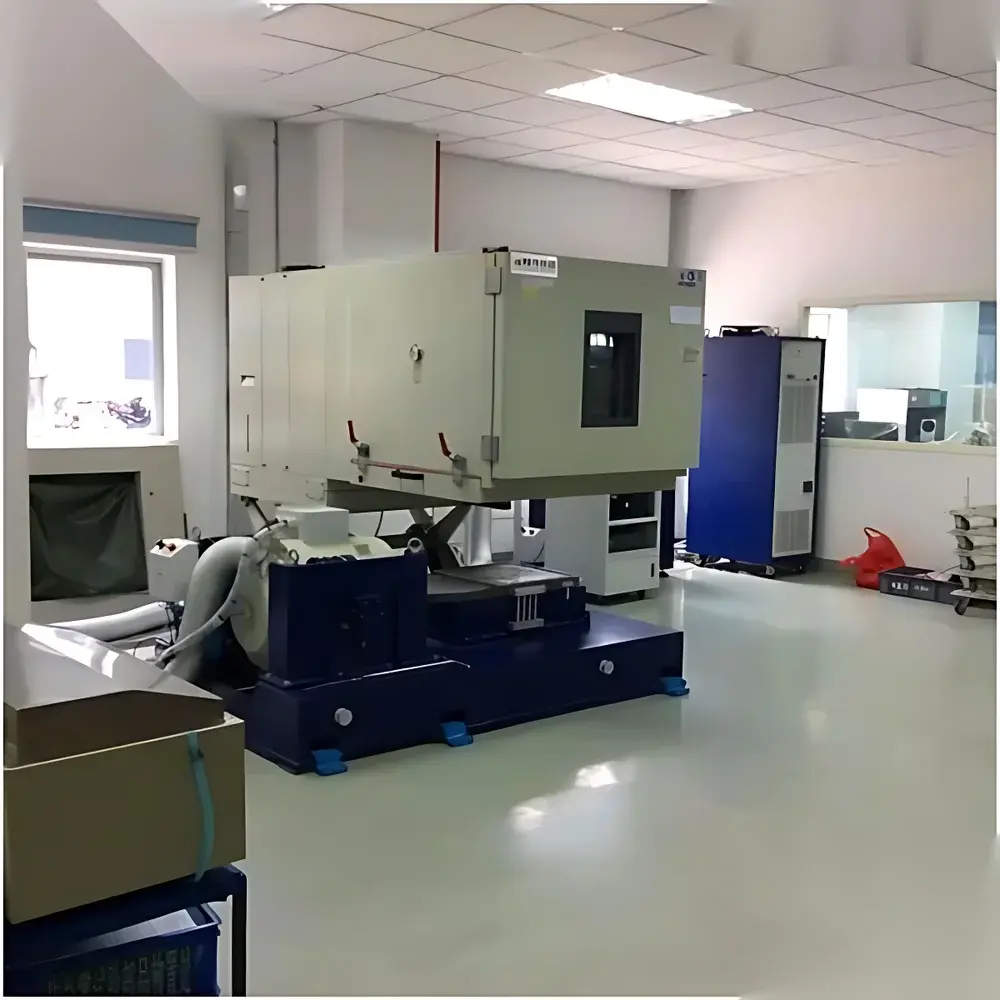
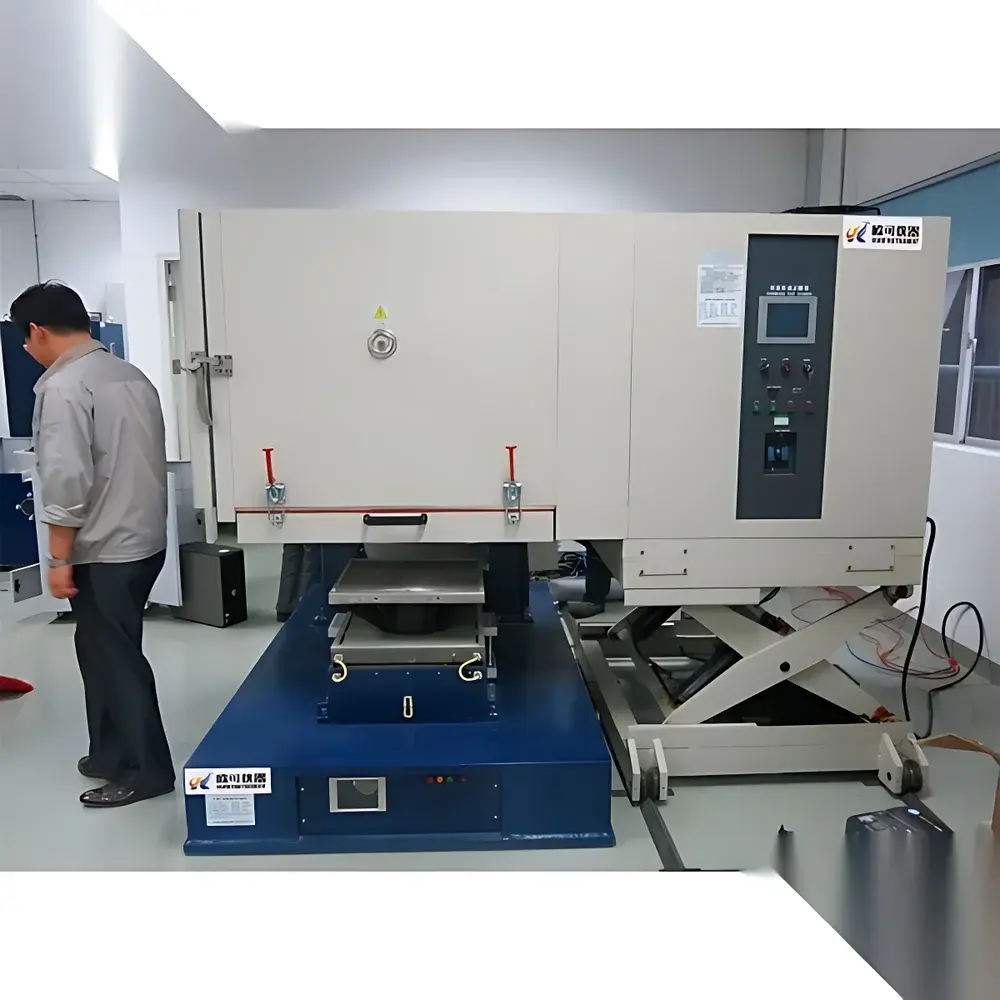
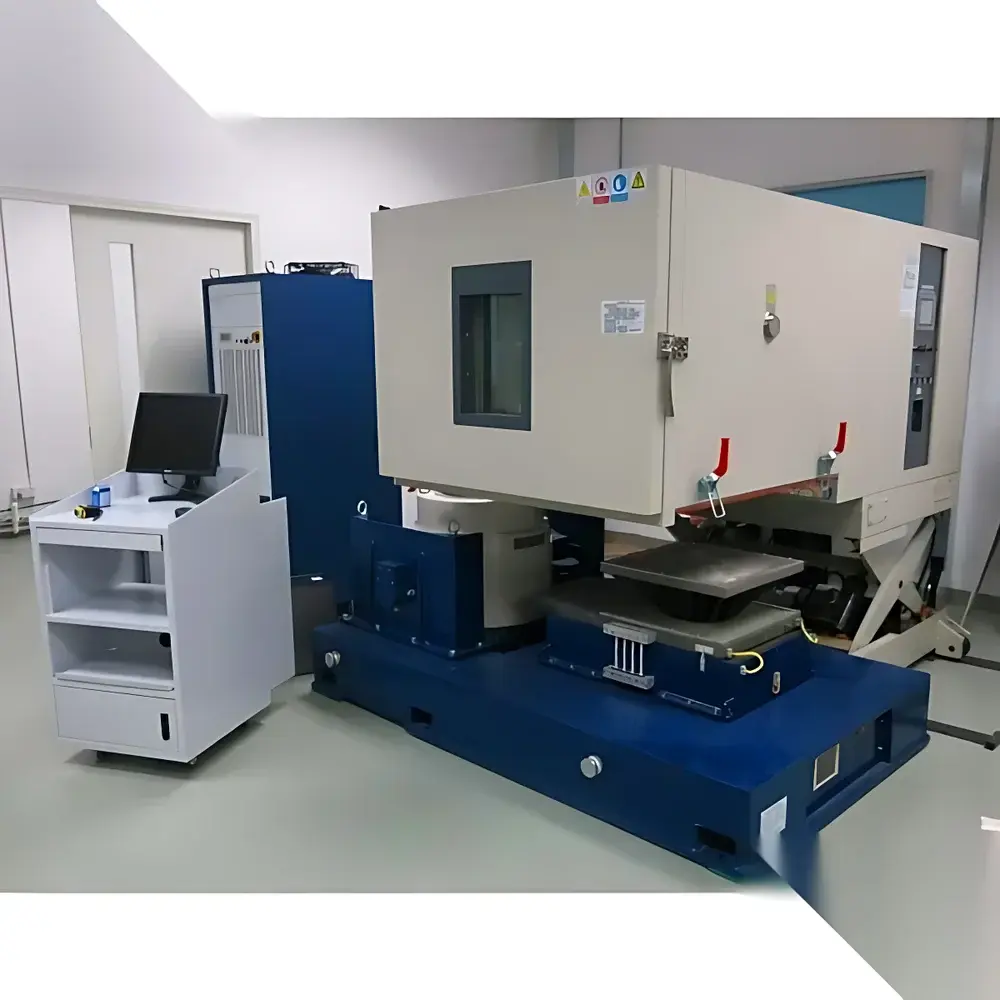
Combined Temperature-Humidity-Vibration Environmental Test Chamber
| Key | Brand: Other Brands |
|---|---|
| Origin | Imported |
| Manufacturer Type | Authorized Distributor |
| Price | USD 21,500 (FOB) |
| Temperature Range | −70 °C to +150 °C |
| Humidity Range | 5–98% RH |
| Temp. Control Accuracy | ±0.5 °C |
| Humidity Control Accuracy | ±2.5% RH |
| Temp. Uniformity | ±2.0 °C |
| Humidity Uniformity | ±3.0% RH |
| Heating System | Stainless Steel Finned Heaters with Infrared Ni-Cr Alloy Elements |
| Cooling System | Dual-Stage Hermetic Compressor (Tecumseh/Tecumseh-derived), Refrigerant R404A/R23 |
| Humidity Generation | Electric Steam Generator |
| Vibration Interface | Removable/Reconfigurable Platform with Epoxy-Silicone Sealed Coupling |
| Control System | Touchscreen PID Controller with RS232/RS485 Communication, Power Failure Recovery, Audit Trail Logging Capability |
Overview
The Combined Temperature-Humidity-Vibration Environmental Test Chamber is an integrated reliability validation platform engineered for simultaneous exposure of test specimens to controlled thermal, hygroscopic, and mechanical stress fields. It operates on the principle of synergistic environmental simulation—where temperature cycling, humidity conditioning, and broadband vibration (typically via externally coupled electrodynamic or servo-hydraulic shakers) are applied in concert to replicate real-world operational or storage conditions. This triaxial stress combination enables accelerated life testing, failure mode identification, and conformance verification per MIL-STD-810H, IEC 60068-2, and RTCA DO-160 Section 21 protocols. The chamber’s architecture separates climatic control subsystems (refrigeration, steam humidification, forced-air convection) from mechanical excitation components, ensuring metrological independence while maintaining tight coupling during multi-stress test profiles.
Key Features
- Modular dual-system design: independent climate control and vibration interface—enabling seamless transition between standalone environmental tests and full three-combined operation.
- Robust thermal envelope: inner chamber constructed from SUS#304 stainless steel with mirror-finish electropolished surfaces; outer shell fabricated from A3 steel with durable epoxy-polyester powder coating.
- High-efficiency air management: low-noise Sanyo Denki or equivalent centrifugal blower (single-cycle configuration), multi-wing impeller, top-down forced convection with bottom return ducting—ensuring uniform airflow distribution and minimizing thermal gradients.
- Hermetic integrity: double-layer high-tension silicone gasket seal at door interface; multi-layer laminated tempered glass observation window with embedded conductive ITO film for anti-fogging and real-time visual monitoring under condensing conditions.
- Thermal performance optimization: finned tubular stainless steel heaters with far-infrared Ni-Cr alloy cores; dual-stage refrigeration circuit (R404A/R23 cascade) supporting extended low-temperature operation down to −70 °C.
- Vibration integration readiness: precision-machined removable rail system beneath working chamber floor; multi-stage epoxy-silicone composite sealing between vibration table mounting interface and chamber base—preserving environmental containment without compromising dynamic transmission fidelity.
- Intelligent control architecture: 7-inch color TFT LCD touchscreen controller with embedded PID+SSR regulation logic, programmable ramp-soak profiles, automatic dew-point compensation, and configurable alarm thresholds for over-temperature, over-humidity, compressor fault, and safety cutoff events.
Sample Compatibility & Compliance
This test chamber accommodates a wide range of physical configurations—from PCB assemblies and avionics enclosures to automotive ECUs and medical device housings—via standardized 50 mm diameter cable/port access on the left side wall. Internal dimensions are scalable across models (standard variants: W600 × D600 × H600 mm to W1200 × D1000 × H1000 mm), with optional internal lighting and data acquisition feedthroughs available upon request. The system complies with GB/T 2423.1–2022 (cold), GB/T 2423.2–2022 (dry heat), GB/T 2423.3–2016 (damp heat, steady state), GB/T 2423.10–2019 (vibration), and JJG 190–2021 (calibration procedures for environmental test equipment). When configured with validated vibration shakers and operated under documented SOPs, it supports GLP-compliant test reporting and satisfies audit requirements under ISO/IEC 17025 and FDA 21 CFR Part 11 when paired with compliant software modules.
Software & Data Management
The embedded controller supports local profile programming and real-time parameter logging at user-defined intervals (minimum 1 s resolution). Data export is enabled via RS232/RS485 serial interface or optional Ethernet module, compatible with industry-standard SCADA platforms including LabVIEW, WinCC, and custom Python-based acquisition scripts. All operational logs—including setpoint history, actual sensor readings, alarm timestamps, power interruption records, and controller firmware version—are stored internally with non-volatile memory retention exceeding 30 days. Optional software packages provide remote monitoring dashboards, automated PDF report generation (with digital signature support), and electronic audit trail functionality aligned with 21 CFR Part 11 Annex 11 expectations for traceability and data integrity.
Applications
- Aerospace component qualification per MIL-STD-810H Method 514.8 (vibration) and Method 502.7 (temperature/humidity).
- Automotive electronics validation under ISO 16750-4 (climate resistance) and ISO 16750-3 (mechanical loads).
- Medical device shelf-life and sterilization packaging integrity assessment under IEC 60601-1 Clause 10.2.2 (environmental stress screening).
- Telecom infrastructure hardware endurance testing per GR-63-CORE (NEBS) and Telcordia SR-332.
- Consumer electronics drop-test preconditioning using combined cold soak and mechanical shock sequences.
- Material science studies involving polymer creep-fatigue interaction under cyclic hygrothermal loading.
FAQ
Can this chamber operate vibration and climate control simultaneously without cross-interference?
Yes—the system employs galvanically isolated control loops, physically decoupled power supplies, and dedicated signal grounding for each subsystem. Vibration-induced electromagnetic noise is mitigated via shielded cabling and ferrite suppression on all I/O lines.
Is calibration certification included with delivery?
Factory calibration certificates traceable to NIM (China National Institute of Metrology) are provided. Optional UKAS or DAkkS-accredited third-party calibration services are available pre-shipment.
What vibration shaker models are compatible?
The chamber accepts standard 400 kg–2000 kg payload shakers with 200 mm–400 mm table diameters, including but not limited to TIRA TV 50120, LDS V875, or MTS 850 series—subject to mechanical interface verification.
Does the controller support multi-step test sequencing with conditional branching?
Yes—up to 100 segments per program, with jump-to-segment, repeat-loop, and hold-until-condition met logic. Conditional triggers include temperature rate-of-change thresholds and humidity deviation limits.
How is condensation managed during rapid cooldown with high humidity?
The system implements dynamic dew-point suppression algorithms, coordinated dehumidification pre-cooling, and post-cycle purge cycles using dry nitrogen-compatible ports (optional accessory).



