
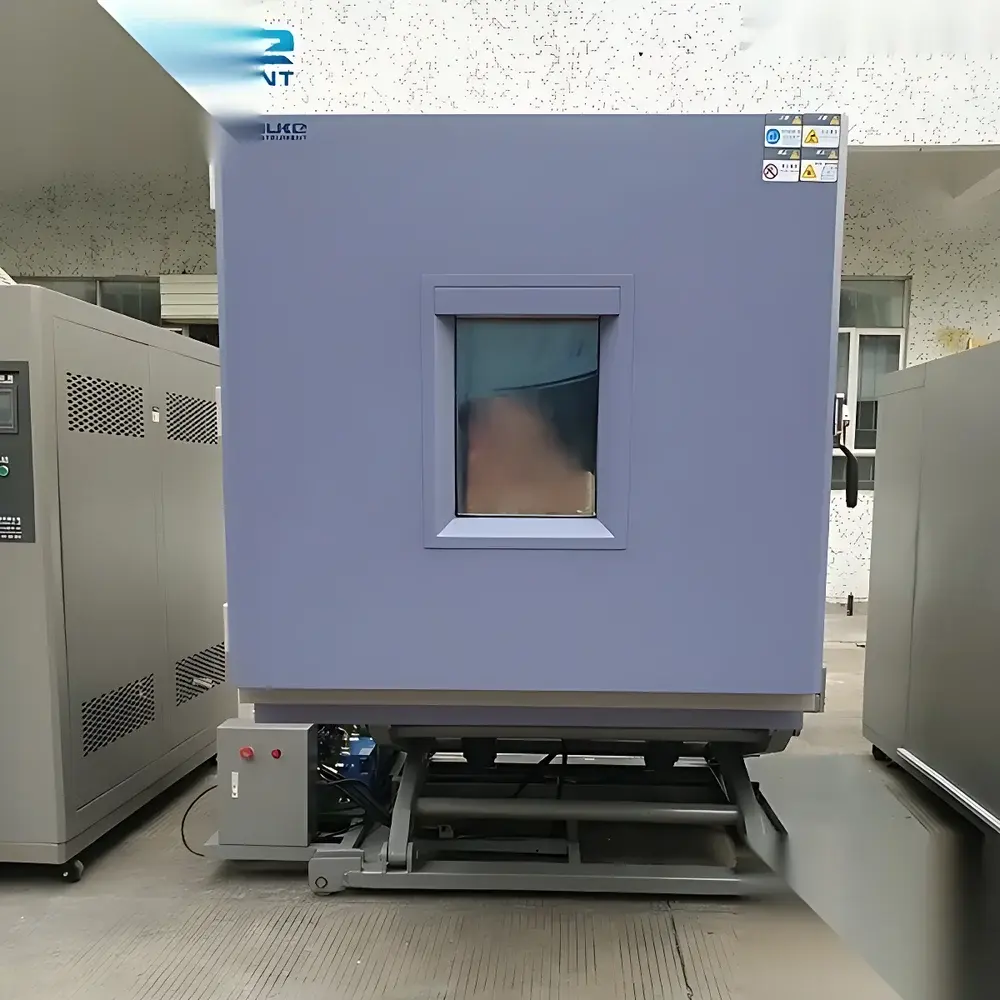
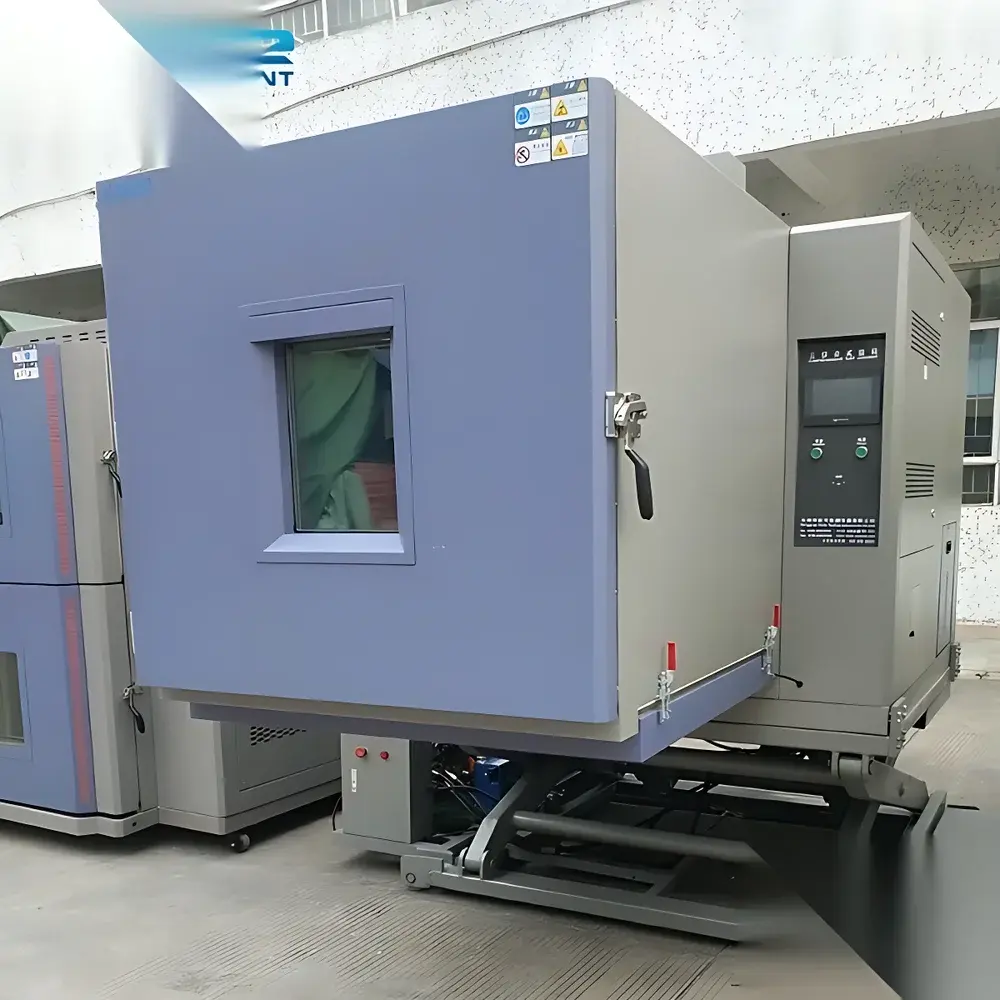
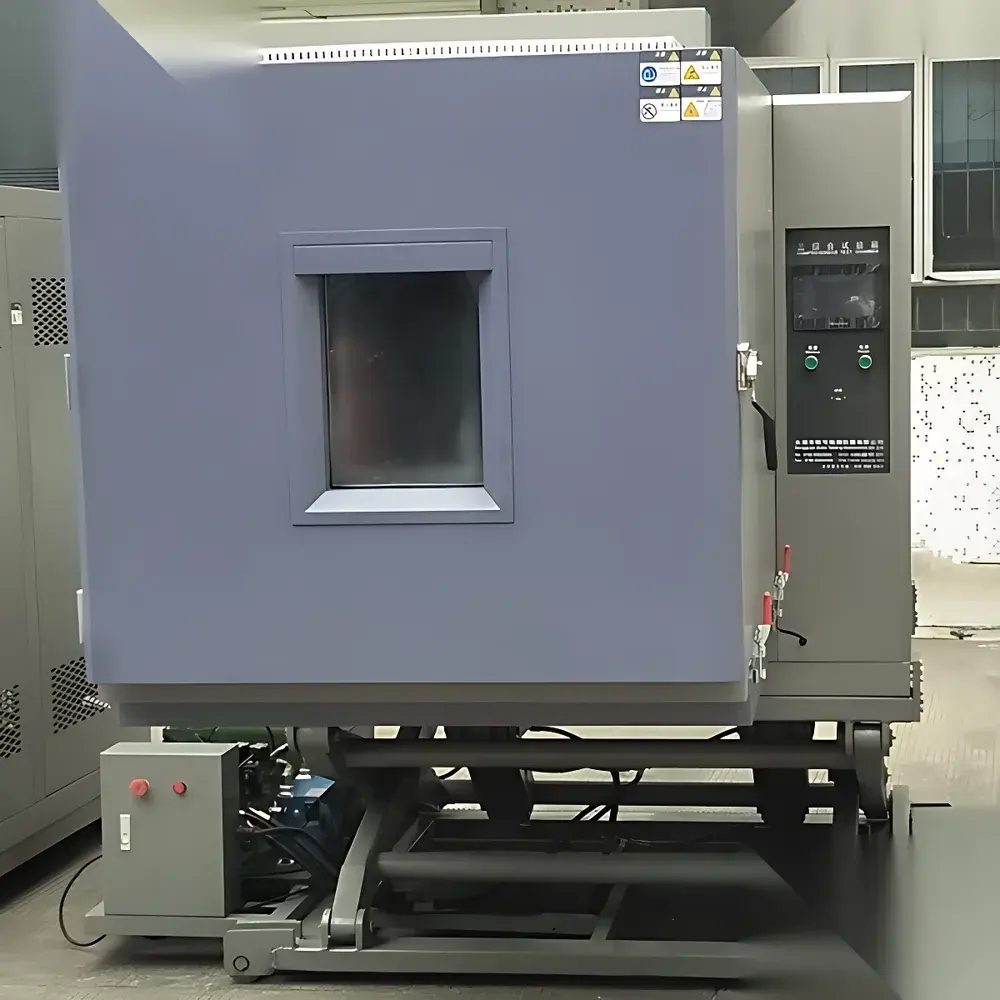
Combined Temperature-Humidity-Vibration Environmental Test Chamber
| Key | Brand: Other Brands |
|---|---|
| Origin | Imported |
| Manufacturer Type | General Distributor |
| Price | USD 21,500 (approx.) |
| Temperature Range | −70 °C to +150 °C |
| Humidity Range | 5–98% RH |
| Temp. Control Accuracy | ±0.5 °C |
| Humidity Control Accuracy | ±2.5% RH |
| Temp. Uniformity | ±2.0 °C |
| Humidity Uniformity | ±3.0% RH |
| Heating Rate | ~4.0 °C/min |
| Cooling Rate | ~1.0 °C/min |
| Controller Memory | 100 programs × 1000 segments × 999 cycles |
| Communication Interface | RS-232 / RS-485 |
| Construction | Inner chamber – SUS#304 stainless steel |
| Vibration Integration | Removable vibration table on precision linear rails |
| Safety Protections | Compressor overload, refrigerant HP/LP cutoff, over-temperature/over-humidity cutout, dry-run protection, fuse, fault alarm system |
Overview
The Combined Temperature-Humidity-Vibration Environmental Test Chamber is an integrated reliability validation platform engineered for accelerated stress testing of electronic components, automotive modules, aerospace subsystems, and medical devices under synchronized thermal, hygroscopic, and mechanical dynamic loading conditions. Unlike sequential or single-stress test chambers, this system implements true concurrent environmental excitation—enabling replication of real-world field failure modes such as solder joint fatigue, conformal coating delamination, condensation-induced corrosion, and PCB warpage under cyclic thermal-mechanical strain. The chamber operates on a dual-loop control architecture: a PID-based climate subsystem regulates temperature and humidity via refrigeration compression stages (single-stage for −20 °C capability; cascade two-stage for −70 °C), while a mechanically decoupled electrodynamic or servo-hydraulic shaker table (user-specified) is precisely aligned and sealed to the chamber base through a multi-layer elastomeric-epoxy interface. This design ensures minimal cross-coupling between thermal expansion and vibrational transmission, preserving test integrity per MIL-STD-810H Method 514.7 and IEC 60068-2-64.
Key Features
- Triple-stimulus synchronization: Independent yet coordinated control of temperature (−70 °C to +150 °C), relative humidity (5–98% RH), and broadband vibration (frequency range and amplitude defined per configured shaker system)
- High-fidelity programmable controller with 100 stored test profiles, each supporting up to 1000 segments and 999 loop repetitions—fully compliant with IEC 61000-4-27 and JEDEC JESD22-A108F test sequencing requirements
- Touchscreen HMI with dual-language support (English/Chinese); real-time graphical display of all monitored parameters including chamber setpoints, actual values, and vibration spectral density (when interfaced with external analyzers)
- Robust chamber construction: Interior chamber fabricated from electropolished SUS#304 stainless steel; outer enclosure of A3 carbon steel with anti-corrosive powder coating; multi-layer insulation combining polyurethane foam and ultra-fine glass wool for thermal stability and low leakage
- Optimized airflow design using low-noise Sanyo Denki (or equivalent) centrifugal blowers and aerodynamically profiled impellers—ensuring uniform temperature/humidity distribution (±2.0 °C / ±3.0% RH) across the working volume
- Modular vibration integration: Precision-ground linear rails allow full extraction of the shaker table during non-vibration tests; hermetic sealing achieved via alternating layers of high-temperature silicone rubber and epoxy resin at the chamber-floor interface
- Comprehensive safety architecture: Dual redundant thermal cutouts, refrigerant high/low pressure switches, humidity sensor fault detection, automatic drain pan dry-run protection, and audible/visual fault alerting with event logging
Sample Compatibility & Compliance
This chamber accommodates DUTs (Devices Under Test) up to standard rack-mount dimensions (e.g., 600 mm W × 600 mm D × 800 mm H), with optional custom internal fixtures available. Standard 50 mm diameter feedthrough ports (left-side mounted) support power, signal, and thermocouple routing under full environmental seal. Viewing window employs laminated tempered glass with embedded conductive ITO film for anti-fogging and EMI shielding—maintaining optical clarity without compromising chamber integrity. The system meets structural and operational requirements for ISO/IEC 17025-accredited laboratories and supports audit-ready documentation for GLP, GMP, and FDA 21 CFR Part 11 compliance when paired with validated data acquisition software. It is routinely deployed in qualification testing per ASTM D4332, IPC-9701, and SAE J2380 standards.
Software & Data Management
The chamber integrates seamlessly with industry-standard test management platforms via native RS-232/RS-485 Modbus RTU protocol. Optional Ethernet/IP or EtherCAT interfaces are available for factory automation environments. Logged data—including time-stamped temperature, humidity, and (via external DAQ) acceleration spectra—is stored in CSV and binary formats with configurable sampling intervals (100 ms to 10 s). All controller operations generate immutable audit trails with user ID, timestamp, and action type—enabling full traceability for regulatory submissions. Remote monitoring and script-based test initiation are supported through secure HTTPS web interface or OPC UA client integration.
Applications
- Accelerated life testing of automotive ECUs subjected to thermal cycling + road-spectrum vibration
- Qualification of avionics enclosures per DO-160 Section 25 (Temperature, Humidity, Vibration)
- Reliability assessment of Li-ion battery packs under combined thermal runaway and mechanical shock conditions
- Validation of medical device sterilization packaging integrity during humidity soak + transport vibration
- Failure analysis of MEMS sensors exposed to condensation-prone thermal transients under resonant excitation
- Material compatibility studies involving polymer adhesives, conformal coatings, and elastomeric seals
FAQ
Does the chamber support simultaneous operation of all three stress domains (temp, humidity, vibration) without performance compromise?
Yes—the system’s mechanical isolation design and independent control loops ensure that vibration does not induce thermal drift or humidity fluctuation beyond specified tolerances (±0.5 °C / ±2.5% RH) during concurrent operation.
Can the controller be validated for use in regulated industries (e.g., pharmaceutical or medical device QA)?
The controller firmware supports IQ/OQ documentation packages; when used with validated third-party data acquisition software, it satisfies FDA 21 CFR Part 11 requirements for electronic records and signatures.
What cooling configurations are available for sub-zero operation?
Single-stage refrigeration achieves −20 °C; cascade two-stage systems support −40 °C, −60 °C, and −70 °C minimum temperatures—each with dedicated oil management and defrost logic.
Is remote diagnostics and firmware update capability built-in?
Yes—standard Ethernet port enables secure remote access for diagnostic logging, parameter adjustment, and over-the-air firmware updates via authenticated TLS 1.2 connection.
How is calibration traceability maintained across temperature, humidity, and vibration channels?
Each channel accepts NIST-traceable sensor inputs; chamber-integrated PT100 and capacitive RH sensors are field-replaceable and certified to ISO/IEC 17025 by accredited calibration labs upon installation and annually thereafter.



