
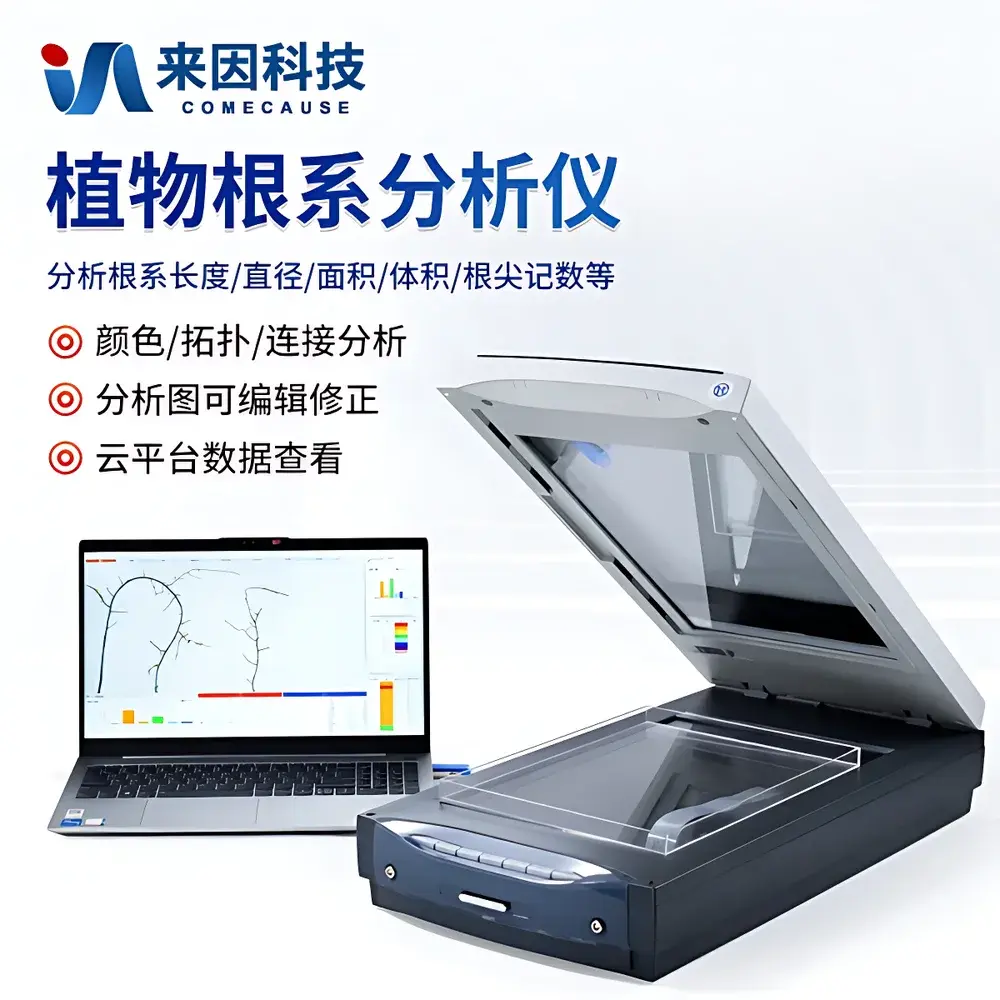
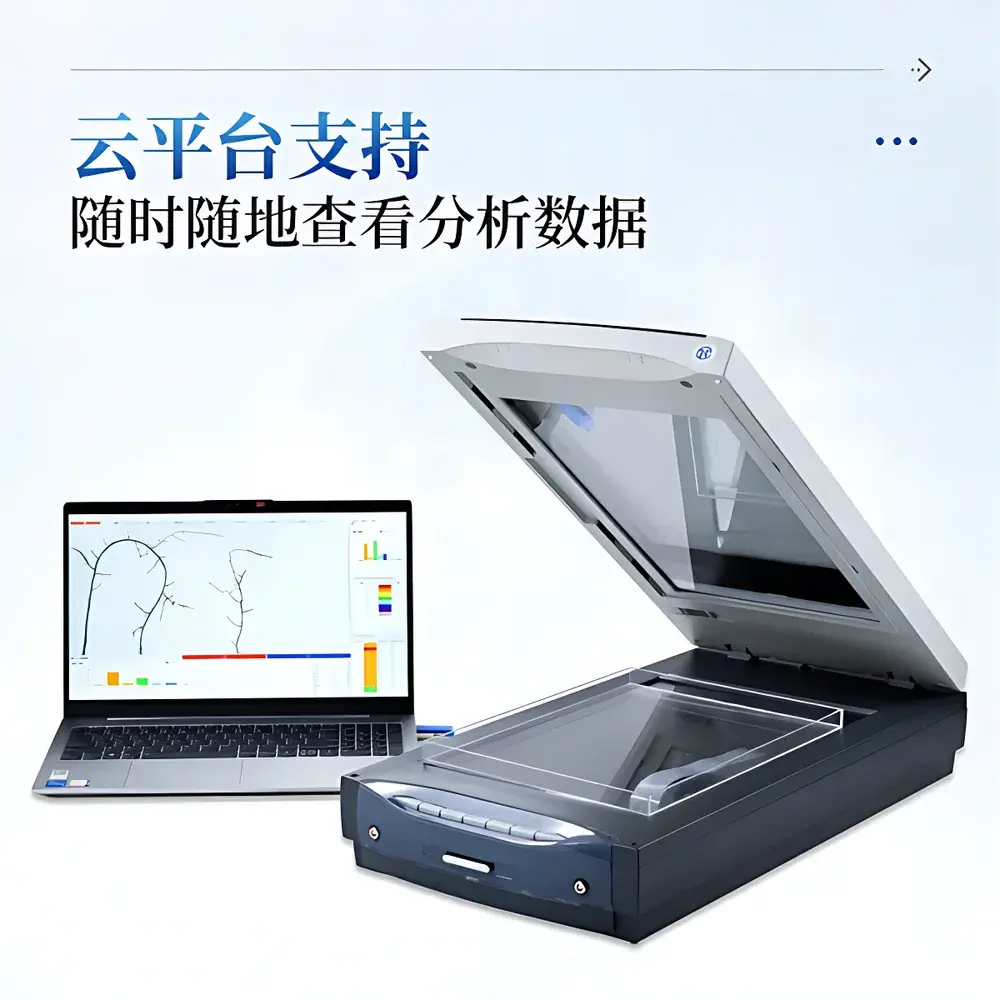
COMECAUSE IN-GX02 Advanced Plant Root System Analyzer
| Brand | COMECAUSE |
|---|---|
| Model | IN-GX02 |
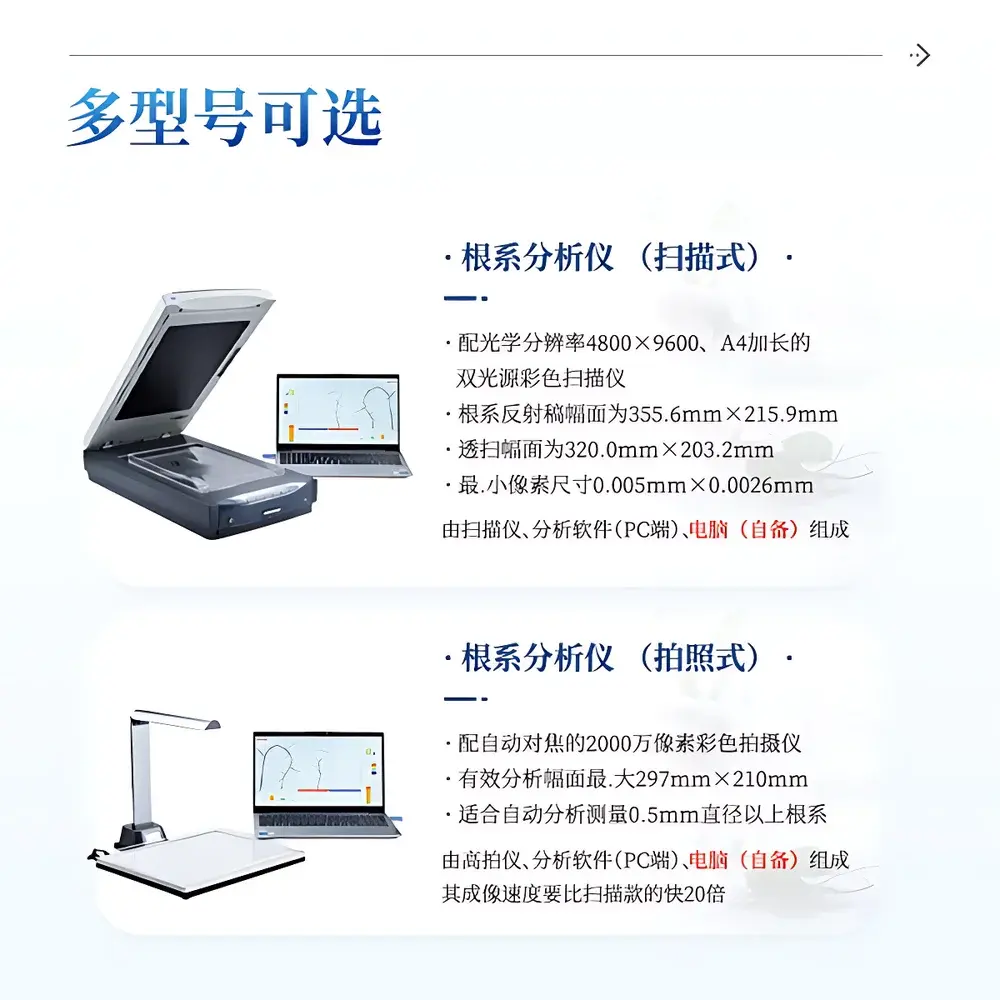
| Scanner Optical Resolution | 4800 × 9600 dpi (A4+ extended) |
| Max Reflective Scan Area | 355.6 mm × 215.9 mm |
| Max Transmissive Scan Area | 320.0 mm × 203.2 mm |
| Minimum Pixel Size | 0.005 mm × 0.0026 mm |
| Color Depth | 48-bit |
| Interface | USB 2.0 |
| Light Source | Dual Cold Cathode Fluorescent Lamp (CCFL) |
| Software | Root morphology & topology analysis suite with fractal dimension, biomass distribution, gravitropic angle, and color-based segmentation modules |
| Cloud Data Sync | Yes |
| Language Support | English & Chinese (switchable) |
| Compliance | ASTM D523-23 (specular gloss reference), ISO/IEC 17025-aligned workflow documentation support, GLP-compliant audit trail via encrypted dongle-authorized software session logging |
Overview
The COMECAUSE IN-GX02 Advanced Plant Root System Analyzer is a high-precision, non-destructive imaging and morphometric platform engineered for quantitative root phenotyping in controlled-environment research. It operates on the principle of dual-illumination reflective/transmissive optical scanning—leveraging calibrated CCFL light sources positioned both beneath the scan platen and within the hinged lid—to eliminate shadowing, specular glare, and uneven illumination across translucent root trays. This architecture ensures consistent contrast and edge fidelity in digitized root images, critical for accurate binary segmentation and topological reconstruction. Unlike statistical sampling or destructive extraction methods, the IN-GX02 captures full-field, sub-millimeter-resolution digital representations of intact root systems—whether excised and washed, grown in rhizoboxes, or imaged in situ through transparent growth media. The system supports TIFF and JPEG input formats and performs deterministic geometric computation—not probabilistic approximation—of morphological parameters, enabling traceable, repeatable measurements compliant with FAIR data principles (Findable, Accessible, Interoperable, Reusable).
Key Features
- Dual-source A4+ extended optical scanner (4800 × 9600 dpi) with 0.005 mm × 0.0026 mm minimum pixel resolution and 48-bit color depth for high-fidelity grayscale and spectral root differentiation.
- Three standardized, optically transparent root imaging trays optimized for uniform light transmission and minimal refraction distortion.
- Root-specific image analysis software with hardware-encrypted dongle authentication, supporting non-statistical measurement of length, diameter, surface area, volume, tip count, branching order, and intersection density.
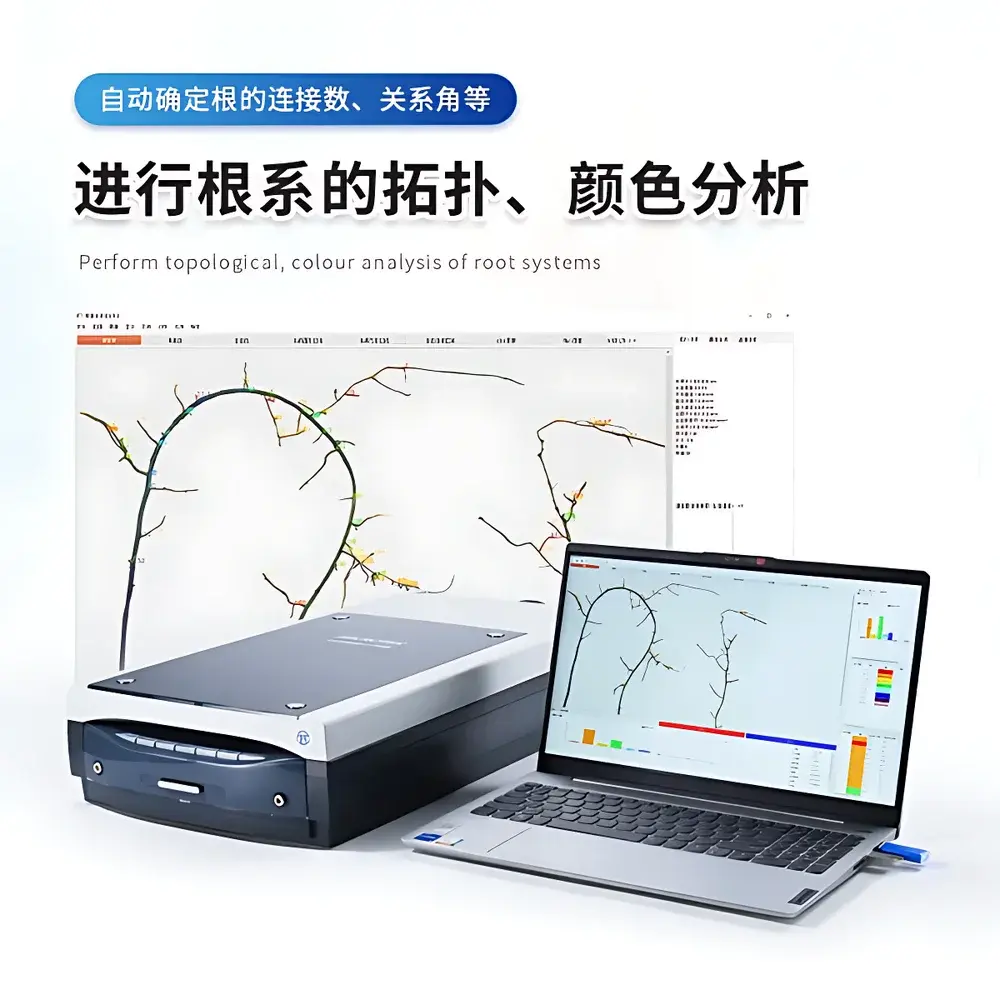
- Advanced topology engine enabling automatic root hierarchy mapping—including primary root isolation, lateral root tracing, connection graph generation, and angular relationship quantification (e.g., branching angles, gravitropic deviation).
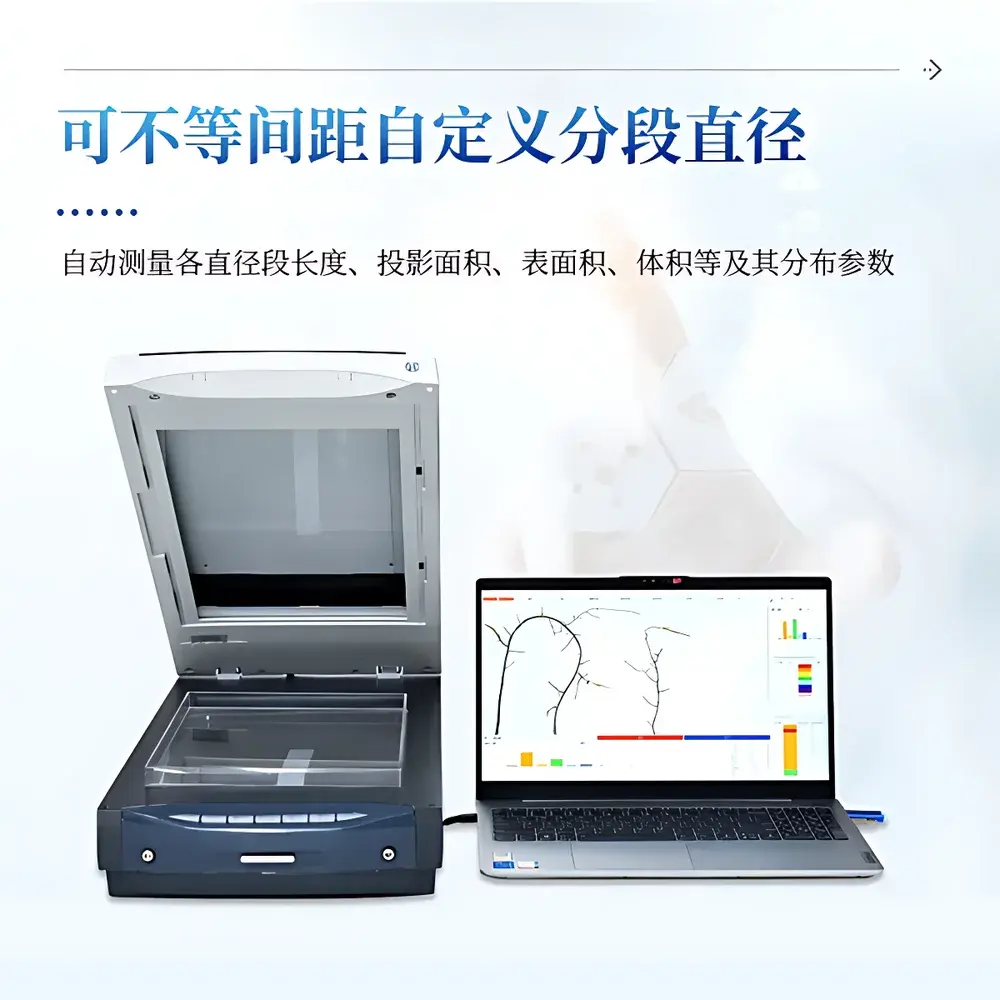
- Fractal dimension calculation via box-counting algorithm, integrated with diameter-class segmentation (user-definable, non-uniform binning) for structural complexity profiling.
- Color-based segmentation module for differential analysis of root developmental zones (e.g., meristematic, elongation, maturation) or symbiotic structures (e.g., rhizobial nodule volume quantification relative to host root volume).
- Cloud-sync capability for centralized data archiving, cross-laboratory collaboration, and longitudinal study tracking—data stored in encrypted, timestamped, version-controlled repositories.
Sample Compatibility & Compliance
The IN-GX02 accommodates a broad range of root architectures—from fine fibrous systems of cereals and legumes to thick taproots of woody perennials—when prepared on standardized transparent trays. It is validated for use with hydroponic, agar-based, sand-filled rhizoboxes, and gel-cultured specimens. While not an in vivo field instrument, its design adheres to metrological best practices referenced in ISO 5725 (accuracy of measurement methods) and supports documentation workflows aligned with GLP (Good Laboratory Practice) requirements. Audit trails—including user ID, timestamp, software version, calibration status, and parameter presets—are embedded in exported Excel reports and annotated image files. The system meets electromagnetic compatibility (EMC) standards per IEC 61326-1 and operates within Class B emission limits for laboratory environments.
Software & Data Management
The proprietary root analysis software runs natively on Windows 10 Professional (64-bit) and requires no internet connection for core computation. All morphometric outputs—including raw parameter tables, diameter distribution histograms, fractal plots, and annotated overlay images—are exportable to CSV and XLSX formats with column headers conforming to MIAPPE (Minimum Information About a Plant Phenotyping Experiment) metadata guidelines. Encrypted dongle licensing enforces session-level accountability, ensuring compliance with FDA 21 CFR Part 11 for electronic records where applicable. Cloud synchronization is optional and TLS 1.2–secured; users retain full ownership and administrative control over their datasets. The interface supports real-time language switching between English and Chinese without restart, facilitating multinational research teams.
Applications
- Quantitative comparison of root architectural responses to abiotic stressors (drought, salinity, nutrient deficiency).
- Genotype-by-environment interaction studies in breeding programs targeting drought resilience or phosphorus-use efficiency.
- Functional characterization of root mutants and transgenic lines (e.g., arabidopsis auxin transport mutants, rice DEEPER ROOTING 1 variants).
- Time-series phenotyping of root development dynamics in controlled-environment chambers or growth rooms.
- Validation of 3D root reconstruction models derived from MRI or X-ray CT data using 2D ground-truth references.
- Evaluation of mycorrhizal colonization extent and spatial distribution via color-segmented hyphal network analysis.
FAQ
What computer specifications are required to run the IN-GX02 software?
A Windows 10 Professional (64-bit) system with Intel Core i5-9th generation or newer CPU, 16 GB RAM, ≥21.5-inch Full HD display, USB 2.0 port (x4 minimum), and integrated wireless networking is recommended.
Can the system analyze roots directly in soil or growth medium?
No—the IN-GX02 requires cleaned or transparent-medium-grown roots placed on calibrated imaging trays. It is not designed for in-soil scanning.
Is A3 scanning supported?
Yes—an optional A3-format dual-source scanner is available (reflective area: 305 mm × 431.8 mm; transmissive area: 304.8 mm × 406.4 mm), extending throughput for large-root species such as maize or sunflower.
How is data integrity ensured during long-term experiments?
All analysis sessions generate immutable metadata logs (user, timestamp, software build, calibration flags), and cloud backups include SHA-256 checksums for file integrity verification.
Does the software support batch processing of multiple root images?
Yes—fully automated batch mode processes unattended image sets with configurable output templates, error logging, and post-hoc manual correction layers.




