
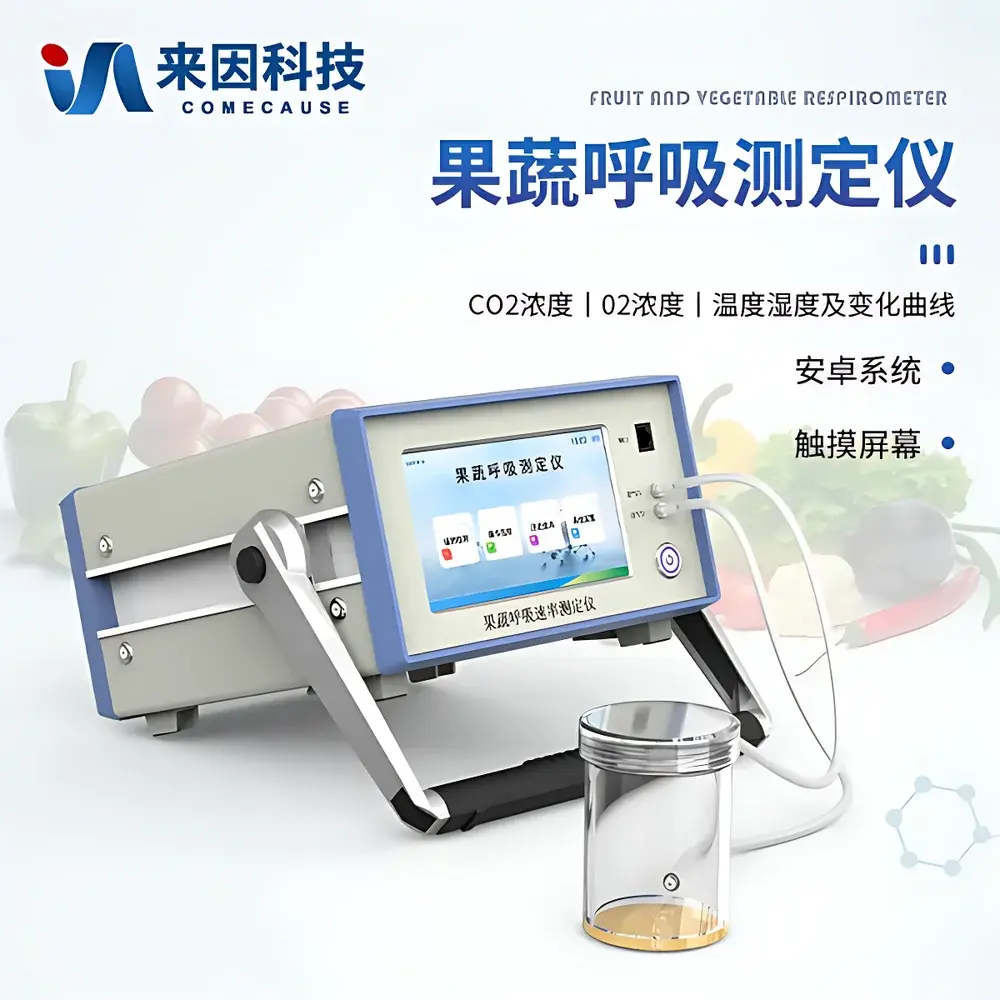
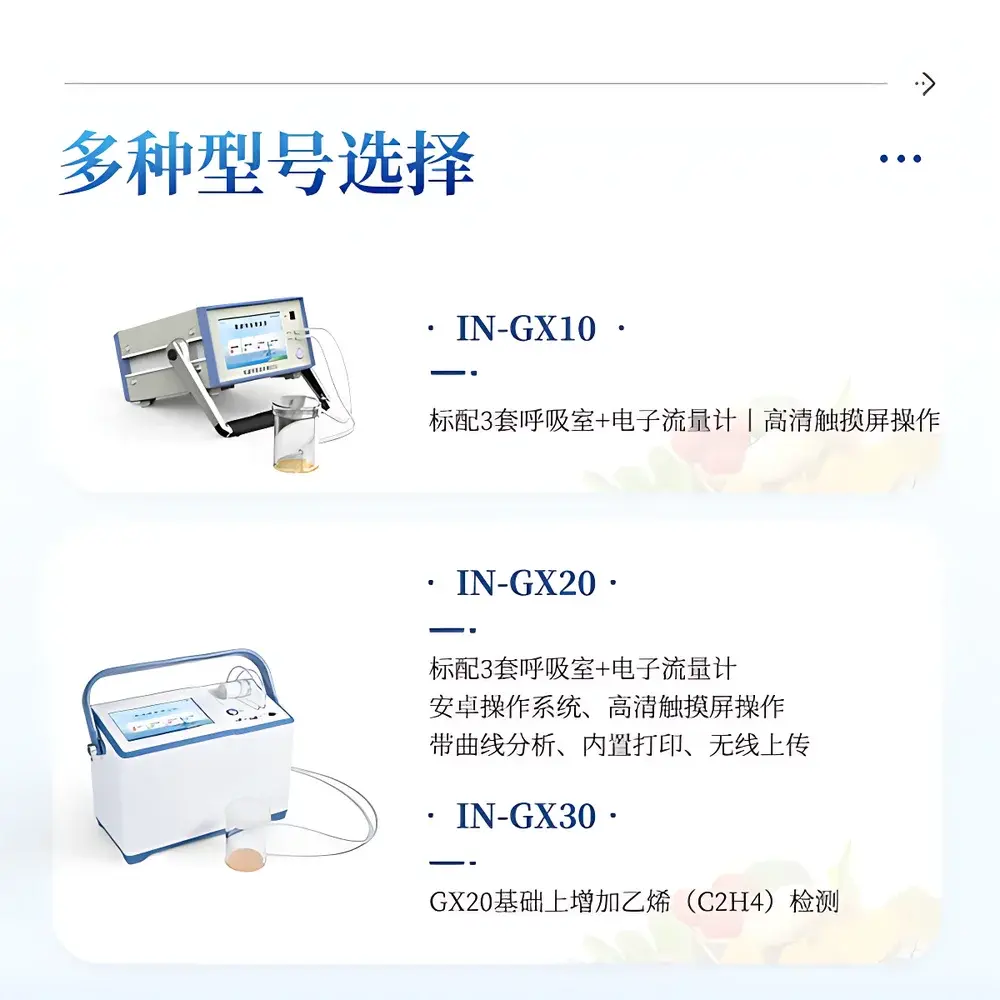
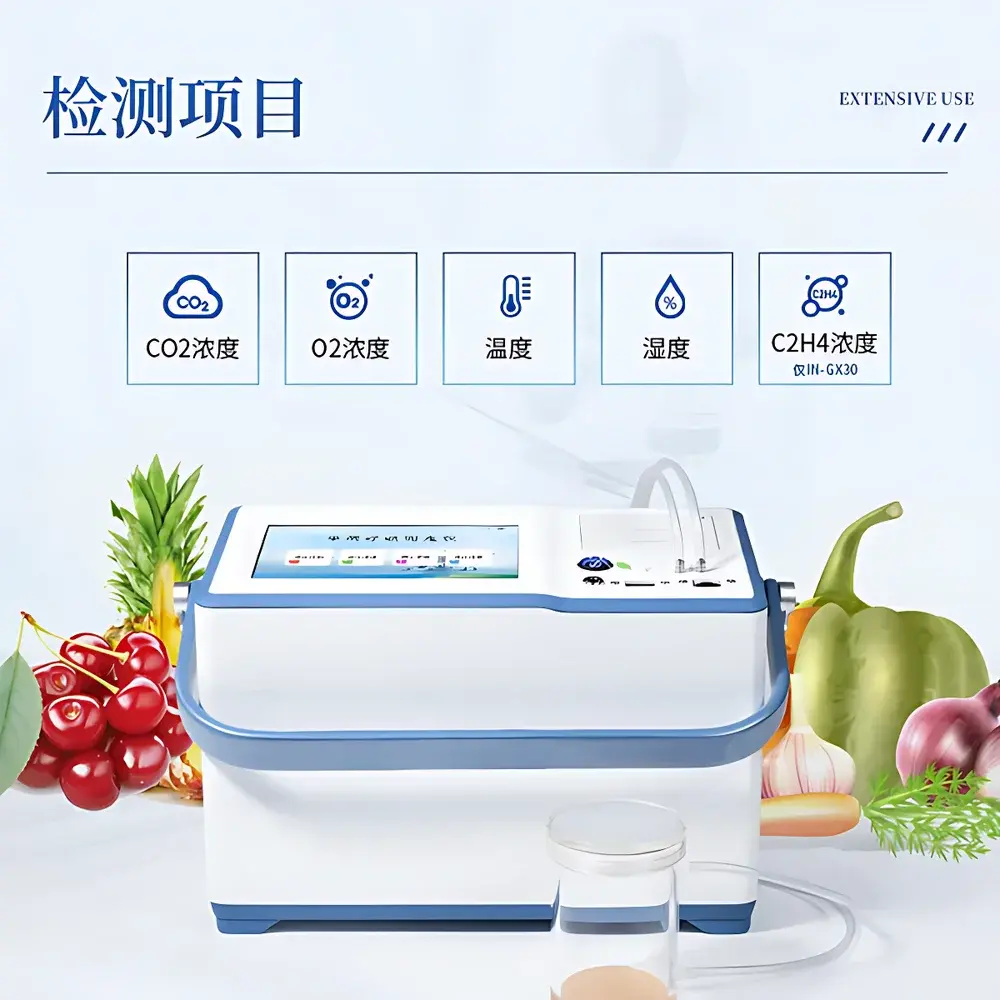
COMECAUSE IN-GX10 Fruit & Vegetable Respiration Rate Analyzer
| Brand | COMECAUSE |
|---|---|
| Origin | Shandong, China |
| Manufacturer Type | Direct Manufacturer |
| Model | IN-GX10 |
| CO₂ Detection Principle | Non-Dispersive Infrared (NDIR) |
| CO₂ Range | 0–5000 ppm |
| CO₂ Sensitivity | ΔCO₂ captured within 1 s |
| CO₂ Accuracy | ±3 ppm |
| CO₂ Resolution | 0.1 ppm |
| O₂ Detection Principle | Electrochemical |
| O₂ Range | 0–100% vol |
| O₂ Linearity | ≤±2% F.S. |
| O₂ Repeatability | ≤±1% |
| O₂ Response Time | 30 s |
| O₂ Zero Drift | ≤±2% F.S./24 h |
| O₂ Span Drift | ≤±2% F.S./24 h |
| Temperature Range | −20 to +95 °C |
| Temperature Resolution | 0.1 °C |
| Temperature Accuracy | ±0.2 °C |
| Humidity Range | 0–100% RH |
| Humidity Resolution | 0.1% RH |
| Humidity Accuracy | ±0.2% F.S. |
| Flow Control | Adjustable via onboard interface |
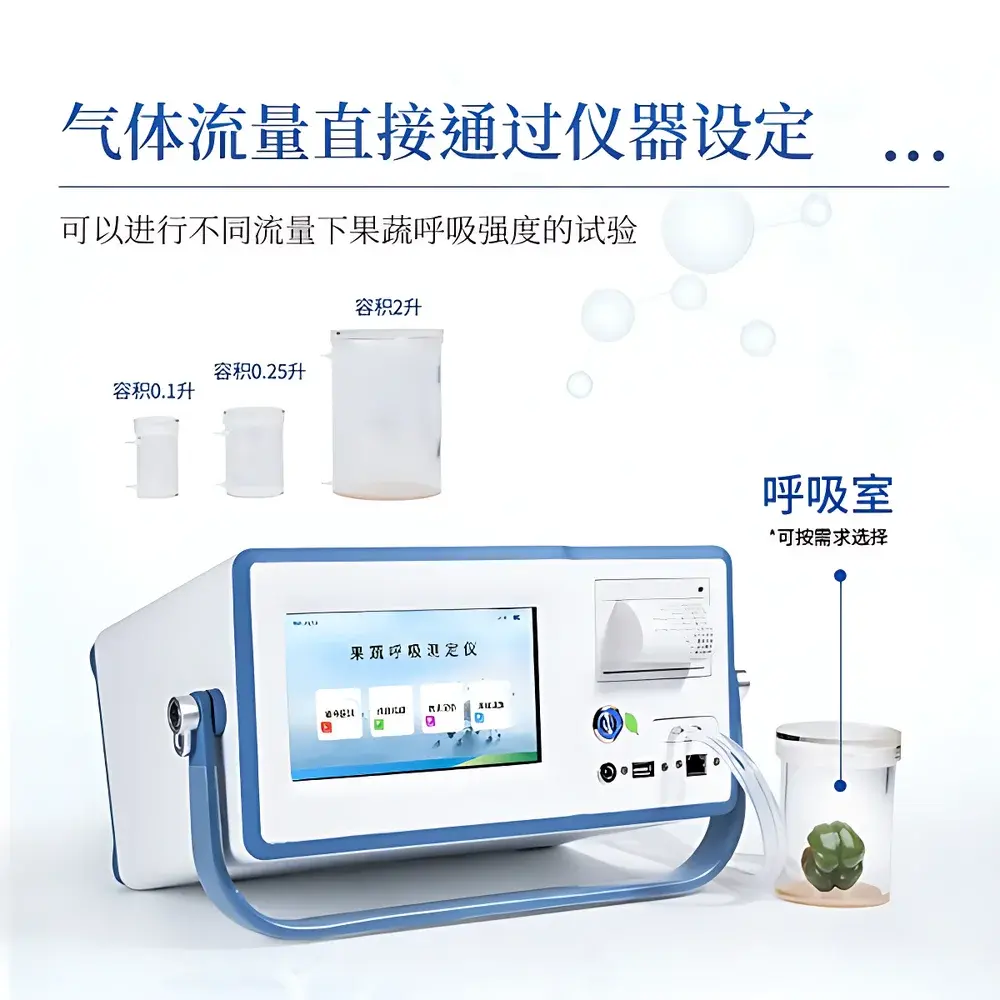
| Respiratory Chamber Volumes | 0.1 L (Ø40 mm × 80 mm), 0.25 L (Ø60 mm × 89 mm), 2.0 L (Ø120 mm × 180 mm) |
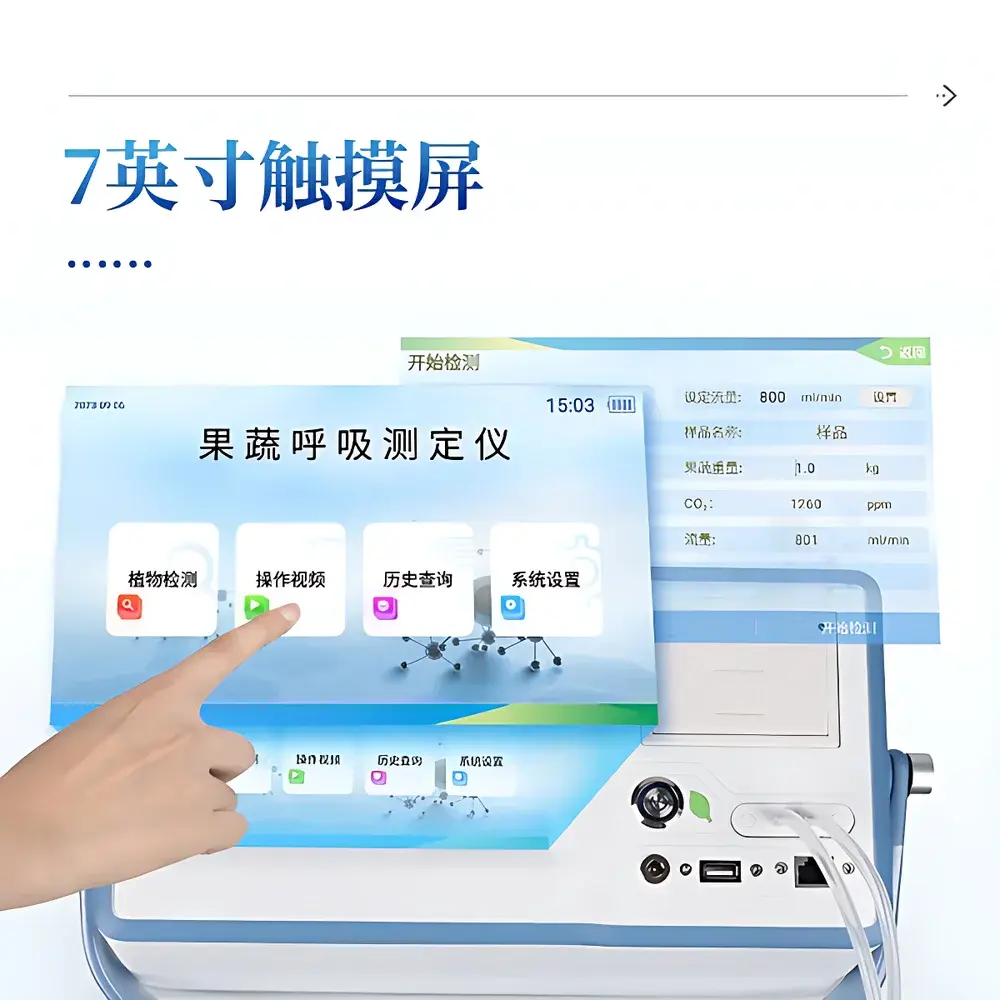
| Display | 7-inch Android-based capacitive touchscreen |
| Onboard Storage | 16 GB (≥100,000 records) |
| Data Export | USB flash drive interface |
| Power Supply | 12 V DC, 3 A adapter |
Overview
The COMECAUSE IN-GX10 Fruit & Vegetable Respiration Rate Analyzer is a dedicated, field-deployable instrument engineered for quantitative measurement of postharvest respiratory metabolism in horticultural commodities. It operates on the principle of closed-system gas exchange analysis, continuously monitoring real-time changes in CO₂ evolution and O₂ consumption within sealed, temperature- and humidity-controlled respiratory chambers. By applying stoichiometric relationships derived from aerobic respiration (C₆H₁₂O₆ + 6O₂ → 6CO₂ + 6H₂O + energy), the system calculates respiration rate—typically expressed as µmol CO₂ kg⁻¹ s⁻¹ or mL O₂ kg⁻¹ h⁻¹—under ambient, refrigerated, controlled-atmosphere (CA), or retail display conditions. Its dual-gas (CO₂/O₂) capability, coupled with simultaneous microclimate monitoring (T, RH), enables physiologically relevant assessment of metabolic status, stress responses, and shelf-life potential without sample destruction.
Key Features
- Integrated dual-sensor gas detection: NDIR-based CO₂ sensor (0–5000 ppm, ±3 ppm accuracy, 0.1 ppm resolution) and electrochemical O₂ sensor (0–100% vol, ≤±2% F.S. linearity, 30 s response time).
- Three interchangeable, geometrically optimized respiratory chambers (0.1 L, 0.25 L, 2.0 L) allow precise volume-to-biomass matching—reducing equilibration time and improving signal-to-noise ratio across diverse sample sizes (e.g., single berries, whole apples, leafy bunches).
- 7-inch high-resolution Android touchscreen interface with native graphical OS—enabling direct parameter configuration, real-time curve visualization (CO₂, O₂, T, RH), and on-device annotation (crop species, harvest date, weight, origin).
- Onboard dynamic analysis engine processes raw gas differentials into respiration rate metrics in real time; no external PC required for acquisition or preliminary interpretation.
- 16 GB internal storage supports ≥100,000 timestamped measurement records with full environmental metadata; data export via standard USB-A port to FAT32-formatted flash drives.
- Independent mass flow control allows systematic investigation of flow-rate dependency—a critical factor in validating diffusion-limited vs. enzyme-limited respiration kinetics per ASTM D6866 and ISO 14855-2 protocols.
Sample Compatibility & Compliance
The IN-GX10 accommodates intact, unprocessed fruits, vegetables, floral stems, and detached leaves—preserving natural cuticle integrity and stomatal function during measurement. Chamber designs minimize boundary layer resistance while preventing condensation-induced sensor interference. All gas pathways employ chemically inert, low-permeability tubing compliant with USP Class VI standards. The system meets essential functional requirements for GLP-aligned postharvest physiology studies, including audit-ready timestamping, operator ID logging (via optional credential input), and immutable record generation. While not FDA 21 CFR Part 11 certified out-of-box, its data structure (CSV/JSON export with embedded metadata) supports traceable integration into validated LIMS environments under ISO/IEC 17025 or ICH-GCP frameworks.
Software & Data Management
The embedded Android application provides a complete experimental workflow: chamber sealing confirmation, baseline stabilization monitoring, automated zero/span validation prompts, kinetic curve fitting (first-order exponential or linear regression), and immediate calculation of respiration quotient (RQ = CO₂/O₂). Raw sensor outputs and derived metrics are stored with UTC timestamps, chamber ID, ambient calibration flags, and user-defined descriptors. Exported datasets include column headers compatible with R, Python (pandas), MATLAB, and industry-standard statistical packages (JMP, SAS). No proprietary software license or dongle is required—data files are human-readable and platform-agnostic.
Applications
- Quantifying respiration climacteric onset and peak timing in ethylene-sensitive fruits (e.g., tomato, banana, avocado) during cold chain transitions.
- Evaluating efficacy of edible coatings, MAP films, or CA storage parameters (O₂/CO₂ setpoints) on metabolic suppression.
- Screening breeding lines for low-respiration phenotypes linked to extended storability.
- Validating predictive models of quality loss (firmness, sugar content, color) against real-time respiratory flux.
- Teaching laboratory modules on plant energetics, postharvest physiology, and environmental stress physiology (e.g., chilling injury, hypoxia tolerance).
FAQ
Can the IN-GX10 measure respiration under true anaerobic conditions?
No—the electrochemical O₂ sensor requires minimum detectable O₂ for stable operation; measurements below 0.5% O₂ vol are not quantitatively reliable. For hypoxic studies, use the 2.0 L chamber with pre-flushed N₂ purge and monitor residual O₂ decay kinetics.
Is calibration gas required for routine use?
Zero calibration (ambient air for O₂, CO₂-scrubbed air for CO₂) is recommended before each session; span calibration with certified 1000 ppm CO₂/N₂ and 21% O₂/N₂ gases is advised every 3 months or after sensor exposure to condensate or volatile organics.
Does the instrument support continuous unattended logging?
Yes—when powered via stable 12 V DC supply and configured for timed interval mode (1–60 min intervals), it logs full 4-parameter datasets for up to 30 days without intervention.
Are chamber gaskets replaceable, and where can spare parts be sourced?
Silicone O-rings and PTFE-coated chamber lids are field-replaceable; genuine COMECAUSE spare kits (P/N GX10-SPK-01) are available through authorized distributors with documented lot traceability.
How is temperature uniformity maintained inside the chamber during long-duration assays?
The IN-GX10 does not actively control chamber temperature—it measures ambient or externally stabilized conditions. Users must conduct assays within thermally equilibrated environments (e.g., climate chambers) and verify spatial homogeneity using independent PT100 probes prior to deployment.



