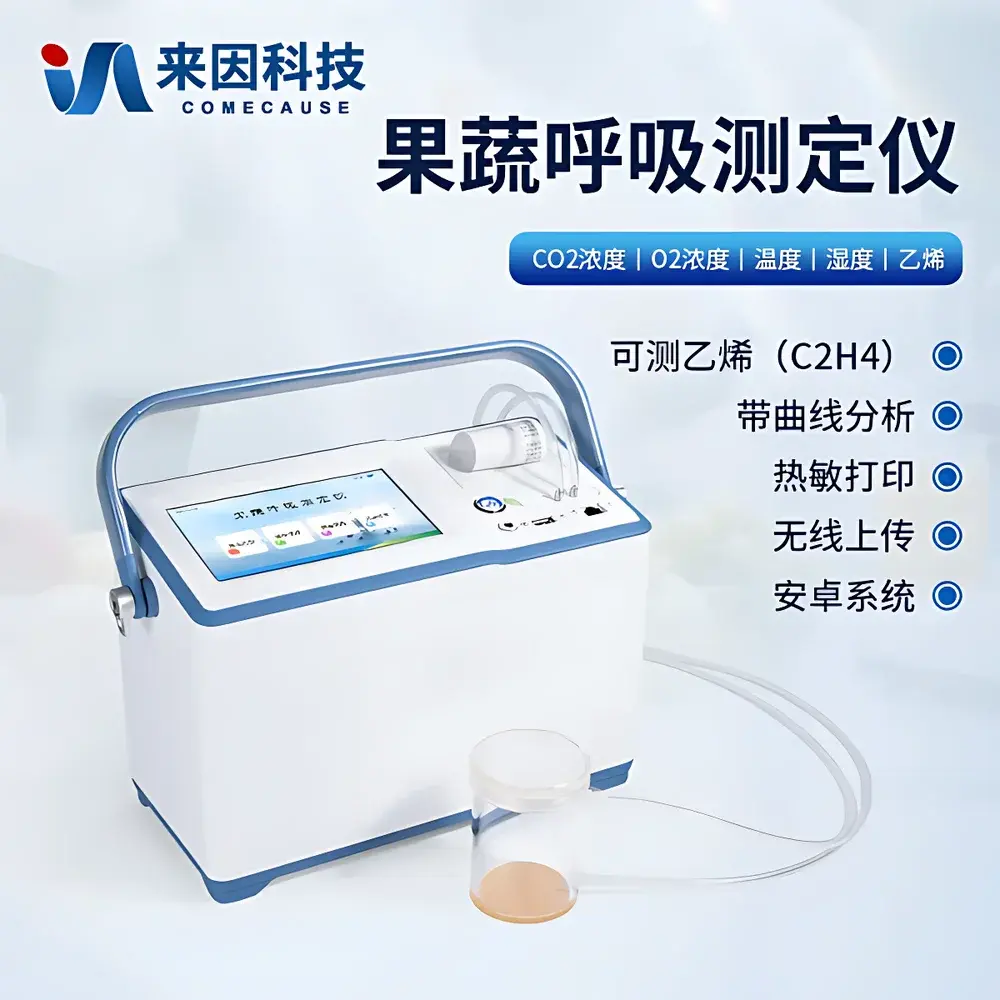
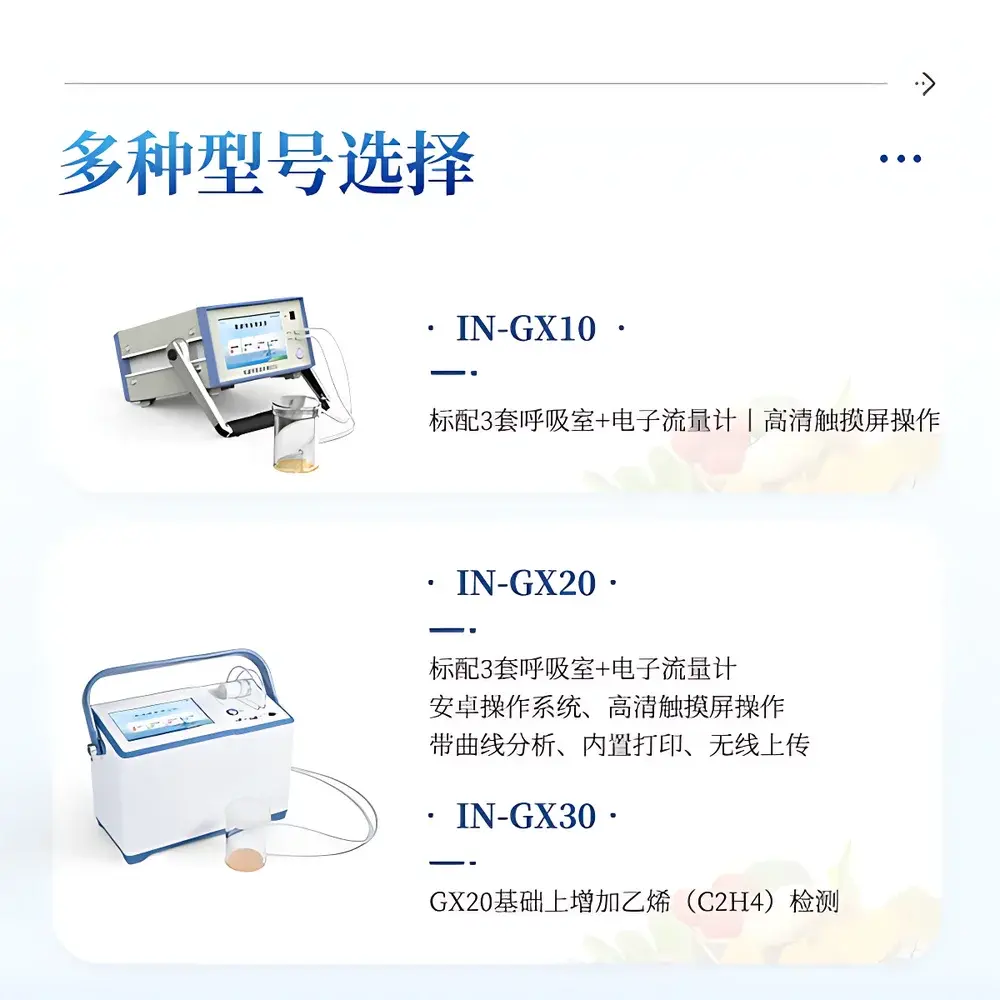
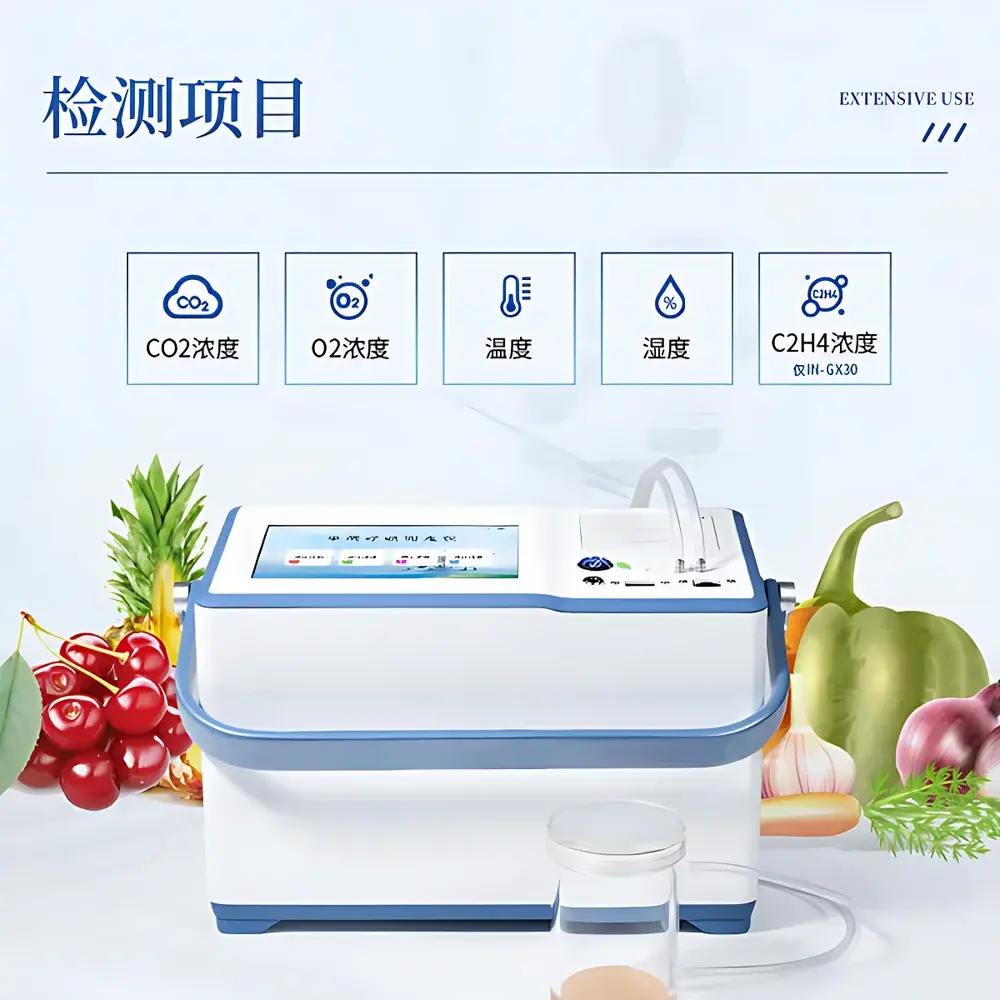

COMECAUSE IN-GX30 Fruit & Vegetable Respiration Rate Analyzer
| [Brand | COMECAUSE |
|---|---|
| Origin | Shandong, China |
| Manufacturer Type | Direct Manufacturer |
| Model | IN-GX30 |
| CO₂ Detection Principle | NDIR (Non-Dispersive Infrared) |
| CO₂ Range | 0–5000 ppm |
| CO₂ Accuracy | ±3 ppm |
| CO₂ Resolution | 0.1 ppm |
| O₂ Detection Principle | Electrochemical |
| O₂ Range | 0–100% vol |
| O₂ Linearity | ≤±2% F.S. |
| O₂ Response Time | ≤30 s |
| C₂H₄ Detection Principle | Electrochemical |
| C₂H₄ Range | 0–200 ppm |
| C₂H₄ Sensitivity | 75±35 nA/ppm |
| C₂H₄ Resolution | 1 ppm |
| Temperature Range | −20 to +95 °C |
| Temp. Accuracy | ±0.2 °C |
| Humidity Range | 0–100% RH |
| RH Accuracy | ±0.2% F.S. |
| Display | 7-inch Android-based capacitive touchscreen |
| Data Storage | 16 GB internal (≥100,000 records) |
| Connectivity | Wi-Fi, 4G, USB export, GPS geotagging |
| Power Supply | 12 V / 3 A adapter |
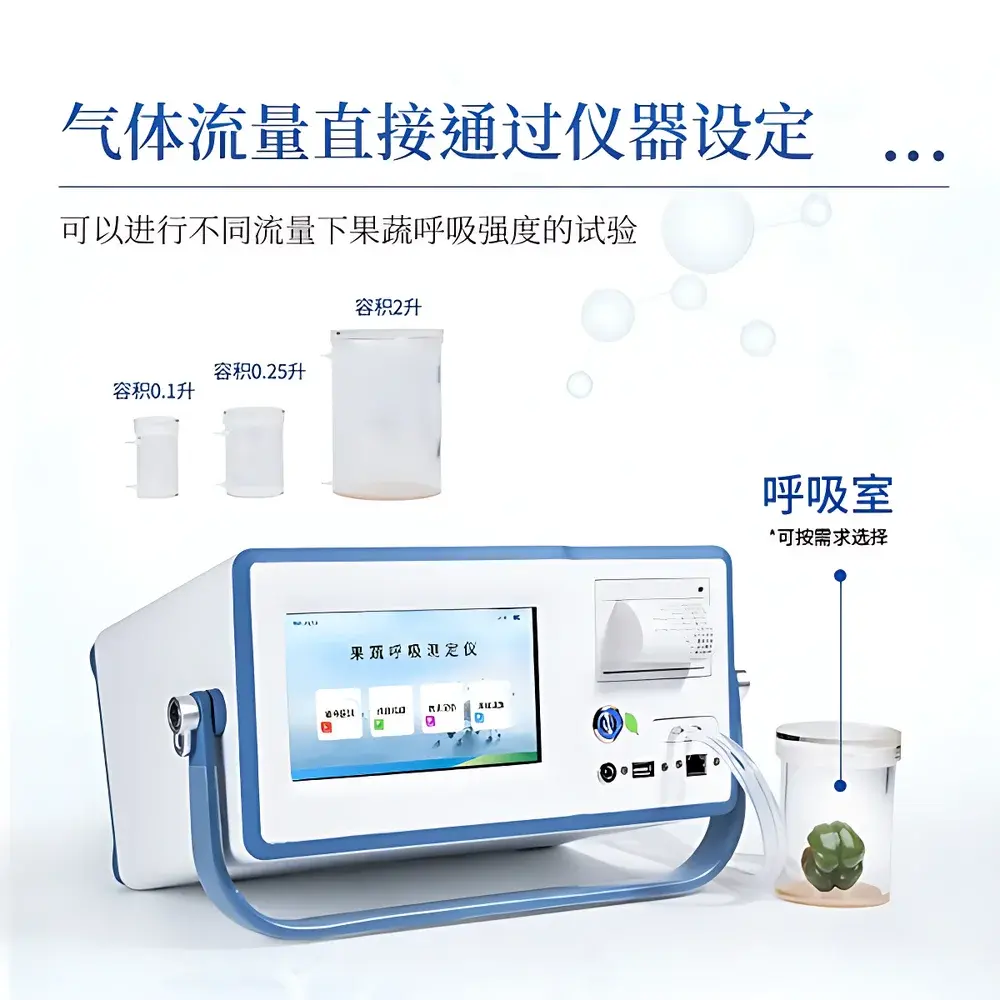
| Respiratory Chamber Options | 0.1 L (Φ40×80 mm), 0.25 L (Φ60×89 mm), 2.0 L (Φ120×180 mm)] |
Overview
The COMECAUSE IN-GX30 Fruit & Vegetable Respiration Rate Analyzer is a field-deployable, multi-parameter gas exchange measurement system engineered for precise quantification of postharvest respiratory metabolism in horticultural commodities. It operates on the principle of closed-system dynamic respirometry: a sealed chamber containing a fruit or vegetable sample is monitored over time for real-time accumulation (CO₂) and depletion (O₂) of respiratory gases, while concurrently tracking ethylene (C₂H₄) emission — a key phytohormonal marker of ripening and stress response. By integrating dual-wavelength NDIR CO₂ detection with electrochemical O₂ and C₂H₄ sensors, the IN-GX30 delivers high reproducibility in heterogeneous biological matrices under ambient, refrigerated, controlled-atmosphere (CA), and retail cold-chain environments. Its design aligns with standardized methodologies described in ISO 8602:2017 (Respiratory quotient determination in fruits and vegetables) and supports experimental protocols compliant with ASTM D7520-21 (Standard Practice for Measuring Respiration Rate of Fresh Produce).
Key Features
- Triple-gas monitoring: Simultaneous, synchronized acquisition of CO₂ (NDIR), O₂ (electrochemical), and C₂H₄ (electrochemical) concentrations — enabling calculation of respiratory quotient (RQ), oxidative phosphorylation status, and ripening stage classification.
- Modular chamber architecture: Three interchangeable stainless-steel chambers (0.1 L, 0.25 L, 2.0 L) allow optimization of surface-area-to-volume ratio across sample types — from single berries to whole melons — minimizing equilibration delay and improving signal-to-noise ratio.
- Embedded Android OS (v11+): Full-featured graphical interface with real-time waveform visualization, touch-enabled parameter configuration, and on-device data annotation (species, cultivar, harvest date, weight, origin, storage condition).
- Integrated environmental sensing: High-accuracy temperature (±0.2 °C) and relative humidity (±0.2% F.S.) probes co-located within the chamber headspace ensure physiologically relevant correction of gas concentration data per ideal gas law assumptions.
- Flexible flow control: Programmable mass flow controller enables user-defined ventilation rates (0–500 mL/min), supporting both static (closed) and forced-flow (semi-open) respirometric modes per USDA-ARS protocol requirements.
- Cloud-connected data management: Native support for Wi-Fi and LTE (4G) facilitates encrypted upload to secure cloud platforms with role-based access, audit trails, and automated metadata tagging including GPS coordinates.
Sample Compatibility & Compliance
The IN-GX30 accommodates intact, unprocessed horticultural specimens — including climacteric (e.g., tomato, banana, apple) and non-climacteric (e.g., citrus, grape, leafy greens) species — without tissue disruption. Chamber sealing integrity is verified via pressure decay test prior to each assay, ensuring measurement fidelity. The instrument meets electromagnetic compatibility (EMC) standards IEC 61326-1:2021 and safety requirements per IEC 61010-1:2010. Sensor calibration traceability follows NIST-traceable reference gases (CO₂/N₂, O₂/N₂, C₂H₄/N₂), with documented calibration intervals aligned with GLP-compliant laboratory practice. Data logging complies with FDA 21 CFR Part 11 readiness through electronic signature support, immutable timestamps, and operator ID authentication.
Software & Data Management
The embedded analysis suite provides real-time derivative computation (d[CO₂]/dt, d[O₂]/dt), automatic baseline subtraction, and RQ derivation (CO₂/O₂ molar ratio). Export formats include CSV (with ISO 8601 timestamps), PDF reports (including chamber ID, sensor diagnostics, and environmental logs), and XML for LIMS integration. Local storage (16 GB eMMC) retains ≥100,000 full-session records with cyclic overwrite protection. USB-C port enables direct export to FAT32-formatted drives; no proprietary software required for data retrieval. Firmware updates are delivered OTA or via microSD card, maintaining version-controlled revision history per ISO/IEC 17025 documentation requirements.
Applications
- Postharvest physiology research: Quantifying respiratory shifts during ripening, senescence, chilling injury, or hypoxia exposure.
- Controlled atmosphere (CA) storage optimization: Validating O₂/CO₂ setpoints and detecting off-gassing anomalies in commercial storage facilities.
- Supply chain quality assurance: Benchmarking respiration rates across harvest batches, transport durations, and retail display conditions.
- Pre-breeding phenotyping: High-throughput screening of respiration-related QTLs in germplasm collections.
- Regulatory compliance testing: Supporting shelf-life claims, organic certification audits, and phytosanitary export documentation per IPPC guidelines.
FAQ
What respiration parameters does the IN-GX30 calculate directly?
It outputs raw time-series gas concentrations (ppm CO₂, % O₂, ppm C₂H₄), derived respiration rate (mg CO₂·kg⁻¹·h⁻¹), O₂ consumption rate (mg O₂·kg⁻¹·h⁻¹), ethylene production rate (nL C₂H₄·kg⁻¹·h⁻¹), and respiratory quotient (RQ = mol CO₂ / mol O₂).
Can the instrument operate unattended for extended periods?
Yes — with external 12 V DC power and optional battery pack (not included), it supports continuous logging for >72 hours; chamber seal integrity and sensor drift are monitored autonomously.
Is calibration required before each use?
Zero calibration for CO₂ and O₂ is recommended before critical assays using certified zero air; span calibration is advised every 30 days or after sensor exposure to condensation or extreme contaminants.
How is temperature and humidity compensated in gas calculations?
Real-time T/RH values feed into the Ideal Gas Law correction algorithm embedded in firmware, converting volumetric concentrations (ppm) to molar flux rates normalized to sample mass and chamber volume.
Does the system support custom respiratory chamber fabrication?
Yes — the instrument accepts third-party chambers via standardized 1/4″ Swagelok fittings and pressure/vacuum interlock signals; API documentation for hardware integration is available under NDA.