
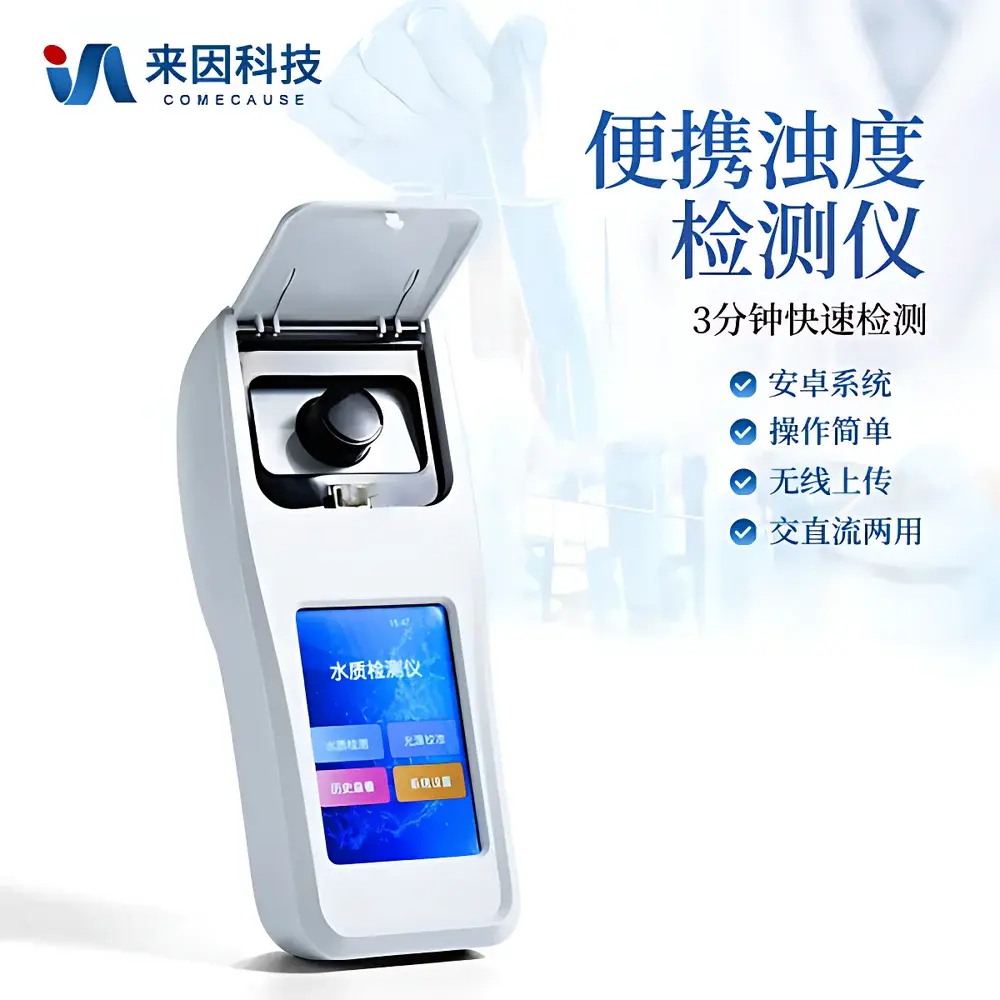
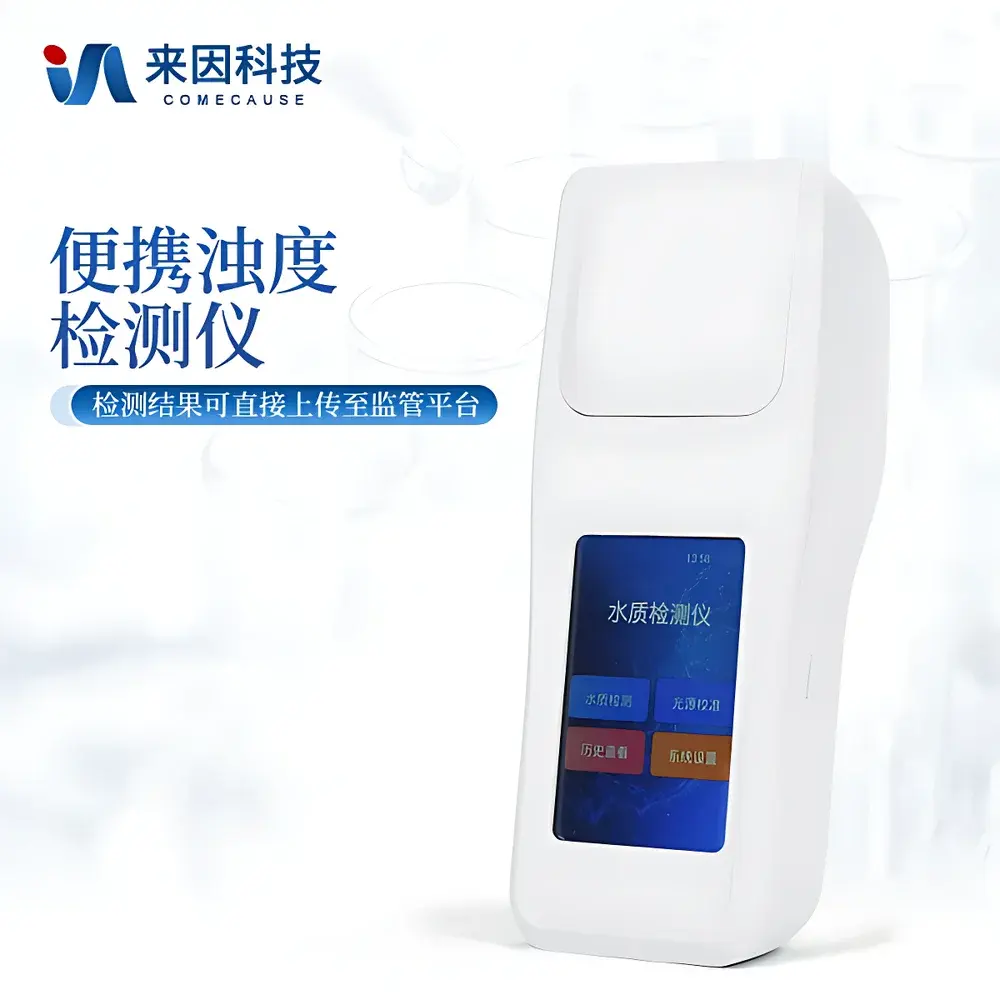
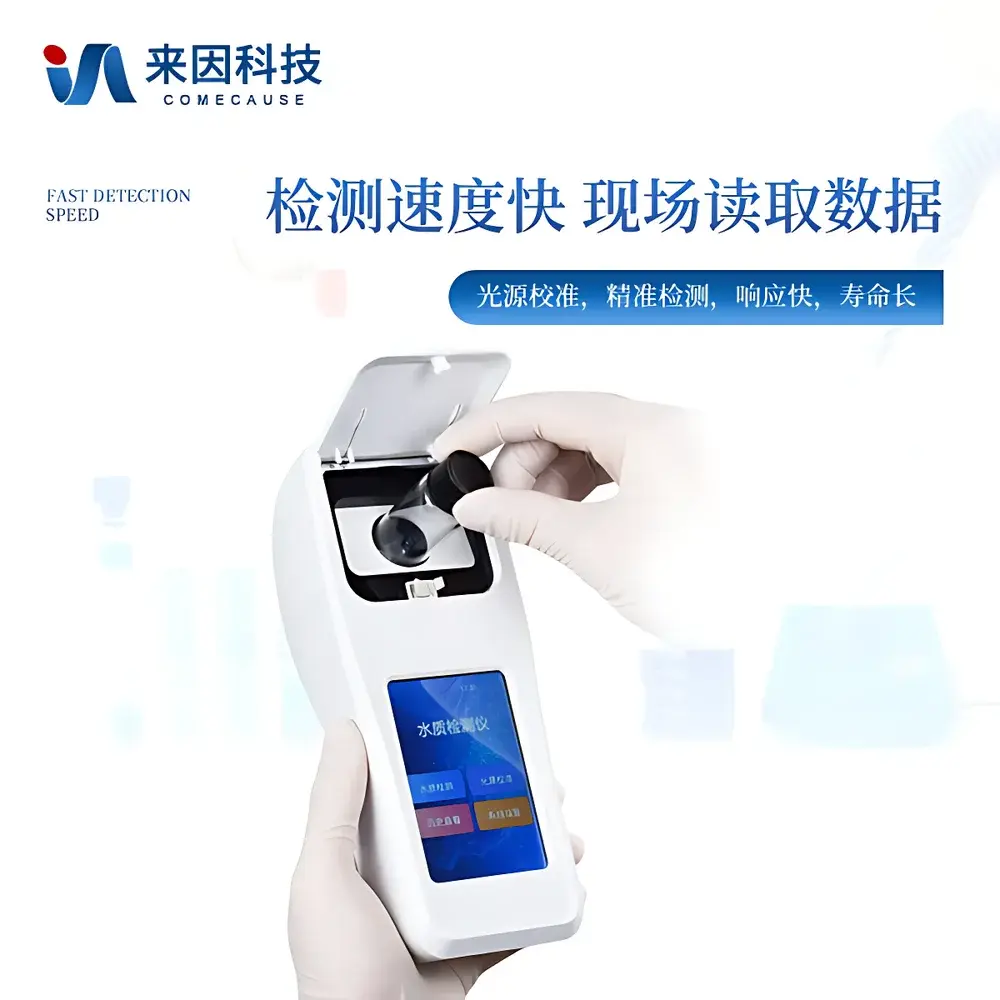
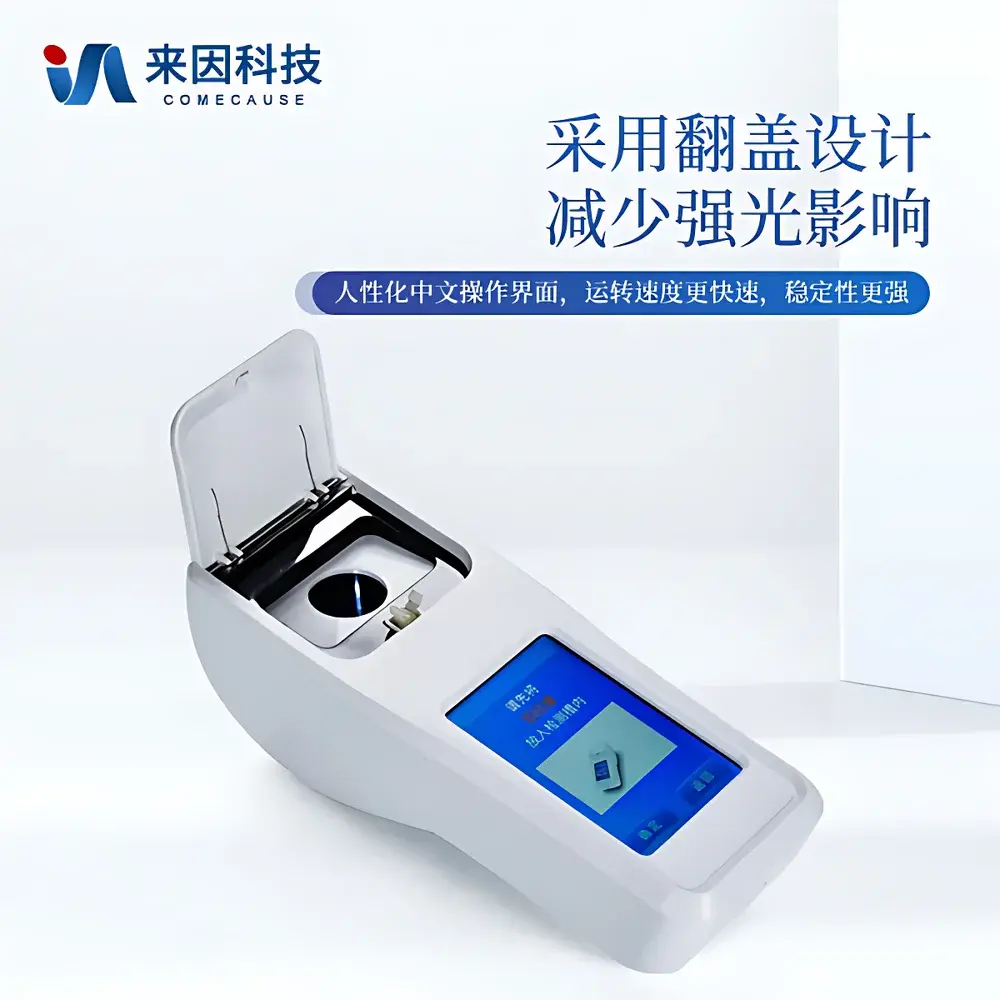
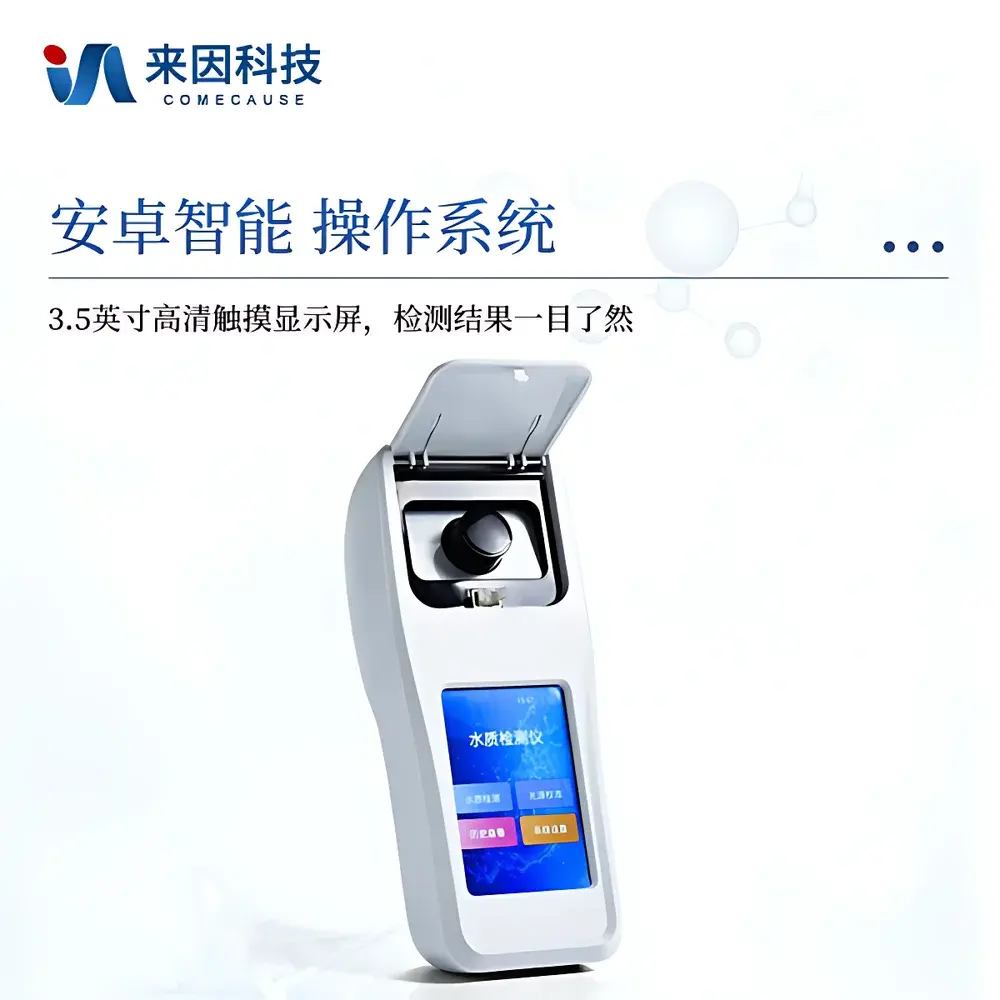
COMECAUSE IN-NTU Portable Turbidimeter
| Brand | COMECAUSE |
|---|---|
| Origin | Shandong, China |
| Manufacturer Type | Direct Manufacturer |
| Product Type | Portable |
| Measurement Range | 0.05–100 NTU |
| Operating Temperature | 0–50 °C |
| Wavelength Range | 340–800 nm |
| Measurement Principle | Nephelometric (90° scattered light detection) |
| Accuracy | ≤5% FS |
| Repeatability | <0.5% |
| Stability | <0.5% |
| Light Source | Imported Cold LED (Lifespan ≥100,000 h) |
| Display | 3.5-inch Color TFT Touchscreen |
| Data Storage | >80,000 Records |
| Connectivity | USB Type-C, Wi-Fi, Bluetooth, Hotspot |
| Power | 5 V DC / 5600 mAh Li-ion Battery (12 h continuous operation) |
| Dimensions | 180 × 80 × 70 mm |
| Weight | 700 g |
| Compliance | GB/T 13200–1991, ISO 7027:2016 (Nephelometric Method) |
Overview
The COMECAUSE IN-NTU Portable Turbidimeter is an engineered field-deployable instrument designed for rapid, on-site quantification of turbidity in water and transparent liquid samples. It operates on the nephelometric principle—measuring the intensity of light scattered at a 90° angle by suspended particulate matter—as defined in ISO 7027:2016 and aligned with national standard GB/T 13200–1991. This optical configuration ensures high sensitivity to low-level turbidity (down to 0.05 NTU) while maintaining linearity across a broad dynamic range (0.05–100 NTU), making it suitable for both raw water screening and finished-water quality verification. The device employs a thermally stabilized, imported cold LED light source with spectral output spanning 340–800 nm, eliminating drift associated with tungsten-halogen lamps and enabling consistent photometric performance over its rated lifetime (>100,000 h). Its compact form factor, integrated rechargeable battery, and robust housing allow uninterrupted operation under ambient conditions from 0 to 50 °C and relative humidity up to 90%, supporting unattended field use in diverse environmental and industrial settings.
Key Features
- True nephelometric detection geometry (90° scatter) compliant with ISO 7027:2016 and GB/T 13200–1991
- High-stability cold LED optical system with calibrated spectral output and minimal thermal drift
- 3.5-inch capacitive touchscreen interface running a dedicated Android-based firmware—no external PC or driver required
- Preloaded measurement workflows with guided calibration, sample loading prompts, and real-time validation feedback
- On-device data management: storage capacity exceeding 80,000 timestamped records with automatic metadata tagging (date, time, operator ID, calibration status)
- Multi-modal connectivity including USB Type-C for bulk export, Wi-Fi for cloud synchronization, Bluetooth for peripheral pairing (e.g., printers, GPS loggers), and mobile hotspot mode for offline tablet integration
- IP65-rated enclosure with shock-absorbing silicone bumper, optimized for transport and repeated field deployment
Sample Compatibility & Compliance
The IN-NTU accepts standard 25-mm round glass or disposable plastic cuvettes (10-mm path length), accommodating both laboratory-grade and field-ready sample vessels. It supports routine calibration using formazin or polymer-based NTU standards traceable to NIST SRM 2134. Instrument validation includes built-in zero-check routines, span verification protocols, and optical path integrity diagnostics. Regulatory alignment extends to GLP-compliant data handling: all measurements are cryptographically timestamped, user-authenticated (via PIN or optional RFID badge), and support audit-trail generation per FDA 21 CFR Part 11 requirements when paired with validated cloud platforms. The device meets electromagnetic compatibility (EMC) Class B limits per IEC 61326-1 and carries CE marking for safety and radio emissions compliance.
Software & Data Management
Firmware is upgradable via signed OTA packages, ensuring traceable version control and cybersecurity hardening. Raw absorbance and scatter intensity values are retained alongside calculated NTU results, enabling retrospective reprocessing if calibration parameters are updated. Export formats include CSV (with ISO 8601 timestamps), PDF reports (customizable templates), and encrypted binary archives compatible with LIMS interfaces. Optional COMECAUSE Cloud Connect enables role-based access control, automated report generation, trend analysis dashboards, and remote firmware push—fully auditable for ISO/IEC 17025-accredited laboratories.
Applications
- Drinking water distribution monitoring (source, treatment plant effluent, network endpoints)
- Wastewater treatment process control (clarifier performance, filtration efficiency, disinfection pre-check)
- Pharmaceutical water systems (PW, WFI) per USP <1231> and EU GMP Annex 1 guidance
- Food & beverage production (bottled water, juice, beer clarity verification)
- Environmental field surveys (rivers, lakes, stormwater runoff, sediment plume tracking)
- Educational labs and technical training programs requiring ISO-aligned turbidity instruction
FAQ
What turbidity standard does the IN-NTU use for calibration?
It supports both formazin (FTU) and stable polymer standards (NTU), with factory calibration traceable to NIST SRM 2134.
Can the instrument be used in outdoor sunlight without screen glare interference?
Yes—the 3.5-inch TFT display features anti-reflective coating and adjustable brightness (up to 800 cd/m²), optimized for direct-sun viewing.
Is the battery replaceable in the field?
The 5600 mAh Li-ion battery is user-replaceable using standard Torx T5 tools; spare batteries are available as consumable part #IN-BAT-01.
Does the device support multi-point calibration?
Yes—it allows up to five custom calibration points across the 0.05–100 NTU range, with linear or polynomial curve fitting options.
How is data integrity ensured during wireless transmission?
All Wi-Fi and Bluetooth transfers use TLS 1.2 encryption; local storage employs AES-256 full-disk encryption with hardware-backed key management.





