
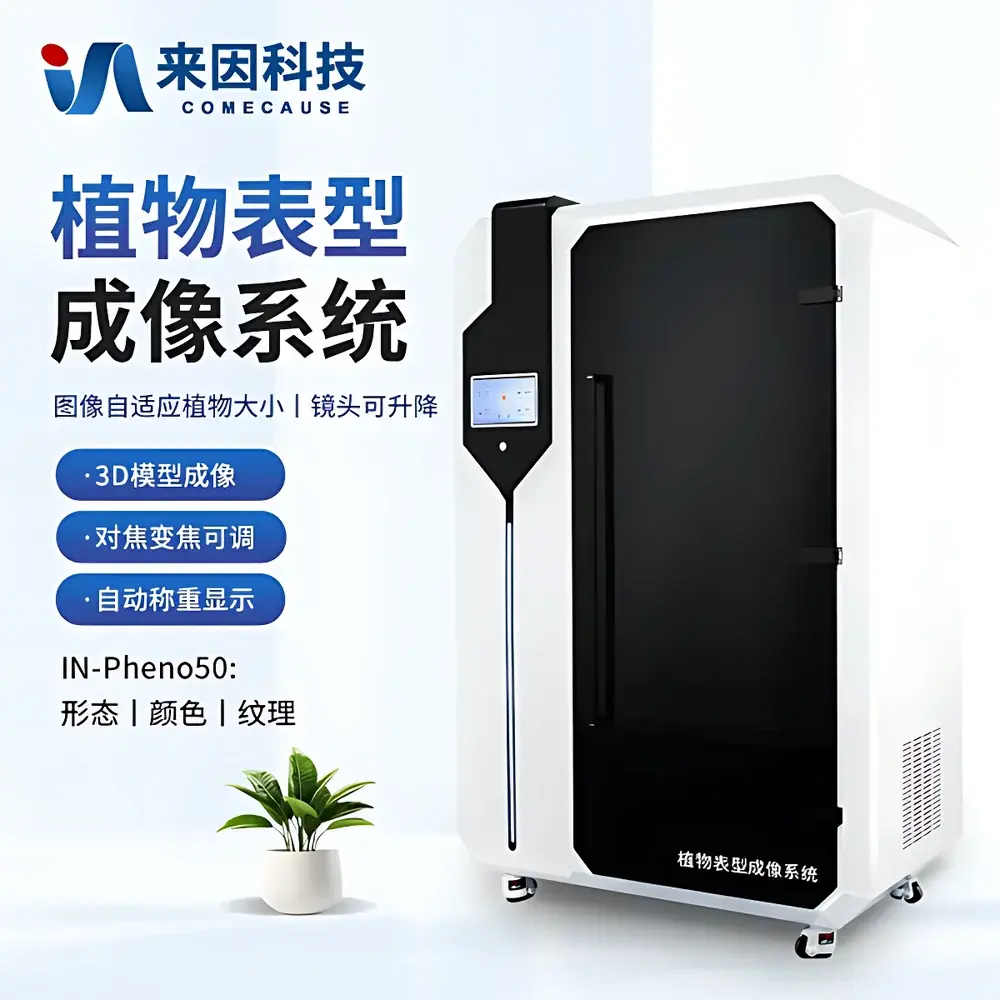
COMECAUSE IN+Pheno50 Plant Phenotyping Imaging System
| Brand | COMECAUSE |
|---|---|
| Origin | Shandong, China |
| Manufacturer Type | Direct Manufacturer |
| Country of Origin | China |
| Model | IN+Pheno50 |
| Price | USD 77,000 (FOB Qingdao) |
| Max Plant Height | 300–1000 mm |
| Max Plant Width | 100–500 mm |
| Max Fresh Weight | 100–75,000 g |
| Enclosure Dimensions | 1400 × 830 × 2140 mm (L×W×H) |
| Camera Resolution | Up to 12 MP |
| Imaging Modalities | Top, Side-Above, Side-Below Visible-Light Multi-View Capture |
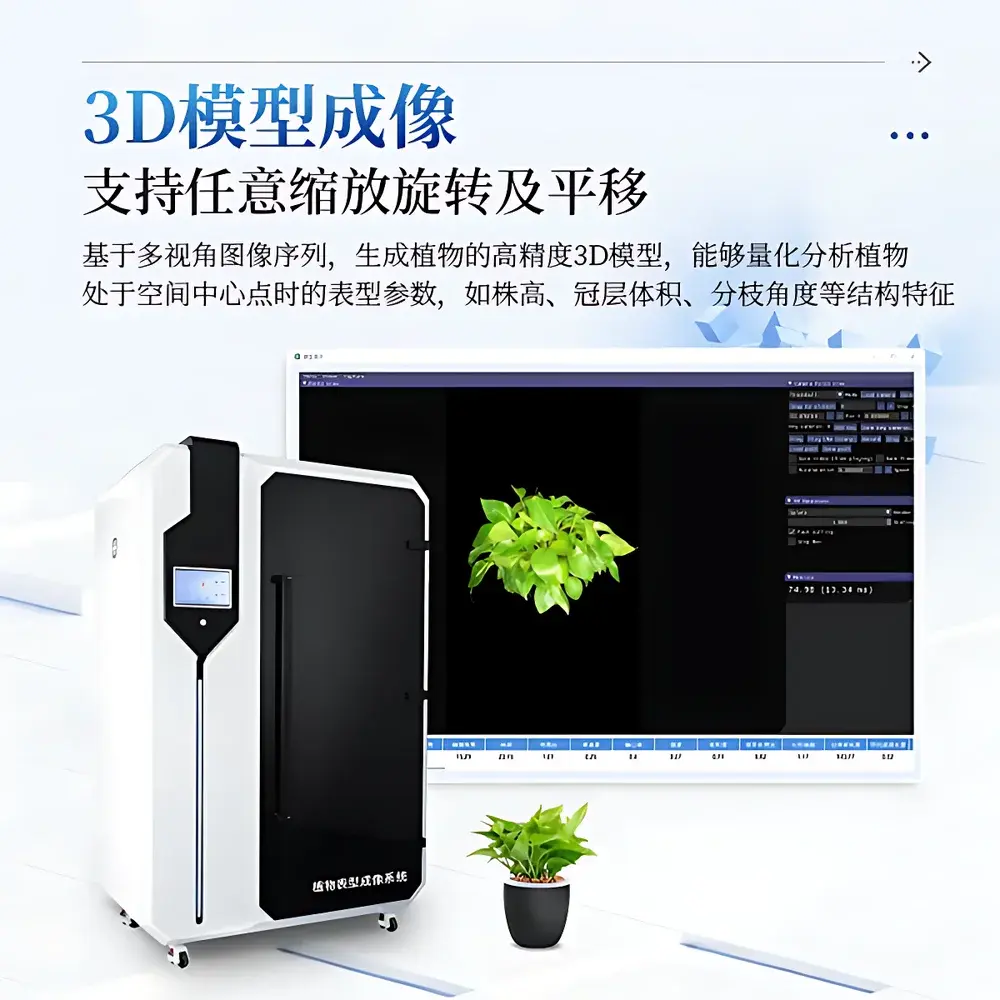
| 3D Reconstruction Method | Multi-View Stereo (MVS) with AI-Enhanced Depth Estimation |
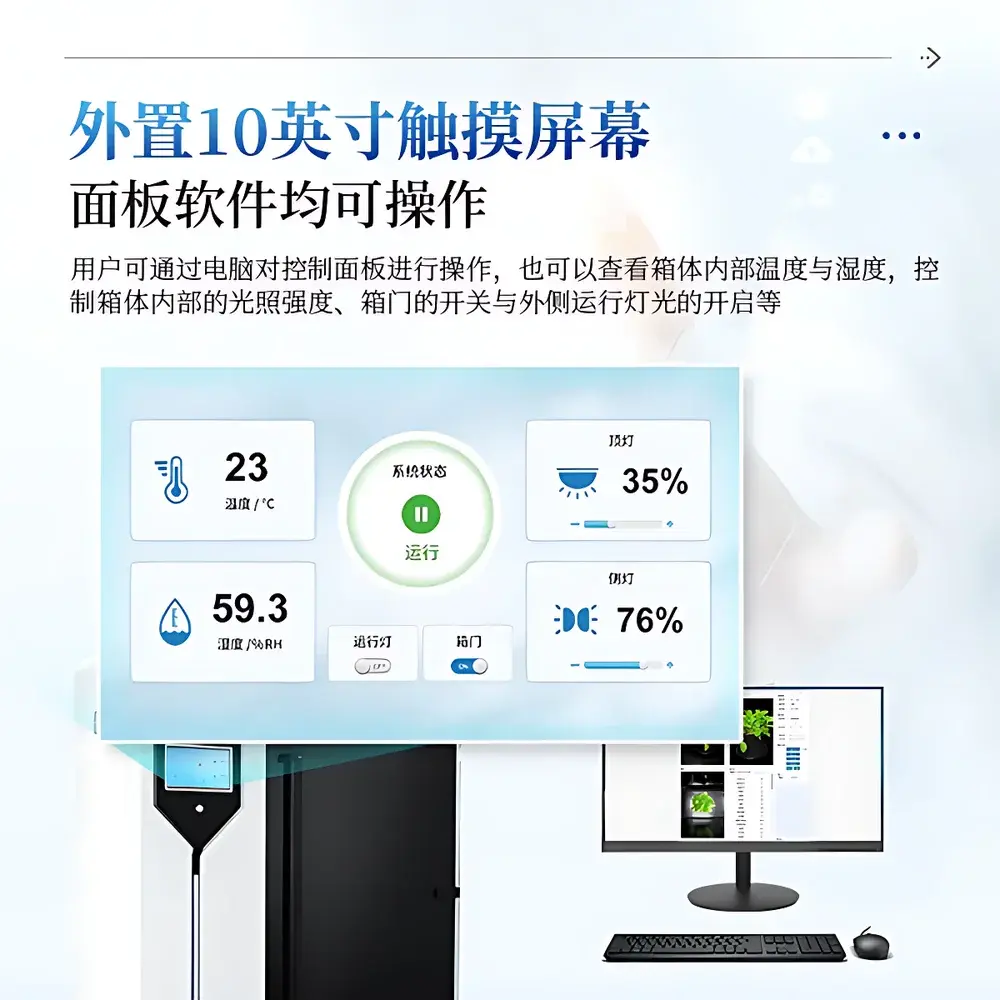
| Environmental Sensors | Integrated Temperature & Relative Humidity Monitoring |
| Control Interface | 10-inch External Touchscreen + PC Software (Windows 10/11, Intel i5+, 8 GB RAM, NVIDIA GPU ≥ 8 GB VRAM) |
| Data Export | CSV, PNG, OBJ, STL, MP4 (3D model video), JSON |
| Compliance | Designed for GLP-aligned workflows |
Overview
The COMECAUSE IN+Pheno50 Plant Phenotyping Imaging System is a fully integrated, non-destructive phenotyping platform engineered for high-throughput, quantitative analysis of plant morphological, chromatic, and textural traits under controlled environmental conditions. It employs multi-angle visible-light imaging—capturing top-down, side-above, and side-below views—combined with synchronized rotation of a precision motorized turntable to acquire comprehensive angular coverage. Leveraging multi-view stereo (MVS) computer vision algorithms enhanced by deep learning-based depth refinement, the system reconstructs accurate, metrically scaled 3D surface models from unstructured image sequences. Unlike single-view or laser-scanning systems, the IN+Pheno50 delivers true volumetric quantification—including canopy volume, branch orientation in 3D space, and spatial distribution of color gradients—without requiring fiducial markers or structured light projection. Its enclosed cabinet design ensures stable illumination (LED-spectrum configurable), thermal-humidity control, and operational repeatability across diurnal cycles and experimental batches—critical for longitudinal studies in genetics, stress physiology, and breeding pipelines.
Key Features
- Tri-axial visible-light imaging architecture: Independent optical paths for top, side-above, and side-below capture ensure complete occlusion-free coverage of upright-grown plants.
- Automated adaptive imaging protocol: Real-time size estimation triggers dynamic adjustment of camera height, lens zoom, and exposure settings; large specimens are handled via seamless image tiling and geometric stitching.
- Integrated environmental monitoring: Onboard temperature and relative humidity sensors log ambient conditions synchronously with each imaging event—enabling covariate-aware statistical modeling.
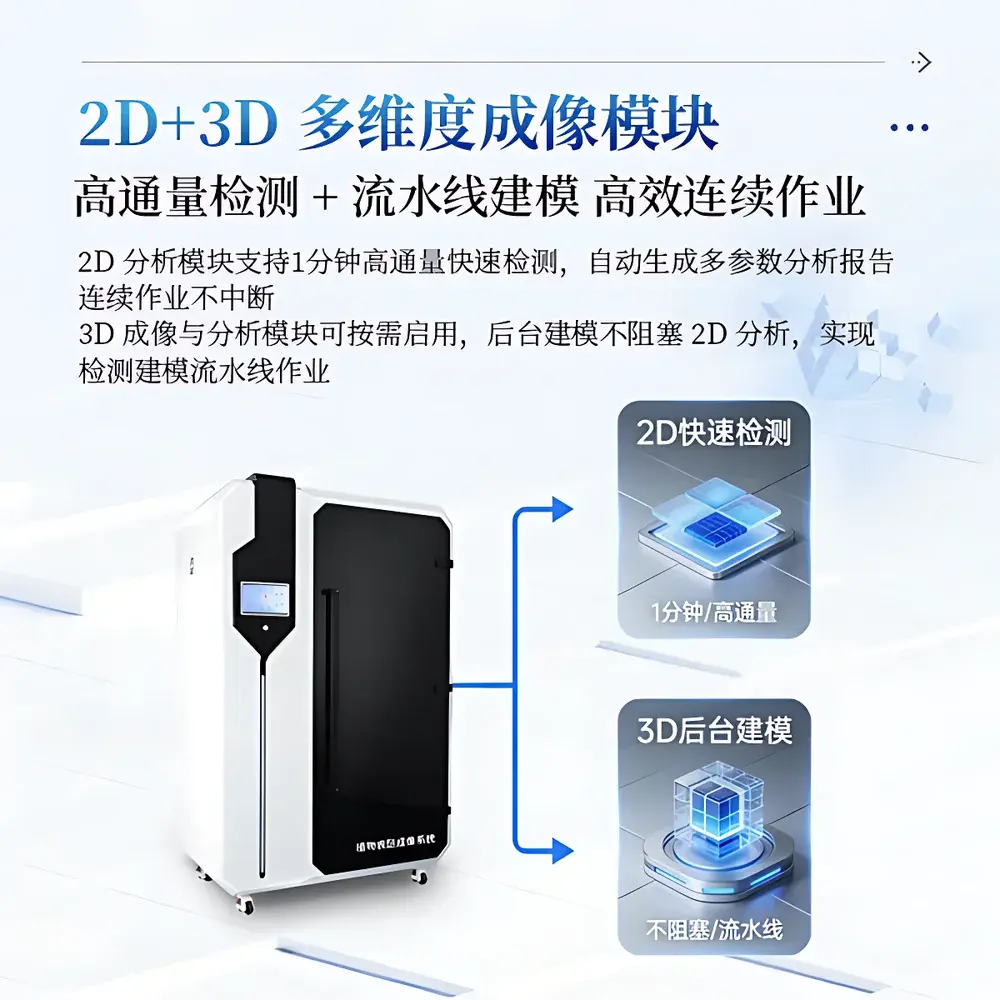
- Dual-mode analysis pipeline: Concurrent 2D high-throughput processing (≤60 s/sample) and background-queued 3D reconstruction enable uninterrupted screening while preserving full structural fidelity.
- Full-resolution 3D model interaction: Reconstructed meshes support real-time rotation, pan, zoom, and sectioning in native 3D space; all morphometric parameters (e.g., branch angle, skeleton length, convex hull volume) are computed directly from the 3D point cloud or mesh—not projected 2D proxies.
- Hardware-integrated weighing: Load-cell transducer embedded in the rotating stage records fresh mass automatically upon placement and associates weight data with each imaging session.
- Cloud-enabled data synchronization: Encrypted, device-ID-bound upload to secure cloud storage with role-based access control and versioned dataset management.
- Regulatory-ready software infrastructure: Audit trail logs include operator ID, timestamp, firmware version, calibration certificate ID, environmental readings, and parameter modification history—aligned with GLP documentation requirements.
Sample Compatibility & Compliance
The IN+Pheno50 accommodates intact, soil-grown or hydroponic specimens from major angiosperm families—including Poaceae (e.g., rice, wheat, maize), Solanaceae (tomato, tobacco), Brassicaceae (Arabidopsis, canola), and Fabaceae (soybean, pea)—within defined dimensional and mass limits (300–1000 mm height; 100–500 mm width; 100–75,000 g fresh weight). Its enclosed chamber meets IEC 61000-6-3 (EMC emission) and IEC 61000-6-2 (immunity) standards. While not certified for clinical or pharmaceutical GMP environments, the system’s deterministic data capture, traceable calibration routines, and immutable metadata logging support compliance with ISO 17025 principles for testing laboratories and facilitate alignment with FAO/IAEA plant phenotyping best practice guidelines. All exported datasets include embedded EXIF and custom JSON metadata schemas compliant with MIAPPE 1.1 (Minimum Information About a Plant Phenotyping Experiment).
Software & Data Management
The proprietary IN+Pheno Suite runs on Windows 10/11 and provides a unified interface for hardware control, acquisition scheduling, batch analysis, and report generation. It implements a modular plugin architecture: the 2D Analyzer computes over 50 standardized descriptors—including geometric metrics (aspect ratio, solidity, fractal dimension), CIELAB color space values (D65 illuminant, 2° observer), and Haralick texture features (ASM, Contrast, Entropy, Homogeneity)—all calculated per view and aggregated across angles. The 3D Analyzer extracts volumetric traits (canopy volume, surface area, centroid height), skeletal topology (branch order, bifurcation count, tip density), and spatially resolved color-texture mapping. Data export supports CSV (tabular phenotypes), PNG (processed images), OBJ/STL (3D mesh), and MP4 (rotating 3D model video). All operations generate timestamped, digitally signed log entries compatible with FDA 21 CFR Part 11 electronic record requirements when deployed with validated identity management and electronic signature modules.
Applications
This system serves as a core instrumentation platform for academic and industrial research programs requiring reproducible, scalable phenotypic characterization. Key use cases include: QTL mapping and GWAS validation where 3D architectural traits (e.g., tiller angle, leaf inclination, inflorescence compactness) serve as quantitative endophenotypes; abiotic stress phenotyping (drought, salinity, heat) through temporal tracking of wilting dynamics, chlorosis progression, and canopy closure rates; biotic stress assessment (pathogen/herbivore damage) via automated detection of lesion area, necrosis texture entropy, and compensatory growth patterns; ideotype selection in crop breeding—particularly for lodging resistance (stem rigidity proxy via bending moment estimation from 3D curvature), harvest index optimization (shoot:root biomass ratio inferred from correlated imaging), and light-use efficiency modeling (via 3D canopy light interception simulation using reconstructed geometry). Its modularity also supports method development in spectral phenotyping when integrated with optional narrowband LED sources.
FAQ
What lighting spectrum options are available?
Standard configuration uses uniform white LED illumination (5000 K CCT, CRI >90). Optional narrowband modules (450 nm, 530 nm, 660 nm, 730 nm) can be installed for reflectance-based vegetation indices (e.g., NDVI, PRI) or photomorphogenic response studies.
Is the 3D reconstruction calibrated for absolute metric accuracy?
Yes—each system undergoes factory calibration using NIST-traceable checkerboard targets and photogrammetric ground control points. Volumetric error is ≤±1.2% at 500 mm working distance (validated per ASTM E2924-21 Annex A1).
Can raw image data be accessed for custom algorithm development?
Yes—full-resolution TIFF stacks (top/side-above/side-below) and intermediate depth maps are accessible via local file system or API (RESTful JSON endpoints with OAuth2 authentication).
Does the system support time-series imaging with automated scheduling?
Yes—the scheduler module enables programmable multi-day campaigns with adjustable intervals (minutes to days), environmental setpoint ramping, and conditional triggers (e.g., initiate scan if RH drops below 60%).
What level of technical support and software updates is provided post-purchase?
COMECAUSE offers 24-month hardware warranty, lifetime access to minor software updates, and annual major-version upgrades under a valid maintenance agreement. Remote diagnostics and on-site application support are available globally via authorized service partners.
Related Products



