
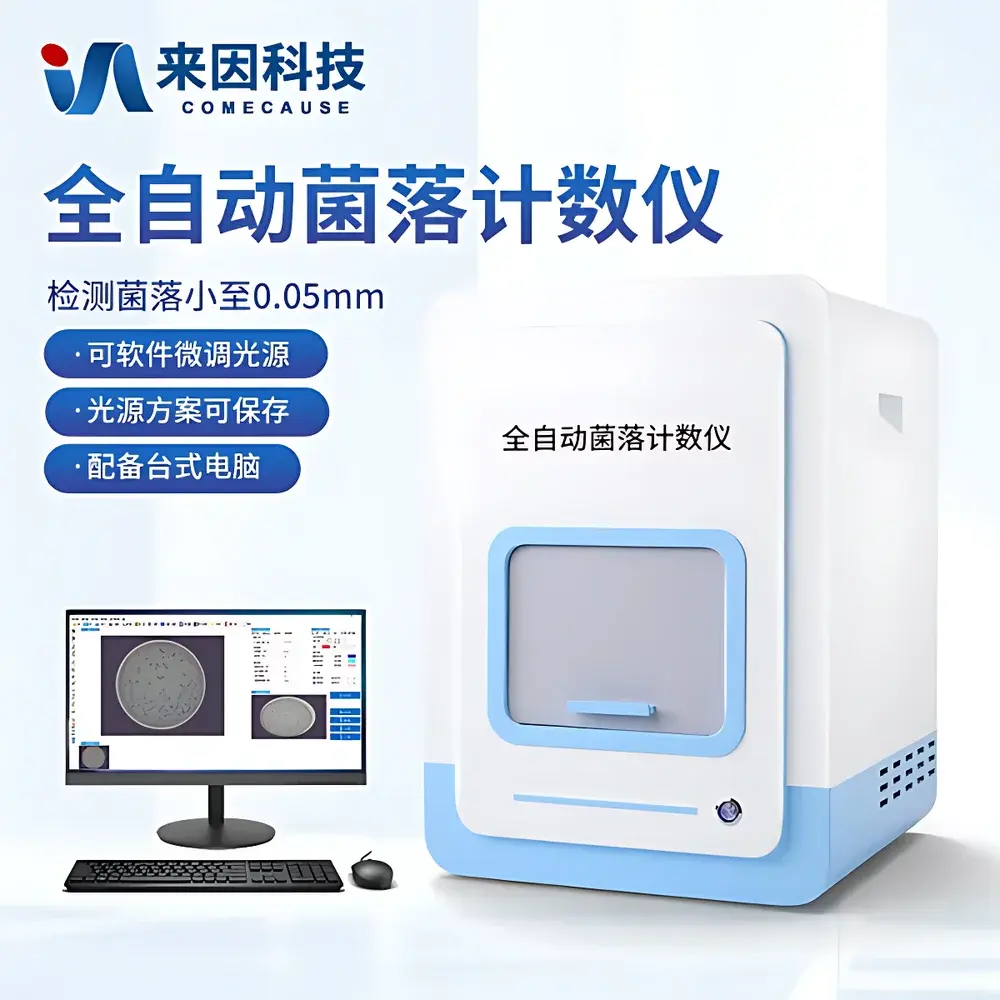
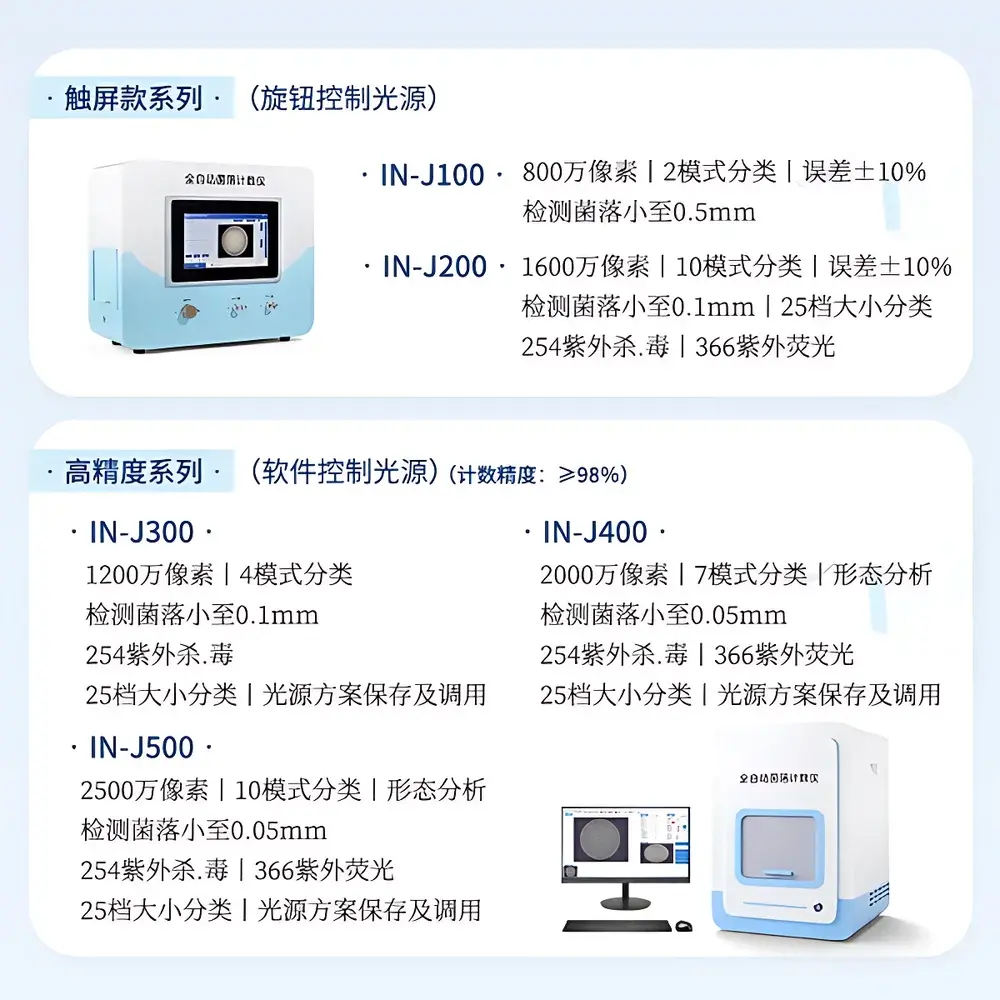
COMECAUSE IN/J500 Automated Colony Counter System
| Brand | COMECAUSE |
|---|---|
| Origin | Shandong, China |
| Manufacturer Type | OEM/ODM Manufacturer |
| Country of Origin | China |
| Model | IN/J500 |
| Price | USD 11,400 (FOB) |
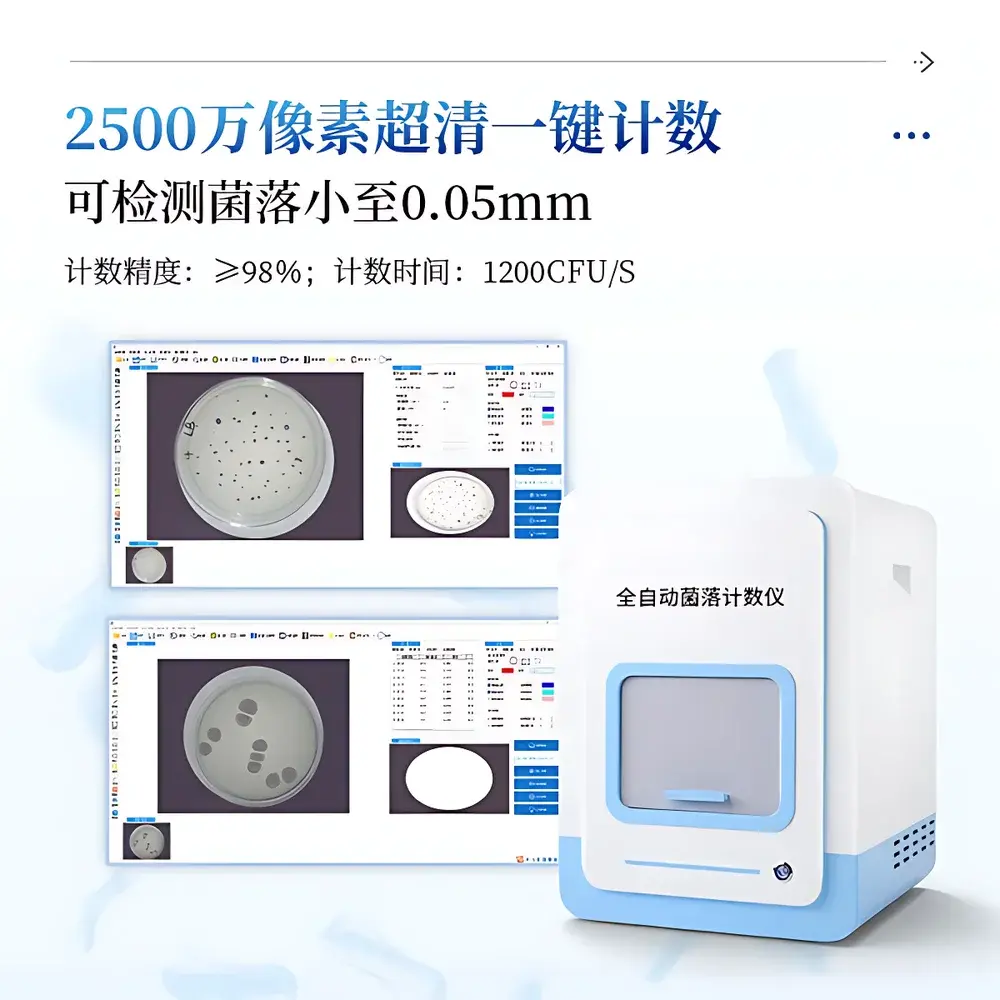
| Imaging Sensor | 25 MP color CMOS |
| Lens | 12 mm f/1.4 high-resolution macro lens |
| Minimum Detectable Colony Diameter | 0.05 mm |
| Counting Accuracy | ≥98% (per ISO 4833-1:2013 validation protocols) |
| Counting Speed | ≤2 sec per standard 90 mm Petri dish (1200 CFU/s equivalent throughput) |
| Compatible Dish Types | Pour plate, spread plate, membrane filtration, 3M Petrifilm™, Compact Dry™, RIDA™ filters |
| Dish Diameter Range | 90–110 mm |
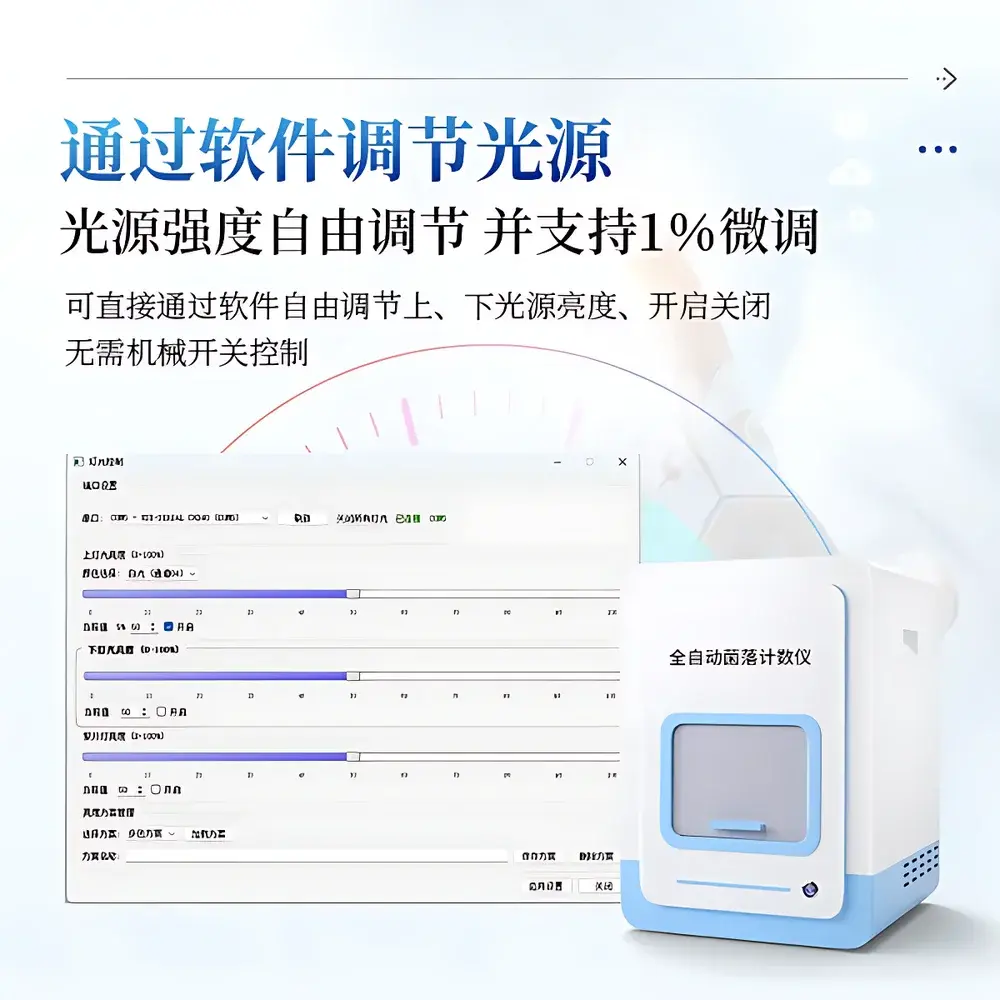
| Illumination | Dual independent LED sources (top/bottom) |
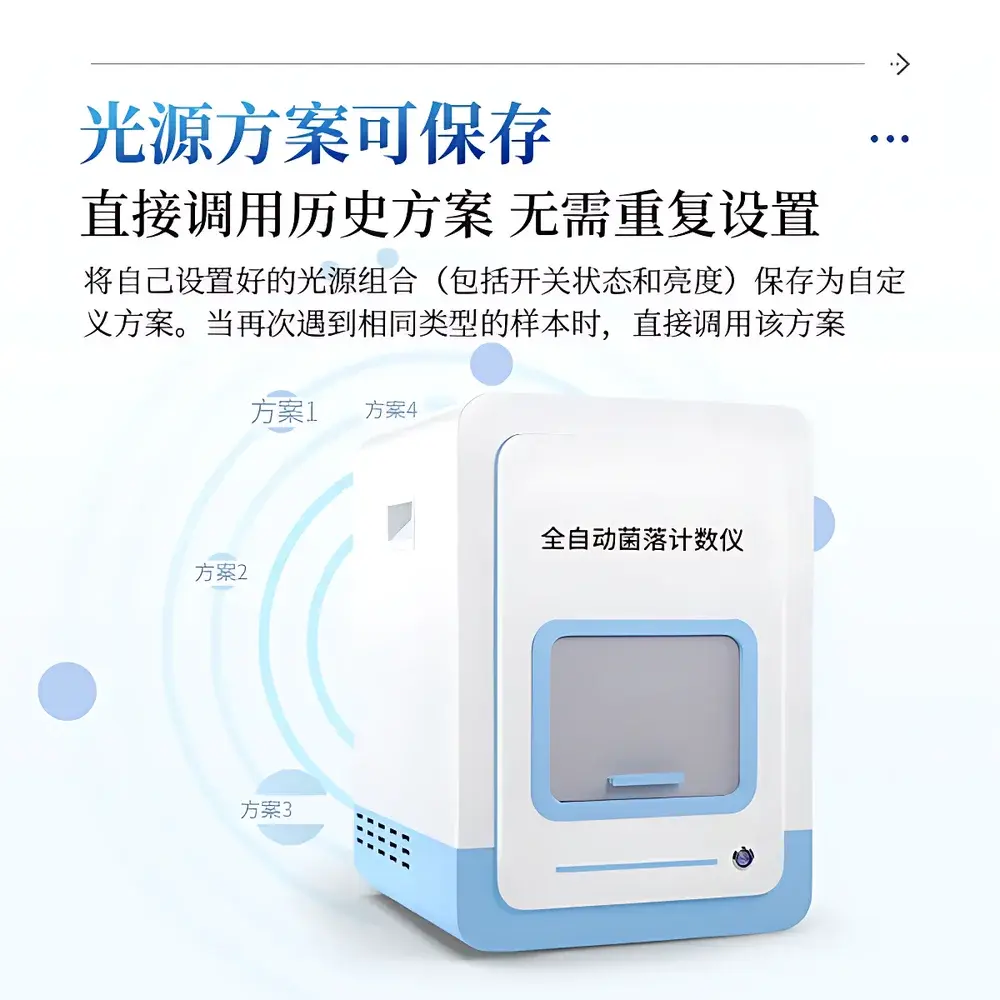
| Software Control | Real-time brightness adjustment (1–100%, 1% increments), illumination mode switching (top-only / bottom-only / dual), preset illumination profile storage & recall |
| Calibration | Pixel-to-mm auto/manual calibration with traceable reference standard |
| Compliance | Supports audit trails per FDA 21 CFR Part 11, GLP/GMP data integrity requirements, ISO/IEC 17025 documentation standards |
Overview
The COMECAUSE IN/J500 Automated Colony Counter System is an ISO-compliant digital image analysis platform engineered for high-throughput, objective, and auditable microbial colony enumeration in regulated laboratory environments. It operates on the principle of high-fidelity digital microscopy combined with adaptive threshold-based segmentation and morphological feature extraction algorithms. Unlike manual counting or semi-automated systems reliant on fixed contrast settings, the IN/J500 employs dynamic illumination control and multi-spectral imaging to resolve colonies across diverse media formulations—including chromogenic, selective, and fluorescent substrates—without operator-dependent parameter tuning. Its architecture integrates a 25-megapixel scientific-grade color sensor with a 12 mm macro lens optimized for uniform field illumination and sub-0.05 mm spatial resolution, enabling reliable detection of microcolonies and confluent zones under standardized conditions defined in ISO 4833-1:2013 and AOAC Official Method 990.12.
Key Features
- Quad-spectrum visible illumination (white/red/green/blue) with software-controlled intensity (1–100% in 1% steps) and independent top/bottom source activation for optimal contrast adaptation across agar types and colony pigmentation.
- Dual-wavelength UV subsystem: 254 nm UV-C for internal chamber decontamination between runs; 366 nm UV-A for fluorescence excitation compatible with GFP-expressing strains, ColiComplete™, and other fluorogenic media.
- Automated colony classification engine supporting ten distinct counting modes—dispersed, clustered, micro-colony (2 mm), Petrifilm™, Compact Dry™, RIDA™ filter, background-matched, monochromatic, and polychromatic segmentation—with user-adjustable sensitivity and shape filters.
- Real-time interactive correction suite: dual-click insertion/deletion, rectangular ROI annotation, intelligent impurity removal (by size, circularity, hue, or saturation), and single-colony morphometric analysis (diameter, area, perimeter, roundness).
- Traceable dimensional calibration system with NIST-traceable reference disk support; automatic pixel-to-mm conversion applied to all quantitative outputs including colony size distribution histograms (25-bin classification).
- FDA 21 CFR Part 11–ready software architecture featuring role-based multi-user authentication, immutable PDF report generation, full audit trail logging (user/action/timestamp/parameter set), and encrypted local database storage.
Sample Compatibility & Compliance
The IN/J500 accommodates standard microbiological sample formats: pour plates, spread plates, membrane filters (0.45 µm and 0.22 µm), 3M Petrifilm™ aerobic count plates, Compact Dry™ dry-rehydratable films, and RIDA™ grid-filter membranes. It supports Petri dishes ranging from 90 mm to 110 mm in diameter, with centering fixtures ensuring repeatable positioning. All image acquisition and analysis workflows adhere to ISO 4833-1:2013 validation criteria for colony counter performance, including linearity, repeatability (RSD ≤5%), and recovery rate (≥95% for spiked controls). The system’s electronic record structure satisfies GLP and GMP documentation requirements, with timestamped raw images, processing parameters, and final counts archived in a tamper-evident format compliant with ISO/IEC 17025 clause 7.5.2.
Software & Data Management
COMECAUSE ColonyVision™ v4.2 software provides a unified interface for instrument control, image analysis, and regulatory reporting. It includes cloud-sync capability via secure TLS 1.3–encrypted API endpoints, enabling remote data access and centralized lab-wide analytics. Each user account maintains isolated data partitions with configurable retention policies. Reports export natively to PDF (with embedded digital signature) and CSV/Excel (for statistical process control integration). Audit logs capture every action—including illumination profile selection, threshold adjustment, manual correction, and result export—with hash-verified immutability. Optional LIMS integration is supported through ASTM E1467-compliant HL7 and RESTful webhooks.
Applications
The IN/J500 serves critical roles across food safety laboratories (pathogen load quantification per ISO 6579-1), pharmaceutical QC (bioburden testing per USP and EP 2.6.12), clinical microbiology (blood culture isolate enumeration, antibiotic susceptibility screening), environmental monitoring (water and surface bioburden assessment per ISO 9308-1), and academic research (microbial ecology profiling, biofilm dispersion kinetics). Its fluorescence mode enables rapid E. coli identification on CHROMagar™ ECC and enumeration of recombinant strains expressing GFP/RFP reporters. The system also supports concurrent colony counting and inhibition zone measurement for Kirby-Bauer assays when used with calibrated zone rulers.
FAQ
Does the IN/J500 comply with FDA 21 CFR Part 11 requirements?
Yes—the software enforces electronic signatures, audit trails, and data integrity controls aligned with Part 11 Subpart B for closed systems.
Can the system differentiate colonies of similar color but different morphology?
Yes—morphological filters (circularity, aspect ratio, convexity) are applied independently of color thresholds during segmentation.
Is calibration required before each use?
No—once validated using the included NIST-traceable calibration disk, the system retains calibration until hardware maintenance or lens replacement.
What file formats are supported for raw image export?
TIFF (16-bit lossless), PNG (8-bit), and JPEG (high-quality) with embedded EXIF metadata including illumination settings and timestamp.
How is data backup handled in the event of local storage failure?
Automatic daily encrypted backups to network-attached storage (NAS) or optional COMECAUSE Cloud Vault with versioned retention and AES-256 encryption.






