

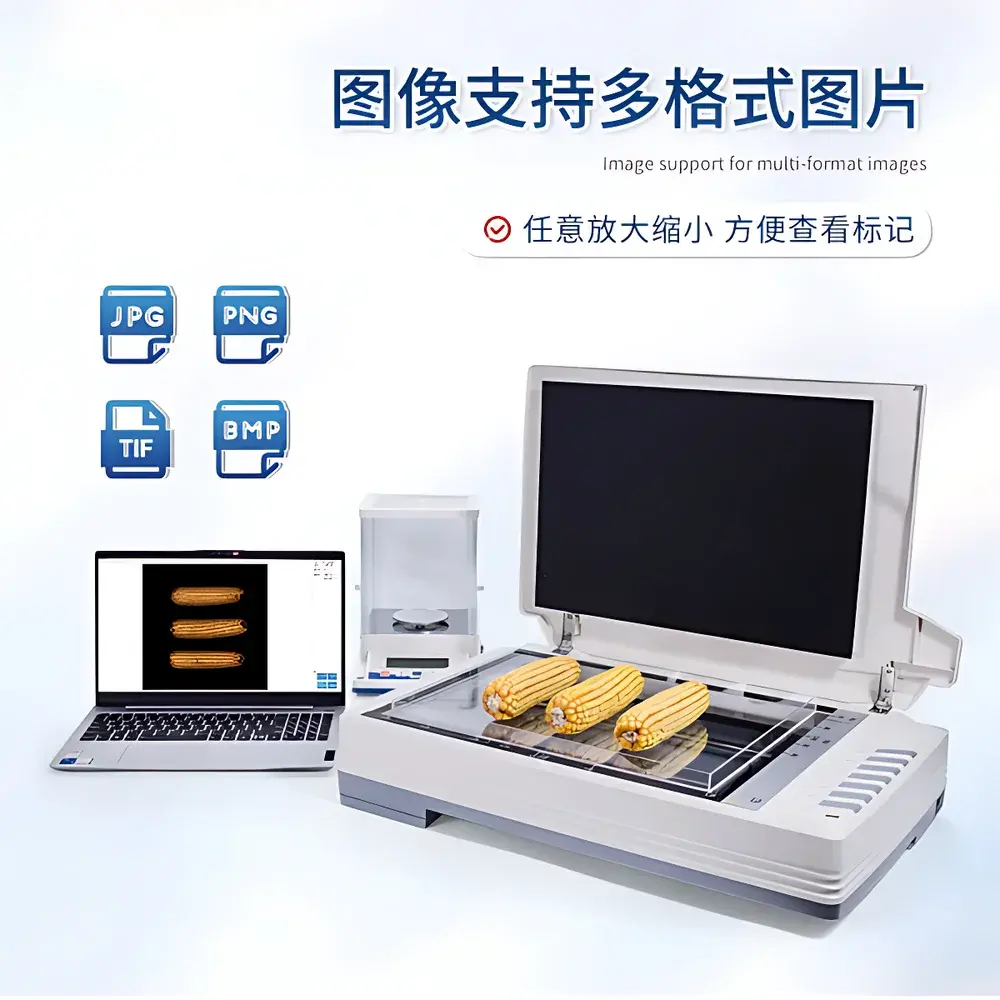



COMECAUSE IN-KZ04 Corn Seed Phenotyping & Cross-Sectional Analysis System
| Brand | COMECAUSE |
|---|---|
| Origin | Shandong, China |
| Manufacturer Type | Direct Manufacturer |
| Country of Origin | China |
| Model | IN-KZ04 |
| Price | USD 6,300 (FOB) |
Overview
The COMECAUSE IN-KZ04 Corn Seed Phenotyping & Cross-Sectional Analysis System is a high-throughput, image-based seed metrology platform engineered for precision morphometric characterization of maize and other small-grain crops. It operates on the principle of high-resolution digital image acquisition coupled with algorithm-driven pixel-level segmentation and geometric feature extraction. Unlike manual or semi-automated methods, the system delivers traceable, operator-independent quantification of structural traits critical to breeding programs, quality control, and regulatory seed certification. Designed specifically for agricultural research stations, seed testing laboratories, and crop science departments, the IN-KZ04 integrates optical imaging, gravimetric measurement, and relational data management into a single validated workflow compliant with international seed testing standards—including ISTA Rules and OECD Seed Schemes.
Key Features
- Multi-modal phenotyping: Simultaneous analysis of intact ears, transverse cross-sections, and individual seeds—supporting full-ear metrics (ear length, ear diameter, row number, kernel rows per ear, barren tip length, ear weight), cross-sectional morphology (rachis diameter, kernel count per section, kernel length/width/perimeter/area), and single-kernel traits (length, width, length-to-width ratio, perimeter, area, color via calibrated RGB values).
- High-fidelity imaging: A3-format flatbed scanner (M1 Plus UV-enhanced color model) delivering 1600 × 1600 dpi optical resolution, enabling sub-pixel edge detection and reliable segmentation even for irregularly shaped or overlapping kernels.
- Integrated mass measurement: RS232-connected precision balance automatically synchronizes weight data with image acquisition; software computes 100-seed weight (HW) and 1000-seed weight (KW) in real time using configurable unit conversion and statistical outlier rejection.
- Scalable throughput: Processes up to 10 whole ears, 35 cross-sections, or ~1000 kernels per imaging session; grain counting speed: 1500–4000 seeds/min with ≤ ±0.5% counting error (verified against manual recount); morphometric accuracy: ≤ ±0.3% deviation from reference calibrations.
- Dual-language UI & OS compatibility: Fully localized English/Chinese interface with one-click switching; native support for Windows 10 and later (64-bit); no virtualization or legacy OS dependencies.
Sample Compatibility & Compliance
The IN-KZ04 supports standardized phenotyping across major cereal and oilseed species—including Zea mays (maize), Oryza sativa (rice), Triticum aestivum (wheat), Glycine max (soybean), Brassica napus (rapeseed), Arachis hypogaea (peanut), and Sesamum indicum (sesame). All analytical routines adhere to trait definitions specified in ISTA Handbook Chapter 5 (Seed Morphology), ISO 5725 (accuracy and precision of measurement methods), and national seed quality standards (e.g., GB/T 3543.3–1995 in China). The system enables GLP-aligned documentation through timestamped audit logs, user ID tagging, and immutable export of raw images + metadata. Cloud synchronization (via device-locked authentication) ensures secure remote access to historical datasets without compromising local data sovereignty.
Software & Data Management
The proprietary COMECAUSE SeedAnalyzer v4.x software provides a deterministic, non-proprietary data pipeline: image import (JPG, TIFF, BMP, PNG), batch preprocessing (auto-crop, contrast normalization, background subtraction), AI-assisted kernel separation (including embryo-tip detection for maize), and trait-specific measurement engines. Every analysis generates a structured Excel (.xlsx) report with configurable field mapping, auto-appended timestamps, and optional path-based archival. All outputs include embedded calibration metadata (scanner DPI, balance serial ID, software version, operator ID) to satisfy traceability requirements under ISO/IEC 17025 and FDA 21 CFR Part 11 (when deployed with validated electronic signature modules). Raw images and processed masks are stored losslessly with embedded EXIF tags for forensic reanalysis.
Applications
- Maize breeding programs: Quantitative assessment of ear architecture (e.g., kernel row number stability under drought stress), kernel shape heritability studies, and selection index development.
- Seed certification labs: ISTA-compliant purity testing, germination sample preparation validation, and varietal identity verification via morphometric fingerprinting.
- Grain quality monitoring: Correlation of kernel dimensions (length/width ratio) with milling yield, breakage susceptibility, and nutritional density indices.
- Post-harvest physiology research: Time-series analysis of kernel shrinkage, moisture-induced dimensional change, and storage-related morphological drift.
- Regulatory submissions: Generation of auditable trait datasets supporting DUS (Distinctness, Uniformity, Stability) testing for PVP and plant variety protection applications.
FAQ
Does the system require external calibration standards?
No—the scanner and balance undergo factory calibration with NIST-traceable references; users perform routine verification using included ceramic calibration tiles and certified mass standards.
Can the software process images acquired from third-party scanners or microscopes?
Yes, provided input files meet minimum resolution (≥600 dpi) and format compatibility (TIFF/JPEG/BMP/PNG); however, optimal accuracy requires use of the bundled M1 Plus scanner due to integrated illumination geometry and spectral response profiling.
Is cloud data storage mandatory?
No—cloud sync is optional and disabled by default; all data remains locally unless explicitly uploaded via authenticated session.
What validation documentation is provided?
Each unit ships with a Certificate of Conformance, Factory Calibration Report, Software Validation Summary (covering image processing repeatability and weight correlation R² ≥ 0.999), and ISTA-aligned test protocols.
How is software updated and supported?
Firmware and application updates are delivered via encrypted HTTPS portal; technical support includes remote diagnostics, on-site service contracts, and annual IQ/OQ documentation packages for regulated environments.
Related Products





