
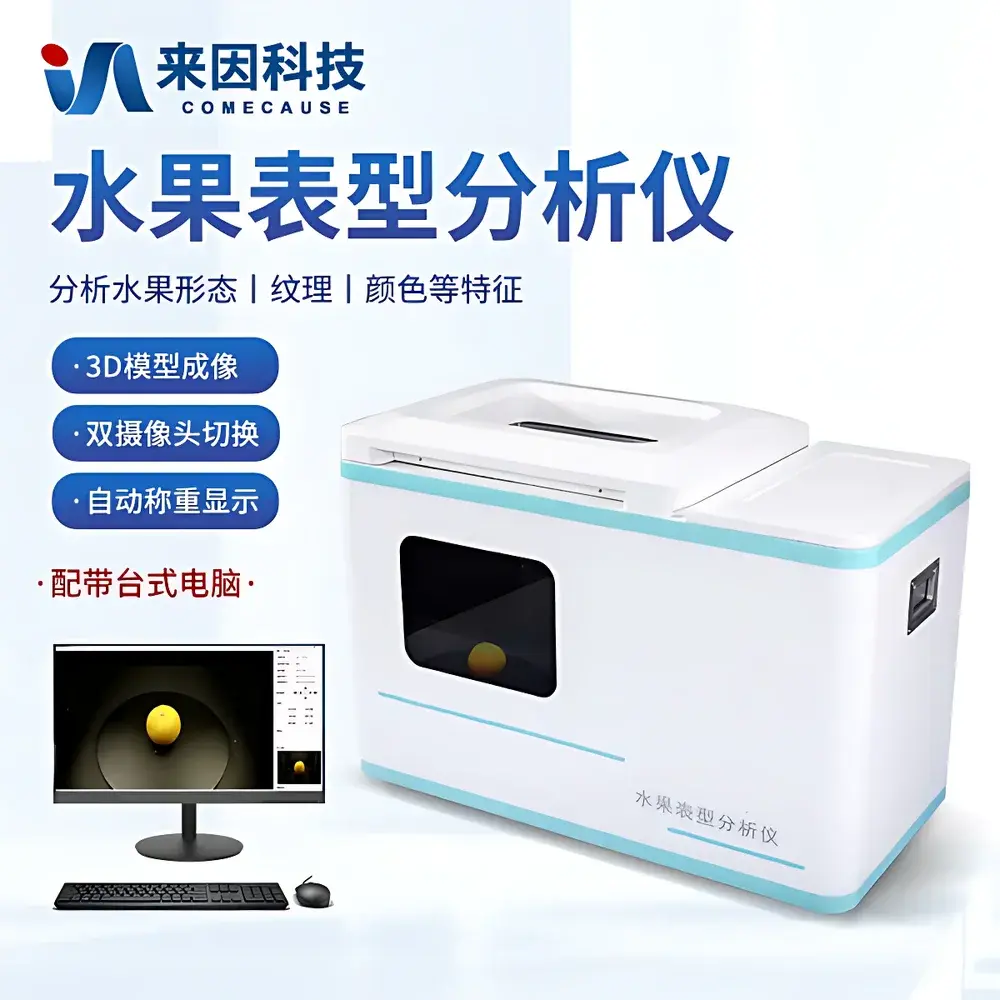
COMECAUSE IN/VistaFruit Citrus & Pome Fruit Phenotyping Analyzer
| Brand | COMECAUSE |
|---|---|
| Origin | Shandong, China |
| Manufacturer Type | Direct Manufacturer |
| Model | IN/VistaFruit |
| Price | USD 12,000 (FOB) |
| Dimensions (W×D×H) | 1006 × 506 × 718 mm |
| Weight | 62 kg |
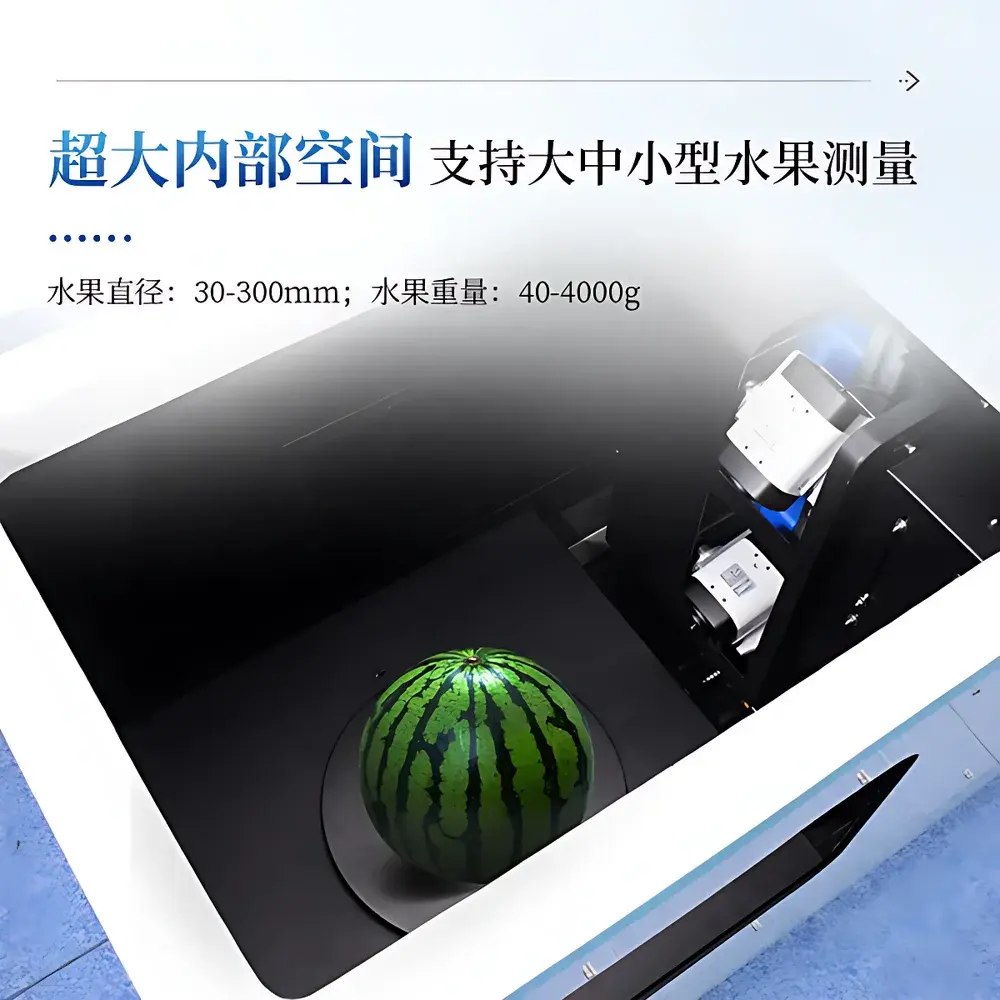
| Integrated Scale Range | 40–4000 g |
| Fruit Diameter Range | 30–300 mm |
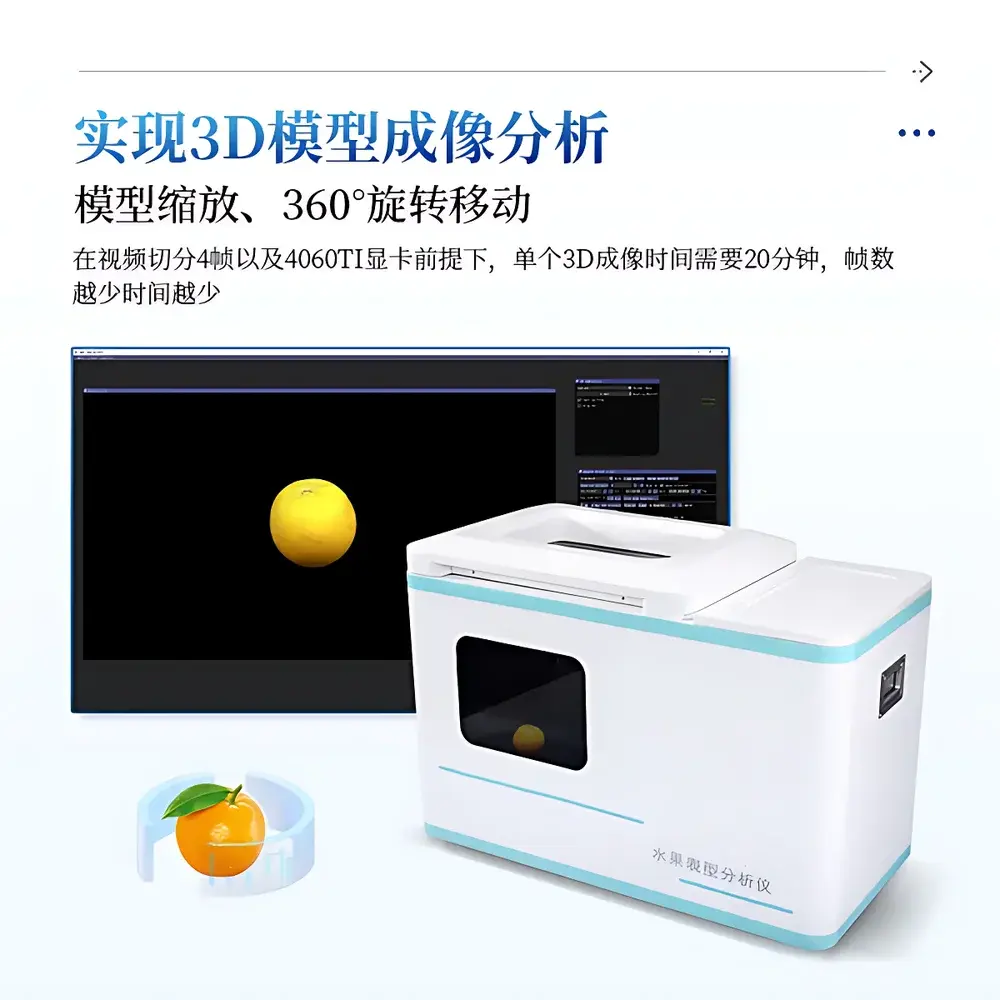
| 3D Reconstruction Engine | Multi-view AI-driven Gaussian Splatting |
| 2D Throughput | ≤1 min/sample |
| 3D Reconstruction Time (typ.) | 20 min/sample (RTX 4060 Ti, 4-frame input) |
| Software UI | English/Chinese Toggle |
| Native Resolution Support | Auto-adaptive to host display |
| System Bundle | Pre-installed on GeekPro-17 workstation (Intel i5-14400F, 16 GB RAM, 1 TB SSD, RTX 4060 Ti 8 GB, 27″ 2K monitor) |
Overview
The COMECAUSE IN/VistaFruit Citrus & Pome Fruit Phenotyping Analyzer is a benchtop, vision-based phenotyping system engineered for non-destructive, high-throughput quantitative assessment of morphological, chromatic, and textural traits in intact fruits—including citrus (e.g., oranges, grapefruits, tangerines), pomes (e.g., apples, pears), and other spherical to oblate fruit types (e.g., watermelons, melons, pomelos). It integrates multi-angle structured-light imaging with AI-accelerated 3D Gaussian Splatting reconstruction to generate dense, metrically calibrated point clouds and textured surface meshes. Unlike conventional 2D image analysis systems, IN/VistaFruit captures volumetric geometry and spatially registered surface properties—enabling true 3D shape descriptors (e.g., sphericity, form index, surface-area-to-volume ratio) alongside spectral reflectance-derived color spaces (CIELAB, HSV, grayscale) and second-order statistical texture features derived from Gray-Level Co-occurrence Matrices (GLCM) and Structural Similarity Index (SSIM). The system operates under ambient lab lighting conditions and requires no sample preparation, staining, or physical contact beyond placement on the integrated precision scale.
Key Features
- Integrated load cell (40–4000 g range) with real-time weight synchronization to analytical output
- Dual-camera imaging station with motorized pan-tilt-zoom control and software-configurable auto/manual focus
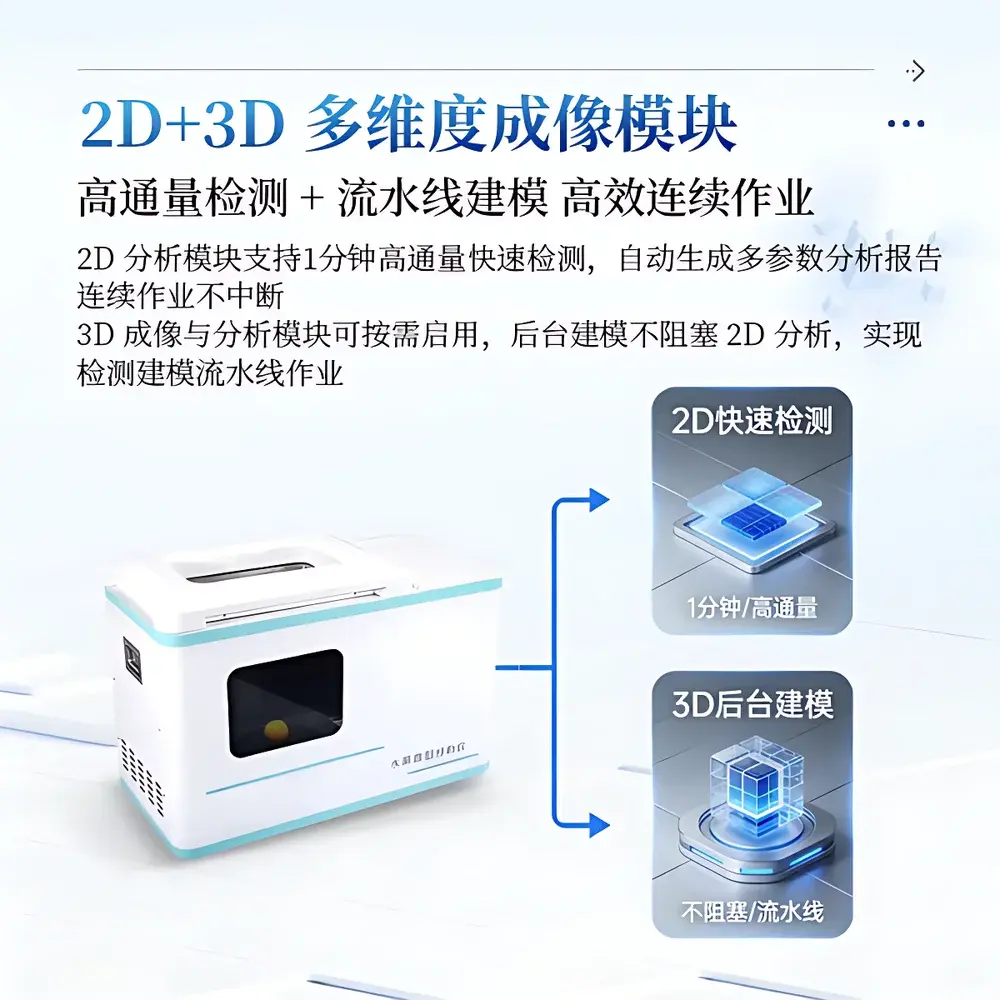
- Modular software architecture supporting concurrent 2D rapid screening (≤60 s/sample) and queued 3D modeling—ensuring uninterrupted workflow during high-volume trials
- AI-powered Gaussian Splatting pipeline optimized for fruit surface topology, delivering sub-millimeter geometric fidelity without meshing artifacts
- Comprehensive trait quantification across three orthogonal domains: morphology (volume, density, aspect ratio, shape coefficients), colorimetry (RGB, CIELAB L*a*b*, HSV, direct RGB mapping), and texture (Contrast, Correlation, Entropy, ASM, Homogeneity, Dissimilarity, Variance, Sum Variance, SSIM)
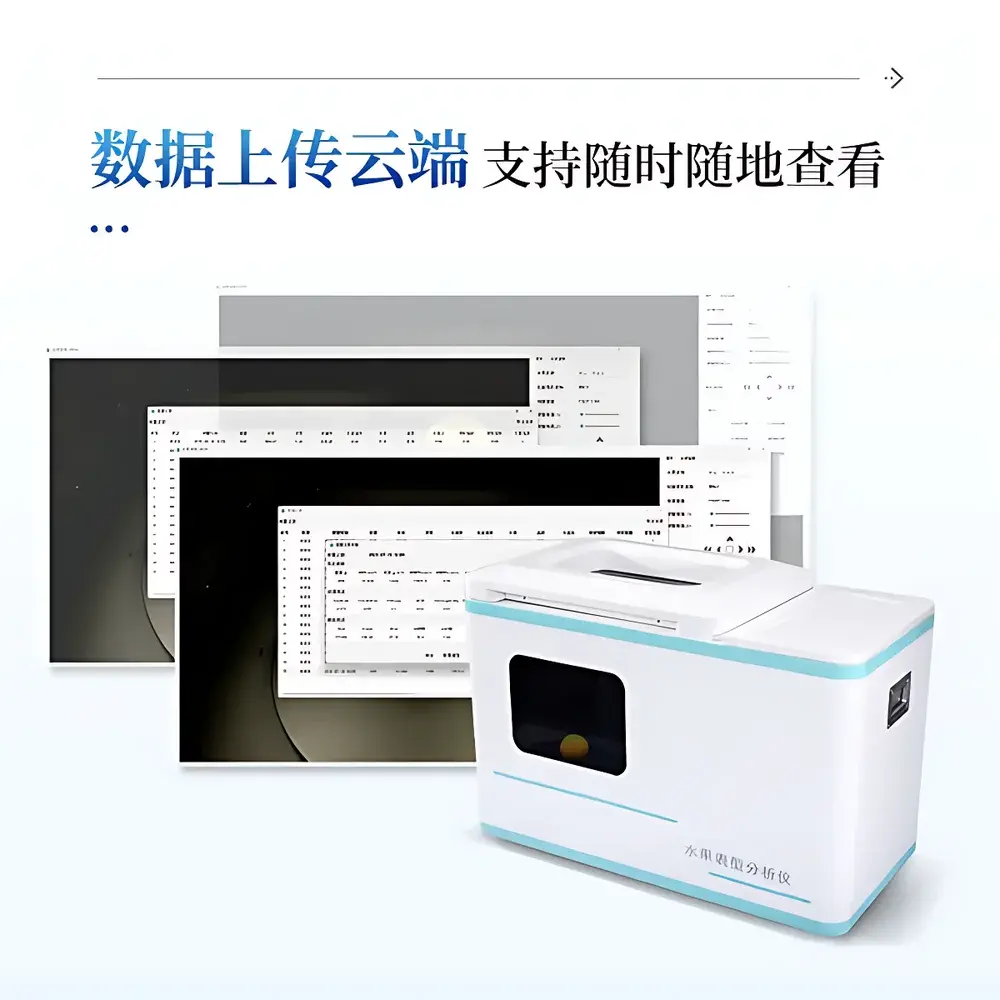
- Cloud-enabled data management with device-specific binding, encrypted upload, timestamped audit trail, and role-based access control
- Full-resolution adaptive GUI supporting native display scaling up to 27″ 2K monitors; one-click language toggle between English and Chinese
Sample Compatibility & Compliance
The IN/VistaFruit analyzer accommodates whole, uncut fruits ranging from 30 mm to 300 mm in maximum diameter and 40 g to 4000 g in mass—including but not limited to Citrus sinensis, Pyrus pyrifolia, Malus domestica, Cucumis melo, Citrullus lanatus, and Punica granatum. Its non-invasive optical design complies with ISO 9241-307 (Ergonomics of human-system interaction — Part 307: Analysis of user performance) for operator interface usability, and its data logging architecture supports GLP-compliant metadata capture (operator ID, timestamp, instrument ID, environmental notes). While not FDA-cleared as a medical device, the system meets general requirements for research-grade instrumentation under ISO/IEC 17025:2017 for testing laboratories, including traceable calibration of the integrated scale and documented uncertainty budgets for dimensional measurements.
Software & Data Management
The VistaFruit Suite v3.x runs natively on Windows 10/11 (64-bit) and leverages CUDA-accelerated inference for real-time 2D feature extraction and background-queued 3D reconstruction. All analytical outputs are stored in vendor-neutral HDF5 containers containing raw image stacks, calibrated point clouds, computed trait vectors, and embedded EXIF-style metadata. The software includes built-in validation checks for outlier detection (e.g., weight–volume density consistency), automatic QC flagging for motion blur or occlusion, and export options to CSV, JSON, and MATLAB .mat formats. Audit logs record all user actions—including parameter edits, result deletions, and cloud sync events—with immutable timestamps. For regulated environments, optional configuration enables 21 CFR Part 11-compliant electronic signatures and full audit trail export in PDF/A format.
Applications
- Pre-harvest maturity monitoring and post-harvest quality grading in breeding programs and commercial packing houses
- Quantitative trait locus (QTL) mapping studies correlating morphometric and textural phenotypes with genomic markers
- Postharvest physiology research on skin browning, shriveling, cracking, and wax degradation under controlled storage conditions
- Validation of non-destructive NIR or hyperspectral models by providing ground-truth 3D structural references
- Educational use in plant science curricula for teaching digital phenotyping principles, computer vision fundamentals, and multivariate trait analysis
FAQ
Does the system require external calibration standards or reference materials?
No—geometric calibration is performed automatically during startup using embedded fiducial patterns; color calibration uses factory-characterized LED illumination profiles traceable to NIST SRM 2035.
Can the 3D model be exported for use in third-party CAD or finite element analysis (FEA) software?
Yes—meshes are exportable in OBJ and PLY formats with vertex-normal and UV texture mapping preserved; point clouds support LAS and XYZ formats.
Is offline operation supported when cloud connectivity is unavailable?
Yes—full local storage, analysis, and report generation are available without internet; cloud sync resumes automatically upon reconnection.
What is the recommended maintenance schedule for optical components?
Lens cleaning with optical-grade methanol and lint-free wipes is advised after every 200 samples; annual recalibration of the integrated scale and camera alignment is recommended for GLP-aligned workflows.
How does the system handle fruits with high surface gloss or translucency (e.g., certain apple cultivars)?
Polarized multi-angle illumination and adaptive exposure bracketing minimize specular reflection artifacts; GLCM texture metrics are computed from desaturated luminance channels to reduce chromatic bias.




