
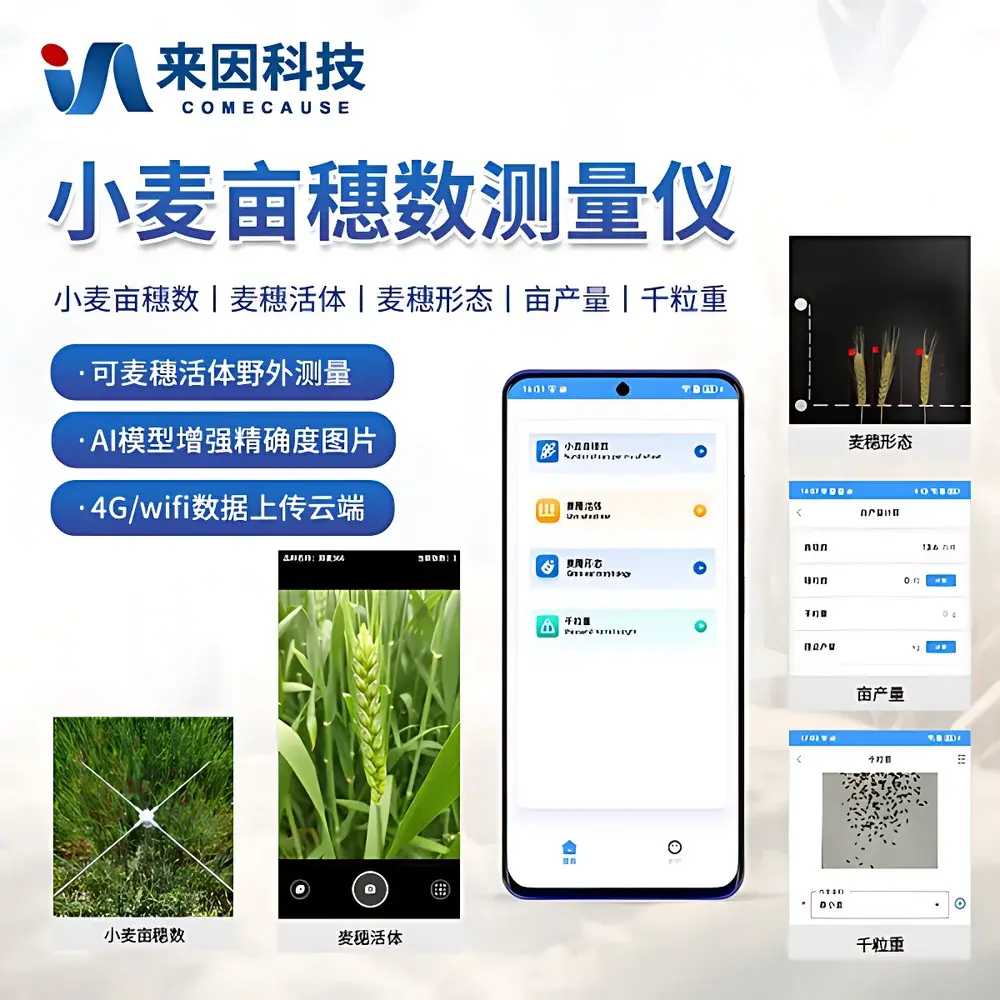
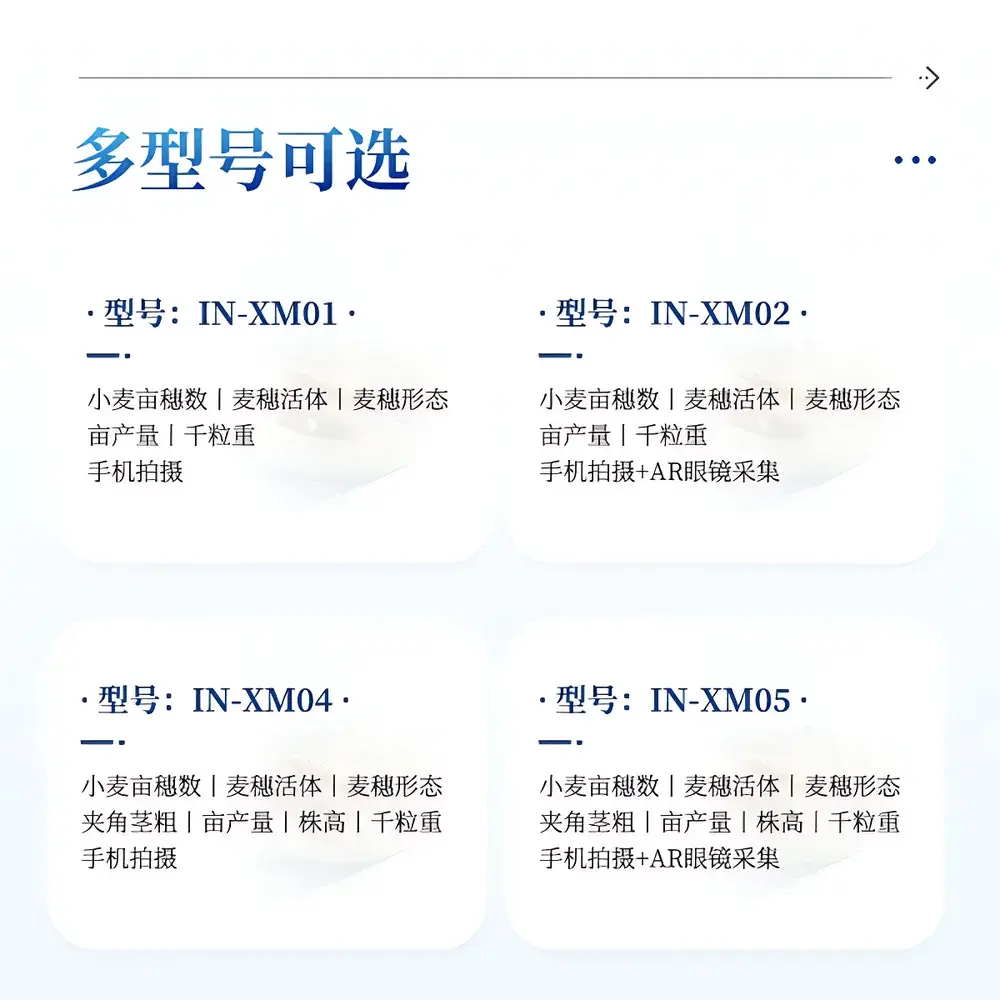


COMECAUSE IN-XM01 Wheat Panicle Density & Phenotyping Analyzer
| Brand | COMECAUSE |
|---|---|
| Model | IN-XM01 |
| Origin | Shandong, China |
| Manufacturer Type | Direct Manufacturer |
| Camera Resolution | 4000×3000 (dual-sensor: 50 MP + 12 MP) |
| Panicle Counting Accuracy | ≤ ±3% |
| Live-Field Panicle Detection Error | ±1% |
| Sample-Based Morphometric Error | ±1% |
| Adjustable Calibration Pole Height Range | 610–1120 mm & 1010–1920 mm |
| Measurement Speed | <3 sec/image |
| Data Export Format | Excel (.xlsx) with GPS metadata, timestamp, and image linkage |
| Cloud Sync | Wi-Fi/4G-enabled |
| Operating System | Android-based embedded UI with bilingual (EN/CN) toggle |
| Onboard Storage | 256 GB SSD |
| Field Deployment | No light shielding required |
Overview
The COMECAUSE IN-XM01 Wheat Panicle Density & Phenotyping Analyzer is a field-deployable, AI-powered imaging system engineered for non-destructive, high-throughput quantification of wheat panicle density (panicles per mu, equivalent to ~667 m²), panicle morphology, and grain yield proxies under real-world agronomic conditions. It operates on the principle of computer vision–guided object detection, leveraging dual high-resolution CMOS sensors (50 MP main + 12 MP auxiliary) and convolutional neural networks trained on geographically diverse wheat germplasm across multiple growth stages—from mid-grain filling to pre-harvest maturity. Unlike manual or semi-automated counting methods subject to observer fatigue and inter-rater variability, the IN-XM01 delivers standardized, auditable outputs compliant with FAO-recommended protocols for crop phenotyping. Its architecture supports both live-field acquisition (no calibration board required) and controlled-lab sampling (with integrated reference backplate), enabling consistent data generation across experimental trials, breeding nurseries, and extension monitoring programs.
Key Features
- AI-enhanced panicle segmentation and counting using domain-specific deep learning models validated against ground-truth manual counts across >12,000 field images from North China Plain, Yellow-Huai-Hai region, and Sichuan Basin trials.
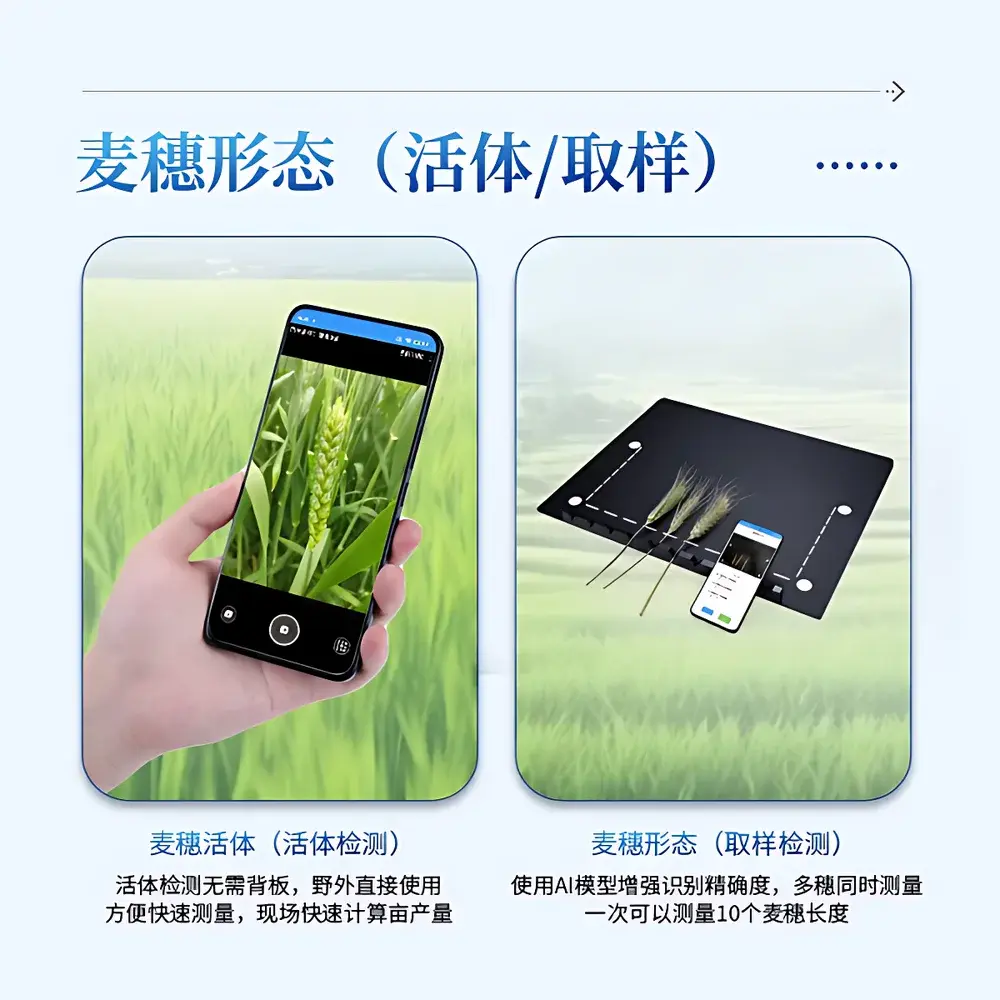
- Dual-mode operation: Live-field mode enables direct in-canopy imaging without background substrates; sample mode employs an optically optimized black matte acrylic backplate (500 × 400 × 5 mm) for precise morphometric analysis of excised panicles.
- Real-time perspective correction and automatic scale calibration—eliminates manual ruler placement and compensates for oblique camera angles during handheld capture.
- On-device batch processing of up to 60 images per session, with full metadata embedding (GPS coordinates, UTC timestamp, device ID, lighting condition index).
- Embedded Android OS with responsive 7-inch capacitive touchscreen; intuitive workflow navigation and one-tap language switching between English and Chinese interfaces.
- Robust environmental adaptability: auto white balance adjustment ensures stable color fidelity under variable solar irradiance (10,000–100,000 lux), cloud cover, and partial shade—no external diffusers or enclosures required.
- Integrated 256 GB onboard storage with encrypted local database; supports offline operation and deferred cloud synchronization upon network reconnection.
Sample Compatibility & Compliance
The IN-XM01 is validated for Triticum aestivum L. cultivars grown under standard agronomic management across temperate and semi-arid agroecosystems. It accommodates panicle architectures ranging from compact (e.g., ‘Zhengmai 9023’) to lax (e.g., ‘Jimai 22’), including awned and awnless types. For morphometric analysis, the system accepts freshly harvested or air-dried panicles 5–25 cm in length. All image acquisition and processing workflows adhere to ISO 20672-1:2021 (Plant phenotyping — Vocabulary and general principles) and align with the MIAPPE v1.1 (Minimum Information About a Plant Phenotyping Experiment) reporting standard. Raw image datasets and derived metrics are structured to support GLP-compliant audit trails when deployed in certified breeding programs or national variety testing networks.
Software & Data Management
Data acquisition, annotation, and export are managed via the proprietary COMECAUSE FieldPheno Suite—an embedded application supporting DICOM-compatible image ingestion, hierarchical project tagging, and role-based user access control. Analytical outputs include: (i) panicle density per mu (converted from measured area via dynamic calibration pole recognition), (ii) mean panicle length, spikelet count, and rachis internode spacing (sample mode only), (iii) estimated thousand-kernel weight (TKW) derived from pixel-scale grain clustering algorithms (±2% error; correctable to ±0.5% using lab-validated TKW calibration curves). All reports are exportable as ISO/IEC 27001-aligned Excel files containing embedded thumbnails, spatial coordinates, and version-stamped processing logs. Optional integration with third-party LIMS or Breeding Management Systems (BMS) is available via RESTful API with OAuth 2.0 authentication—fully compatible with USDA-ARS, CIMMYT, and ICARDA digital phenotyping infrastructure requirements.
Applications
- High-resolution mapping of quantitative trait loci (QTL) associated with panicle architecture and yield components in biparental and multiparent advanced generation inter-cross (MAGIC) populations.
- Rapid field screening of elite lines during early-generation selection (EGS), reducing cycle time by ≥40% compared to traditional plot-level harvest assays.
- Validation of remote sensing-derived yield predictions through ground-truthing at sub-field resolution (≤1 m² sampling units).
- Longitudinal monitoring of canopy development dynamics in response to nitrogen rate trials, drought stress treatments, or fungicide efficacy studies.
- Supporting national agricultural statistics bureaus in generating spatially explicit yield forecasts aligned with FAO’s CropWatch methodology.
FAQ
What growth stage is optimal for panicle density measurement?
The IN-XM01 achieves highest accuracy during late grain filling to soft dough stage (Zadoks scale Z85–Z87), when panicles are fully emerged, turgid, and minimally occluded by flag leaves.
Does the system require internet connectivity for basic operation?
No—image capture, on-device AI inference, and local data storage function entirely offline. Cloud upload and remote dashboard access require Wi-Fi or 4G.
Can the device be used for other small-grain cereals such as barley or oats?
While trained primarily on wheat, the underlying detection architecture supports transfer learning; custom model fine-tuning services are available for non-wheat Triticeae species.
How is measurement traceability ensured for regulatory submissions?
Each exported dataset includes cryptographic hash signatures, device firmware version, model training epoch ID, and raw image EXIF metadata—satisfying documentation requirements under OECD Test Guidelines and national seed certification protocols.
Is the calibration pole included with the instrument?
Yes—the dual-range telescoping calibration pole (1000 × 1000 × [610–1120] mm / [1010–1920] mm) is supplied as standard equipment, manufactured from anodized aluminum with laser-etched metric graduations.



