
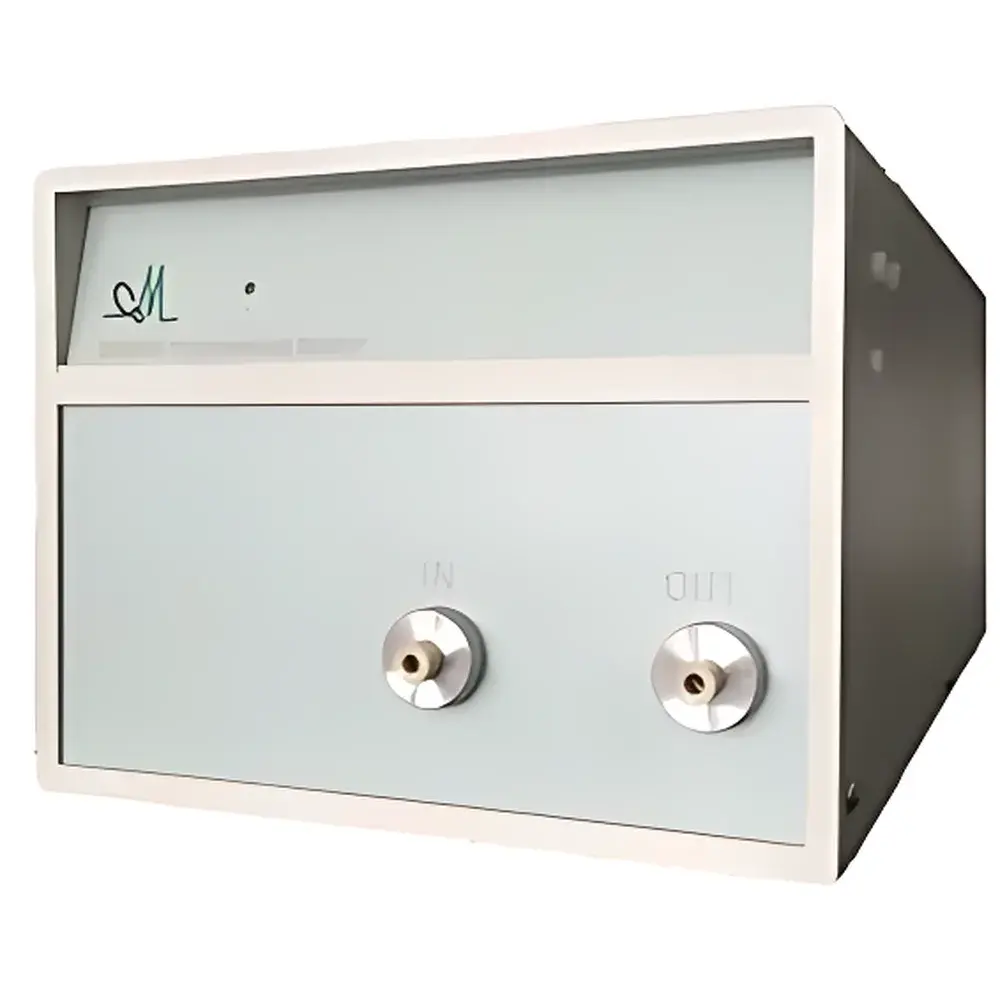
CoMetro 6000 Photochemical Derivatization System
| Brand | CoMetro |
|---|---|
| Origin | Imported |
| Model | 6000 Photochemical Derivatization System |
| Derivatization Flow Rate | 3 mL/min |
| Reaction Coil Material | Stainless Steel |
| Light Source | Cold UV Lamp |
| Wavelength | 254 nm |
| Output Power | 8 mW |
| Illumination Geometry | Köhler Illumination |
| Temperature Control | Forced-Air Cooling |
| Application | Post-Column Derivatization for HPLC |
Overview
The CoMetro 6000 Photochemical Derivatization System is a dedicated post-column derivatization device engineered for high-sensitivity liquid chromatographic analysis of mycotoxins—particularly aflatoxin B₁ and G₁—and sulfonamide antibiotics. It operates on the principle of controlled ultraviolet (UV) photolysis in a flow-through stainless steel reaction coil, enabling on-line, reagent-free photochemical activation of analytes immediately after elution from the HPLC column and prior to fluorescence detection. Unlike chemical derivatization methods requiring pumps, mixing tees, or reagent reservoirs, the 6000 system leverages 254 nm UV irradiation to induce structural modification—such as photooxidation of aflatoxin B₁ to its highly fluorescent dialkoxy derivative—thereby amplifying native fluorescence quantum yield without altering chromatographic resolution. Its compact, modular design integrates seamlessly into standard HPLC workflows, occupying minimal footprint while maintaining full compatibility with both analytical and preparative-scale systems.
Key Features
- Reagent-free operation: Eliminates need for hazardous chemical derivatizing agents (e.g., bromine, iodine, or o-phthalaldehyde), reducing operator exposure, waste disposal burden, and method development complexity.
- Köhler illumination geometry: Ensures uniform, collimated 254 nm UV flux across the entire internal surface of the stainless steel reaction coil—maximizing photon delivery efficiency and reaction reproducibility.
- Forced-air thermal management: Maintains stable coil temperature during extended operation, preventing thermal degradation of labile analytes or unintended side reactions induced by localized heating.
- Zero dead-volume integration: Direct tubing connection between column outlet and detector inlet preserves chromatographic peak shape, minimizes band broadening, and avoids retention time drift.
- Stainless steel reaction coil: Chemically inert, pressure-rated, and compatible with common HPLC mobile phases including aqueous buffers, acetonitrile, and methanol mixtures up to 10,000 psi.
- Plug-and-play compatibility: Designed for immediate integration with all major HPLC platforms (Agilent, Waters, Shimadzu, Thermo Fisher) without hardware modification or firmware updates.
Sample Compatibility & Compliance
The CoMetro 6000 is validated for use in regulated laboratories performing quantitative analysis per AOAC Official Method 2005.08 (aflatoxins in feeds and foods) and USP (sulfonamides in pharmaceutical dosage forms). Its reagent-free, closed-system architecture supports GLP- and GMP-compliant workflows by eliminating uncontrolled reagent addition points and minimizing opportunities for carryover or cross-contamination. The system’s fixed-wavelength UV source complies with IEC 61000-4-3 (electromagnetic immunity) and meets CE marking requirements for laboratory equipment. While not intrinsically compliant with FDA 21 CFR Part 11, it interfaces transparently with LIMS and CDS platforms that provide audit-trail-enabled data capture, electronic signatures, and version-controlled method storage.
Software & Data Management
The 6000 system operates autonomously without embedded firmware or proprietary software. All operational parameters—including lamp status, cumulative irradiation time, and ambient coil temperature—are monitored via external sensors integrated into the host HPLC data system. Chromatographic data generated using the derivatizer are fully traceable within standard CDS environments (e.g., Empower, Chromeleon, OpenLab). Method files retain full metadata: derivatization step annotation, lamp age tracking (based on manufacturer-specified 2,000-hour service life), and calibration history linked to instrument logbooks. For laboratories implementing electronic records, raw chromatograms, integration reports, and system suitability test results are archived in accordance with ALCOA+ principles (Attributable, Legible, Contemporaneous, Original, Accurate, Complete, Consistent, Enduring, Available).
Applications
- Quantification of aflatoxin B₁ and G₁ in cereals, nuts, spices, and dairy products at sub-ppb levels using HPLC-FLD, per EU Commission Regulation (EC) No 401/2006 and ISO 16050.
- Determination of sulfonamide residues in animal tissues and honey following multi-residue LC-MS/MS screening, where photochemical enhancement improves signal-to-noise ratio for low-abundance analogs (e.g., sulfadiazine, sulfamethoxazole).
- Analysis of fumonisins and ochratoxin A in maize and wine matrices when coupled with immunoaffinity cleanup and reversed-phase HPLC.
- Method transfer support for contract testing laboratories seeking robust, low-maintenance alternatives to electrochemical or enzymatic post-column reactors.
- Academic research applications involving photoinduced derivatization kinetics studies, where precise control over UV fluence and residence time enables mechanistic investigation of photolytic pathways.
FAQ
Does the 6000 system require routine lamp alignment or optical recalibration?
No. The Köhler illumination design is factory-aligned and sealed; no user-accessible optics require adjustment during normal operation.
Can the stainless steel reaction coil be replaced in-house?
Yes. The coil is a field-replaceable component with standardized 1/16″ OD stainless tubing and Swagelok® end fittings—no special tools required.
Is the 6000 compatible with UHPLC systems operating above 600 bar?
Yes. The reaction coil is rated to 1000 bar; however, optimal residence time at ultra-high flow rates (95% derivatization efficiency.
What is the typical lamp lifetime under continuous operation?
The cold UV lamp is rated for 2,000 hours of continuous use at nominal output; performance decay is gradual and linear, allowing predictive maintenance scheduling.
Does photochemical derivatization interfere with mass spectrometric detection?
Not inherently—the 6000 is typically used with fluorescence detection; however, if interfaced with LC-MS, the photoproducts must be confirmed for ionization efficiency and fragmentation stability under ESI or APCI conditions.





