
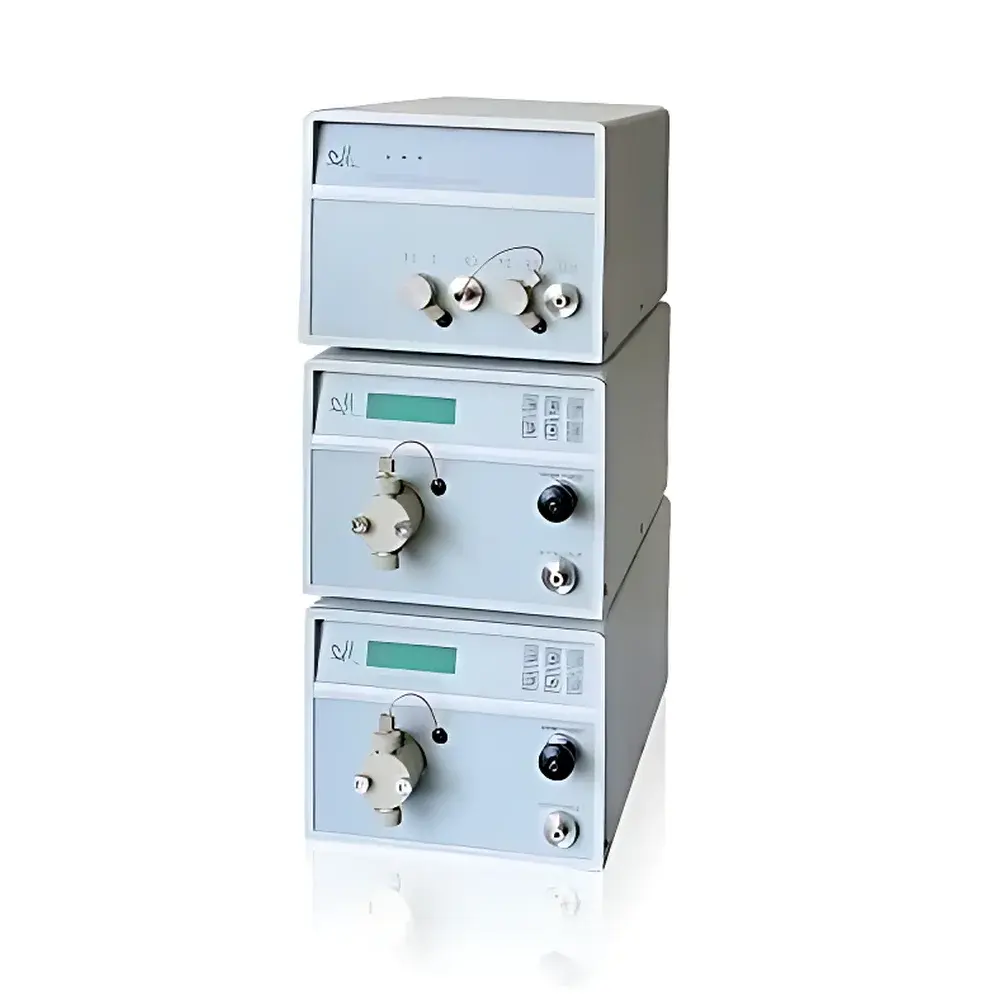
CoMetro 6000 Series Post-Column Derivatization System
| Brand | CoMetro |
|---|---|
| Origin | Imported |
| Model | CoMetro 6000 Series |
| Temperature Range | Ambient +10 °C to 150 °C |
| Derivatization Reagent Flow Rate | 0.001–10 mL/min |
| Reaction Coil Material | PEEK |
Overview
The CoMetro 6000 Series Post-Column Derivatization System is a precision-engineered, modular chromatographic accessory designed for high-sensitivity detection of analytes with poor native chromophoric or fluorophoric properties. Operating on the principle of post-separation chemical derivatization—where reactive reagents are introduced into the eluent stream immediately after column effluent exit—the system enables enhanced detection selectivity and sensitivity in HPLC and UHPLC workflows. By coupling thermally controlled reaction modules with chemically inert PEEK fluidic pathways, the 6000 Series ensures minimal analyte degradation, low carryover, and reproducible reaction kinetics across diverse applications including amino acid profiling, pesticide residue analysis (e.g., carbamates), mycotoxin quantification (aflatoxins, deoxynivalenol), and therapeutic drug monitoring (e.g., erythromycin, voglibose). Its architecture conforms to fundamental requirements for GLP-compliant laboratories, supporting trace-level quantitation under regulated environments.
Key Features
- Modular reactor design accommodating single or dual reaction cores—enabling sequential heated and ambient-temperature derivatization steps within one integrated platform.
- Front-panel digital interface with real-time display of setpoint/actual temperature per reactor zone, reagent flow rate, system pressure, and pressure limits.
- PEEK-only fluidic path throughout—including pump heads, reaction coils (0.15 mL / 0.5 mL / 1.5 mL volume options), and all fittings—ensuring exceptional chemical resistance and compatibility with aggressive derivatization reagents (e.g., OPA, ninhydrin, ortho-phthalaldehyde).
- Thermally stable reaction chamber with ±0.4 °C temperature reproducibility and ±1 °C accuracy across the full operating range (ambient +10 °C to 150 °C); safety cutoff at 160 °C.
- Derivatization pumps featuring stepper-motor-driven precision metering, built-in PEEK exhaust valves, automatic online seal-washing cycles, and pressure feedback control up to 4000 PSI.
- RS232 serial interface for bidirectional remote control and monitoring—fully compatible with third-party chromatography data systems (CDS) and LIMS integration.
- Tool-free reactor core replacement using only two standardized PEEK union connections—minimizing downtime and cross-contamination risk.
Sample Compatibility & Compliance
The CoMetro 6000 Series supports derivatization of primary and secondary amines, hydrazides, aldehydes, and other nucleophilic functional groups commonly found in amino acids, β-lactam antibiotics, biogenic amines, and environmental toxins. Its PEEK-based construction complies with USP , ISO 10993-1 (biocompatibility), and ASTM D5275 (HPLC system compatibility testing). The system meets essential criteria for method validation under ICH Q2(R2), including demonstrated flow precision (≤0.2% RSD) and volumetric accuracy (±1%). For regulated laboratories, audit trails for temperature and flow parameter changes can be logged externally via RS232, supporting alignment with FDA 21 CFR Part 11 requirements when paired with compliant CDS software.
Software & Data Management
While the 6000 Series operates as a hardware-integrated peripheral without proprietary software, its RS232 interface enables seamless command-and-control integration with major chromatography platforms (e.g., Thermo Chromeleon, Waters Empower, Agilent OpenLab). All operational parameters—including reactor temperature setpoints, derivatization pump flow rates, pressure thresholds, and status flags (e.g., “Ready”, “Heating”, “Error”)—are accessible via ASCII protocol commands. Users may implement custom scripting (Python, LabVIEW) or configure SCADA-style dashboards for centralized monitoring. Event logs generated by external controllers satisfy ALCOA+ principles when archived with time-stamped metadata and user authentication.
Applications
- Amino acid and taurine analysis in clinical serum, infant formula, and hydrolyzed protein samples.
- Carbamate pesticide residue quantification in food commodities per AOAC 2007.01 and EPA Method 531.1.
- Glyphosate, paraquat, and diquat detection in water and soil extracts following EPA Method 547.1.
- Aflatoxin B1/B2/G1/G2 and ochratoxin A determination in cereals and nuts per EU Commission Regulation (EC) No 401/2006.
- Neomycin, gentamicin, and monensin assays in animal feed and pharmaceutical intermediates.
- Voglibose and erythromycin content verification in dosage forms per USP monographs.
- Newborn screening for phenylketonuria (PKU) and maple syrup urine disease (MSUD) using tandem LC-FLD workflows.
FAQ
What types of derivatization chemistries are supported?
The system is compatible with o-phthalaldehyde (OPA), fluorescamine, ninhydrin, dansyl chloride, and chloramine-T-based reactions—provided reagents are miscible with the mobile phase and stable under specified thermal conditions.
Can the system be used with UHPLC pressures up to 1300 bar?
No—the maximum rated pressure is 4000 PSI (≈275 bar); it is intended for conventional HPLC and mid-pressure UHPLC configurations.
Is the reaction coil volume adjustable during operation?
Reaction coil volumes (0.15 mL, 0.5 mL, 1.5 mL) are fixed per installed module; switching requires manual replacement but no tools or recalibration.
Does the system support gradient-compatible derivatization?
Yes—its flow path design minimizes band broadening and maintains reaction stoichiometry across solvent composition gradients typical in reversed-phase separations.
How is temperature stability verified during routine use?
Built-in NTC thermistors provide continuous feedback; users may validate performance annually using traceable PT100 reference probes per ISO/IEC 17025 guidelines.
Related Products






