
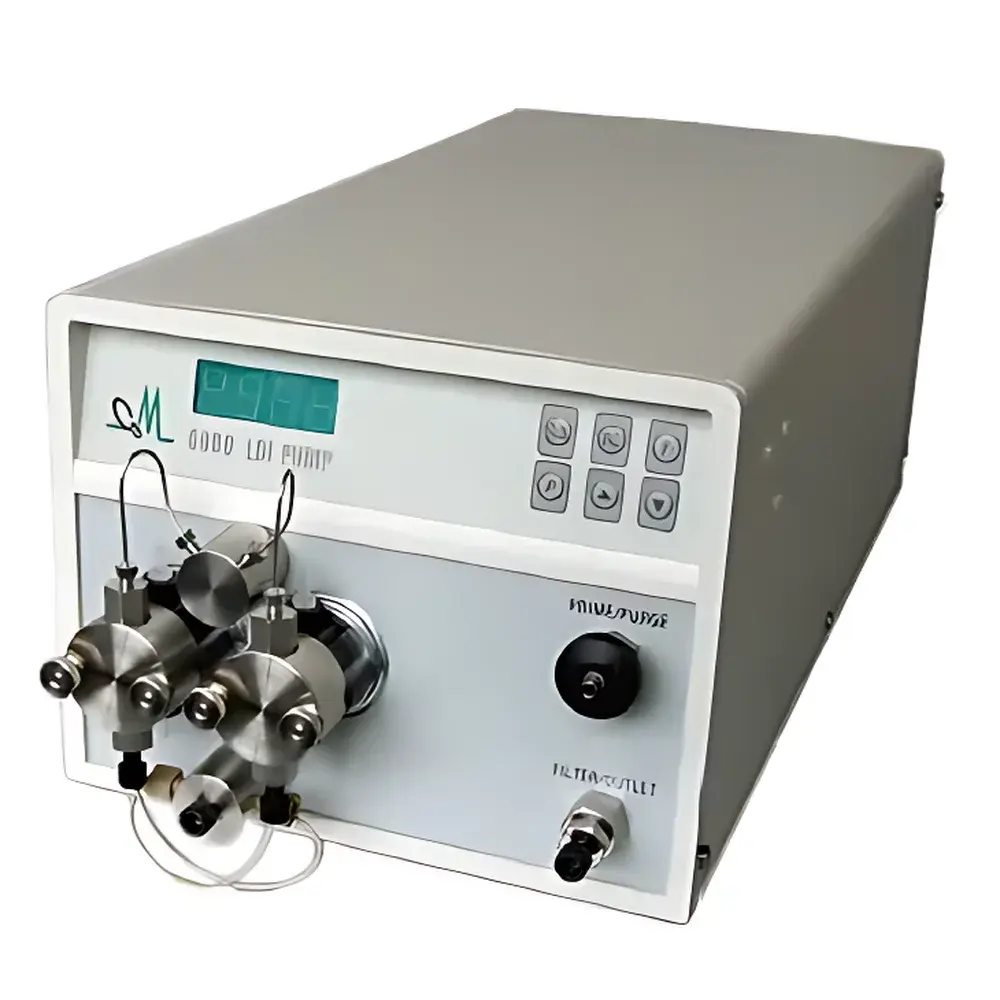
CoMetro CP-LDI High-Pressure Constant Flow Prep Pump
| Brand | CoMetro |
|---|---|
| Model | CP-LDI Pump |
| Flow Rate | 10 mL/min |
| Maximum Pressure | 6000 psi |
| Flow Accuracy | ±1% |
| Flow Precision | 0.1% RSD |
| Pump Head Configuration | Parallel Dual Heads |
| Pressure Units | psi / MPa / bar |
| Control Modes | Front-panel keypad, PC via RS-232/USB, or analog input (0–5 V / 4–20 mA) |
| Compressibility Compensation | Yes |
| Auto-Purge & Solvent Flush | Yes |
| Gradient Capability | Up to 4-pump modular configuration supported |
Overview
The CoMetro CP-LDI High-Pressure Constant Flow Prep Pump is an engineered solution for preparative and semi-preparative liquid chromatography applications requiring precise, stable, and reproducible solvent delivery under elevated backpressure conditions. Based on dual-plunger reciprocating pump architecture with active pressure feedback control, the CP-LDI operates on the principle of positive displacement with real-time flow correction via integrated pressure transduction and motor-speed modulation. Its design conforms to core engineering requirements for high-pressure LC systems—specifically, consistent volumetric output across variable system resistance (e.g., packed columns, viscous mobile phases, or temperature-induced viscosity shifts), minimal pulsation (<0.5% RMS), and long-term mechanical stability under continuous operation. The pump is not intended for analytical-scale UHPLC but targets robustness in purification workflows where flow integrity directly impacts fraction purity, yield consistency, and column lifetime.
Key Features
- Dual parallel plunger heads with synchronized cam-driven actuation ensure redundancy, reduced pulsation, and extended service intervals between maintenance cycles.
- Integrated piezoresistive pressure sensor with closed-loop feedback enables dynamic adjustment of motor speed to maintain setpoint flow within ±1% accuracy—even during gradient elution or sudden backpressure fluctuations.
- Compressibility compensation algorithm accounts for solvent compressibility (especially critical for acetonitrile/water mixtures above 2000 psi), minimizing flow deviation at high pressure.
- Front-panel LED display with adjustable brightness supports remote readability up to 3 meters; displays real-time flow rate (mL/min), actual system pressure (psi/MPa/bar), and status indicators for purge, error, or limit alarms.
- Multi-mode control interface: local keypad programming, RS-232/USB communication for integration into third-party chromatography data systems (CDS), and analog input compatibility for external process controllers.
- Modular scalability: Multiple CP-LDI units can be synchronized (2-, 3-, or 4-pump configurations) to enable binary, ternary, or quaternary gradient formation without external mixing valves.
- Automated solvent flush routine—triggered manually or scheduled—circulates cleaning solvent through pump heads and check valves to prevent salt crystallization and seal degradation when using aqueous buffers.
Sample Compatibility & Compliance
The CP-LDI is compatible with common HPLC-grade organic solvents (acetonitrile, methanol, THF), aqueous buffers (phosphate, acetate, ammonium formate), and mildly corrosive mobile phases (0.1% TFA, up to pH 2–10). Wetted materials include sapphire-ruby check valves, stainless steel 316L pump heads, PEEK tubing interfaces, and fluoropolymer seals—ensuring chemical resistance and low metal leaching. While not certified to ISO 9001 or FDA 21 CFR Part 11 out-of-the-box, its audit-ready logging capability (via optional CDS integration), user-accessible parameter change history, and configurable alarm thresholds support GLP/GMP-aligned method validation protocols. It meets mechanical safety standards per IEC 61010-1 for laboratory equipment and complies with electromagnetic compatibility (EMC) directives EN 61326-1.
Software & Data Management
The CP-LDI supports ASCII-based command protocol over RS-232 or virtual COM port (USB), enabling seamless integration with open-architecture chromatography platforms such as OpenLab CDS, Chromeleon, or custom Python/LabVIEW applications. Firmware includes non-volatile memory for storing up to 16 user-defined methods—including flow profiles, pressure limits, and purge sequences—with timestamped execution logs exportable as CSV. Optional firmware upgrade adds Ethernet TCP/IP connectivity and SNMP monitoring for centralized lab instrument management systems. All parameter changes are logged with operator ID (if configured), timestamp, and pre/post values—satisfying traceability requirements for regulated environments.
Applications
- Semi-preparative and preparative reversed-phase purification of pharmaceutical intermediates, natural products, and synthetic peptides.
- Scale-up method transfer from analytical to 10–50 mm ID columns, maintaining linear velocity and resolution fidelity.
- Multi-solvent gradient synthesis support for combinatorial library purification and reaction mixture cleanup.
- Continuous-flow chemistry setups requiring stable reagent delivery at 2000–6000 psi, including supercritical fluid-assisted reactions.
- Quality control labs performing forced degradation studies where precise buffer/solvent ratios must be maintained across extended runs.
FAQ
What is the maximum recommended operating pressure for continuous use?
The CP-LDI is rated for continuous operation up to 6000 psi (414 bar) at ambient temperatures (15–35 °C); derating is advised above 40 °C.
Can the pump be used with aggressive solvents like DMSO or chlorinated hydrocarbons?
DMSO is compatible with standard wetted materials; chlorinated solvents (e.g., CH₂Cl₂, CHCl₃) require optional Hastelloy pump heads and Viton-free seals—contact technical support for configuration guidance.
Is gradient delay volume minimized in dual-pump configurations?
Yes—the internal flow path between pump heads and mixer inlet is optimized to <150 µL, reducing dwell volume and improving gradient fidelity for early-eluting compounds.
Does the CP-LDI support pulse-free flow for mass spectrometry coupling?
While not a zero-pulsation syringe pump, its dual-head synchronization and active damping reduce pulsation amplitude to <0.3% RMS—sufficient for most ESI-MS interfaces when paired with a passive damper.
How often should the plunger seals be replaced under typical preparative usage?
With regular solvent flushing and avoidance of particulate-contaminated mobile phases, seal replacement interval exceeds 3000 hours of operation; a diagnostic mode monitors seal wear via pressure decay rate during hold tests.



