
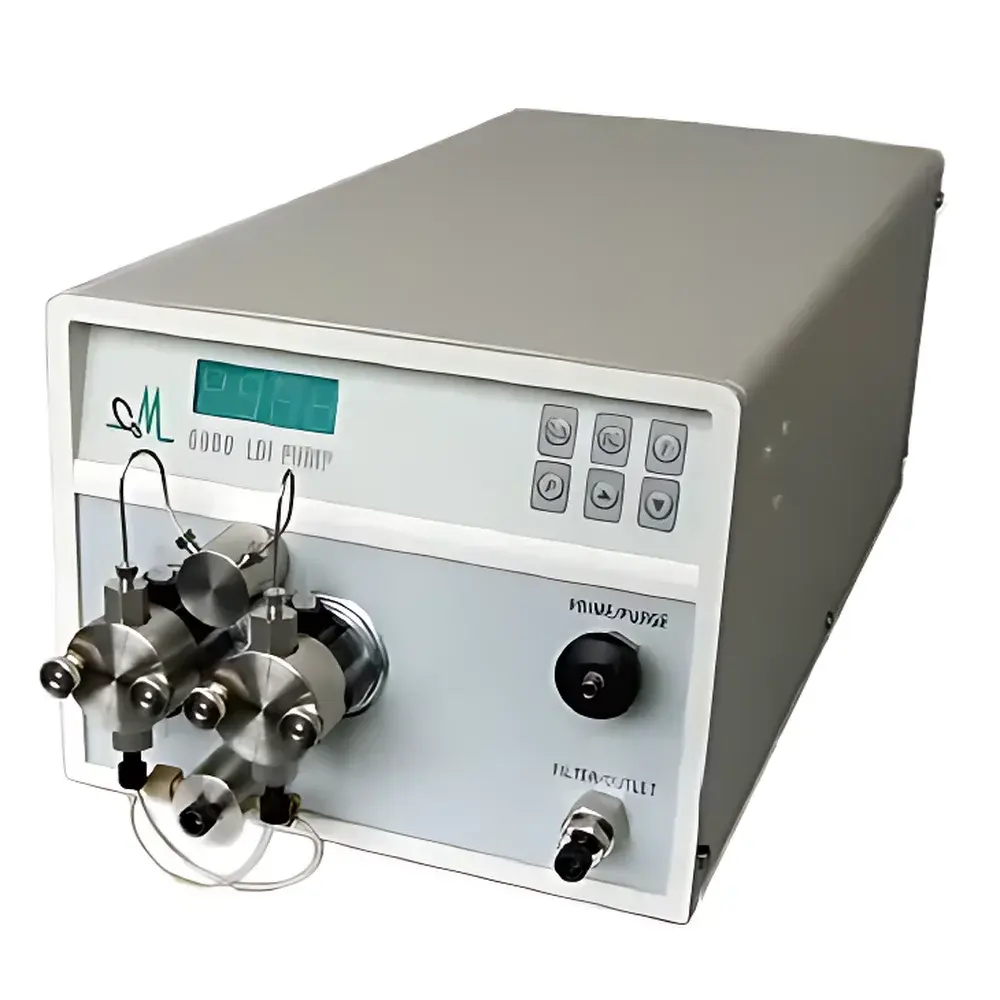
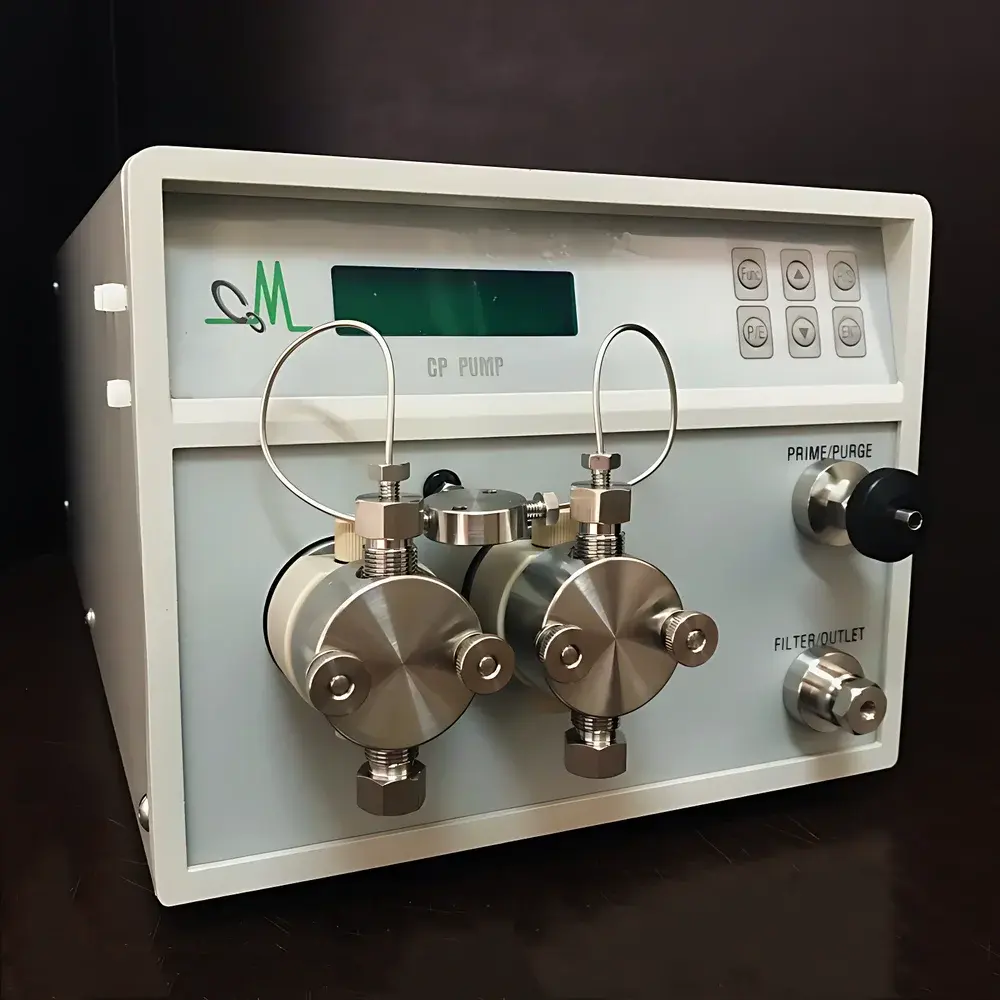
CoMetro CP-LDI High-Pressure Dual-Piston Constant Flow Pump
| Brand | CoMetro |
|---|---|
| Origin | Imported |
| Model | CP-LDI |
| Flow Rate | 0.001–12 mL/min (standard), up to 200 mL/min (optional) |
| Maximum Pressure | 6000 psi (41.4 MPa) |
| Pump Head Configuration | Parallel Dual Piston |
| Flow Accuracy | ±1% |
| Flow Precision | ≤0.1% RSD |
| Control Interface | Front-panel keypad, RS-232/USB, analog input (0–5 V or 4–20 mA) |
| Pressure Units | psi, MPa, bar |
| Compressibility Compensation | Adjustable |
| Auto-purge & Self-cleaning Mode | Yes |
| Gradient Capability | Up to 4-pump modular configuration |
Overview
The CoMetro CP-LDI is a high-pressure, dual-piston constant flow pump engineered for precision liquid delivery in preparative and semi-preparative high-performance liquid chromatography (HPLC) systems. It operates on the principle of positive displacement via reciprocating ceramic-coated stainless-steel pistons, delivering stable, pulse-free flow across a wide operational range—from analytical-scale flow rates (0.001 mL/min) to preparative volumes (up to 200 mL/min). Its hydraulic architecture incorporates dual parallel pump heads with active pressure feedback control and real-time compressibility compensation, enabling consistent volumetric delivery even with solvent compressibility variations (e.g., acetonitrile/water gradients). Designed to meet the mechanical and regulatory demands of regulated laboratories, the CP-LDI maintains flow stability under sustained backpressures up to 6000 psi—making it suitable for applications involving sub-2 µm particle columns, core-shell media, and high-viscosity mobile phases.
Key Features
- Dual parallel piston design ensures continuous, low-pulsation flow with automatic phase synchronization and dynamic load balancing.
- Integrated high-sensitivity piezoresistive pressure transducer enables real-time pressure monitoring with programmable upper/lower limits and audible/visual alerts.
- Front-panel LED interface supports intuitive local operation: flow rate entry, pressure unit selection (psi/MPa/bar), purge mode activation, and compressibility offset calibration.
- Modular expandability allows seamless integration of up to four CP-LDI units into a single gradient system via synchronized external triggering or host PC control.
- Automated pump-head self-cleaning protocol reduces maintenance frequency when using buffered or salt-containing mobile phases—extending seal and piston rod service life.
- Compliance-ready firmware architecture supports audit trail logging, user-level access control, and time-stamped parameter change records—aligned with GLP/GMP documentation requirements.
Sample Compatibility & Compliance
The CP-LDI accommodates a broad spectrum of HPLC-compatible solvents—including aqueous buffers, organic modifiers (acetonitrile, methanol, THF), and mildly corrosive reagents—when used with standard PEEK, sapphire, and ruby check valves and chemically resistant pump seals. It conforms to IEC 61010-1 for electrical safety and meets CE marking requirements for laboratory instrumentation. While not certified as 21 CFR Part 11-compliant out-of-the-box, its firmware supports optional validation packages—including electronic signature workflows, role-based permissions, and immutable audit logs—enabling qualification for FDA-regulated environments upon IQ/OQ/PQ execution.
Software & Data Management
The pump communicates via RS-232, USB virtual COM port, or analog voltage/current inputs, enabling native integration with third-party chromatography data systems (CDS) such as Chromeleon, Empower, and OpenLab. A dedicated CoMetro Pump Control Utility (Windows-based) provides full remote configuration, method sequencing, real-time pressure/flow trending, and export of CSV-formatted operational logs. All parameter changes are timestamped and attributed to user IDs; critical events (e.g., pressure fault, purge initiation, flow deviation >±2%) are automatically logged with context metadata—facilitating traceability during internal audits or regulatory inspections.
Applications
- Semi-preparative and preparative purification of pharmaceutical intermediates, natural products, and synthetic peptides.
- Method development and scale-up studies requiring precise gradient reproducibility across multiple pump configurations.
- Multi-dimensional LC (LC×LC) setups where independent, synchronized flow control is essential for heart-cutting or comprehensive modulation.
- Quality control labs performing USP/EP-compliant dissolution testing or forced degradation studies with high-backpressure column formats.
- Academic and industrial research involving supercritical fluid chromatography (SFC) co-solvent delivery, provided compatible seals and wetted materials are selected.
FAQ
What is the maximum recommended operating pressure for continuous use?
The CP-LDI is rated for continuous operation at up to 6000 psi (41.4 MPa) with standard pump head assemblies. For extended longevity under sustained high-pressure conditions (>4000 psi), we recommend periodic inspection of check valve seating and seal compression every 500 hours of runtime.
Can the CP-LDI be integrated into an existing HPLC system with non-CoMetro detectors or autosamplers?
Yes—the pump supports industry-standard TTL-level trigger signals and analog setpoint inputs, allowing interoperability with most major OEM detectors, fraction collectors, and autosamplers without proprietary middleware.
Is gradient delay volume minimized in the dual-piston architecture?
The internal fluidic path between pump heads and outlet is optimized to <120 µL, and the absence of a proportioning valve eliminates mixing chamber dead volume—resulting in gradient delay times typically under 30 seconds at 5 mL/min flow.
Does the pump support ISO 8573-1 Class 0 compressed air requirements for pneumatic actuation?
No—the CP-LDI is fully electrically driven and contains no pneumatic components; all motion control is achieved via brushless DC motor and precision lead-screw transmission.
How is flow accuracy verified during routine qualification?
We recommend gravimetric flow verification per ASTM D3498 using certified digital balances (±0.1 mg resolution) and temperature-controlled collection vessels, performed at three points across the intended operational range (e.g., 0.1, 5.0, and 15.0 mL/min) with triplicate measurements per point.



