
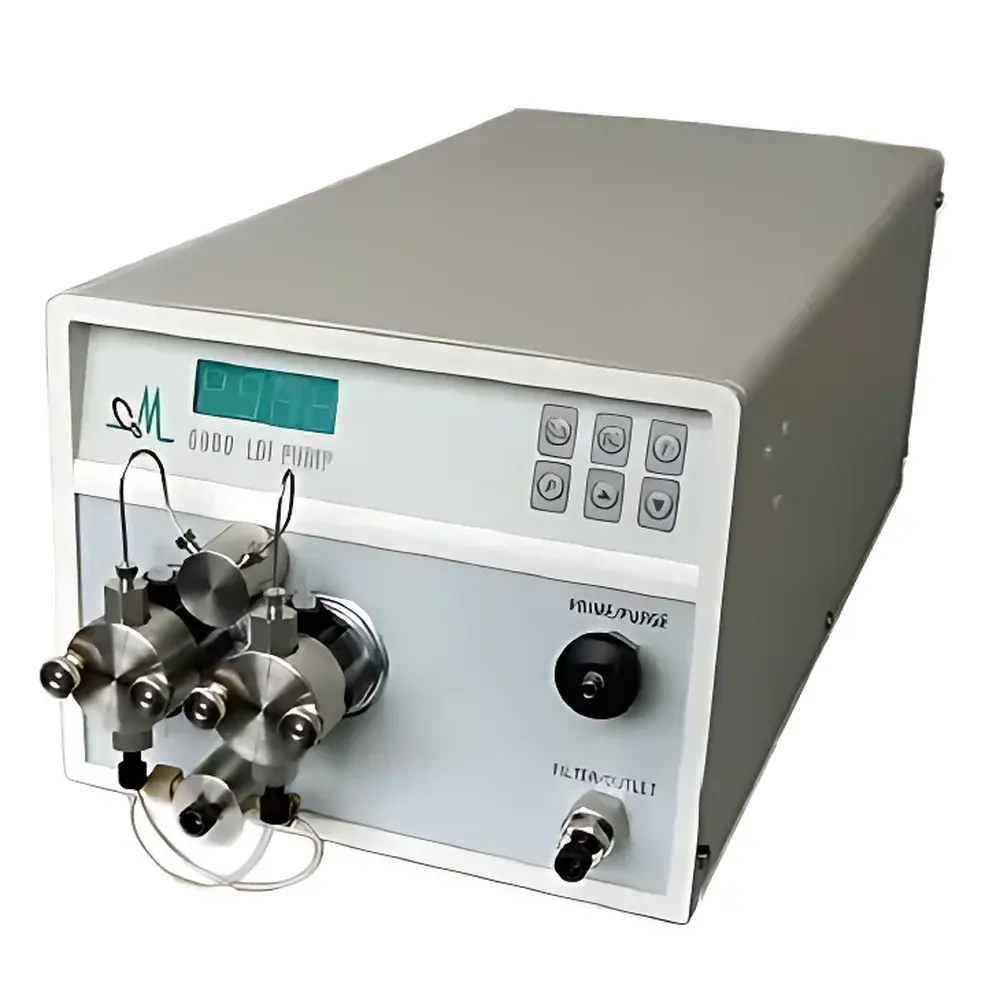
CoMetro CP-LDI High-Pressure Preparative Constant Flow Pump
| Brand | CoMetro |
|---|---|
| Origin | Imported |
| Manufacturer Type | Authorized Distributor |
| Model | CP-LDI |
| Flow Rate | 10 mL/min (standard configuration) |
| Maximum Pressure | 6000 psi |
| Flow Accuracy | ±1% |
| Flow Precision | ≤0.1% RSD |
| Pump Head Configuration | Parallel Dual-Piston Heads |
| Pressure Units | PSI, MPa, or bar (user-selectable) |
| Control Modes | Front-panel keypad, RS-232/USB PC interface, analog input (0–5 V / 4–20 mA) |
| Compressibility Compensation | Adjustable |
| Auto-Purge & Solvent Flush | Supported |
| Self-Cleaning Mode for Salt-Containing Buffers | Enabled |
Overview
The CoMetro CP-LDI High-Pressure Preparative Constant Flow Pump is an engineered solution for demanding liquid delivery applications in preparative and semi-preparative high-performance liquid chromatography (HPLC), flash chromatography, and continuous-flow synthesis systems. Built upon a dual-piston, parallel plunger architecture, the CP-LDI operates on positive displacement principles with active pressure feedback control—ensuring stable volumetric output under variable backpressure conditions up to 6000 psi (414 bar). Its core design integrates a brushless DC motor drive, high-fidelity piezoresistive pressure transduction, and real-time flow calibration algorithms to maintain consistent delivery across solvent viscosity gradients and column aging effects. Unlike standard analytical pumps, the CP-LDI is specifically optimized for extended duty cycles, higher flow rates, and compatibility with large-bore columns (up to 50 mm ID) and packed-bed reactors—making it suitable for scale-up workflows where reproducibility and long-term stability are critical.
Key Features
- Dual parallel piston heads with independent check valve assemblies, minimizing pulsation (<2% ripple at 10 mL/min) and enabling uninterrupted flow during refill strokes
- Programmable compressibility compensation—adjustable per solvent system to correct for fluid elasticity effects at elevated pressures
- Front-panel LED interface with adjustable brightness; displays real-time flow rate (mL/min), system pressure (PSI/MPa/bar), and operational status indicators
- Three control modes supported: local keypad operation, PC-based command via RS-232 or USB virtual COM port, and external analog signal input (0–5 V or 4–20 mA) for integration into automated reactor or fraction collector systems
- Configurable pressure limits (upper/lower bounds) with audible and visual alarms; automatic shutdown on overpressure or low-pressure fault detection
- Integrated solvent flush protocol for pump heads—automated sequence for removing crystallized buffer salts, reducing maintenance frequency and extending seal/piston rod service life
Sample Compatibility & Compliance
The CP-LDI is compatible with common HPLC-grade solvents (acetonitrile, methanol, water, THF, DCM, ethyl acetate) and aqueous buffers (e.g., ammonium acetate, phosphate, TFA). Its wetted materials include sapphire-ruby check valves, PEEK and stainless steel 316L fluidic paths, and chemically resistant ceramic-coated plungers—ensuring compatibility with mildly corrosive mobile phases. While not certified as GMP-compliant out-of-the-box, the pump supports audit-ready operation when paired with validated PC software: full event logging (flow/pressure setpoints, error codes, purge cycles), timestamped parameter changes, and user-access-level controls align with GLP documentation requirements. It meets electromagnetic compatibility standards per IEC 61326-1 and safety specifications per IEC 61010-1 for laboratory equipment.
Software & Data Management
The CP-LDI communicates natively with CoMetro’s proprietary PumpControl Suite (Windows-based), which provides method-driven operation, gradient programming (for multi-pump configurations), and exportable CSV logs of pressure/flow trajectories. When deployed in multi-pump setups (2–4 units), the software enables synchronized gradient generation with dwell volume compensation and interlock logic—critical for reproducible multi-solvent separations. All parameter modifications—including flow rate ramps, pressure thresholds, and compressibility offsets—are recorded with user ID, timestamp, and pre/post values. Optional FDA 21 CFR Part 11 compliance packages include electronic signatures, role-based access control, and immutable audit trails—supporting regulated environments such as QC labs performing ICH Q5/Q6 method transfers.
Applications
- Semi-preparative and preparative HPLC purification of pharmaceutical intermediates, natural products, and synthetic peptides
- Continuous-flow catalysis requiring precise reagent stoichiometry and residence time control
- Method development for column scaling studies—from analytical (4.6 mm ID) to preparative (21–50 mm ID) formats
- Automated fraction collection systems where pump-triggered valve actuation must correlate precisely with UV/ELSD signal thresholds
- Long-duration stability testing of chromatographic columns under constant load conditions
FAQ
What is the maximum recommended operating pressure for continuous use?
The CP-LDI is rated for continuous operation at up to 6000 psi (414 bar); however, sustained operation above 5500 psi may reduce seal longevity and is advised only with low-viscosity solvents and routine maintenance intervals.
Can the CP-LDI be used with aqueous buffers containing >100 mM salt?
Yes—provided the optional self-cleaning flush protocol is executed after each run; this minimizes salt crystallization at check valves and piston interfaces.
Is gradient formation possible with a single CP-LDI unit?
No—gradient elution requires at least two independently controlled CP-LDI pumps (or one CP-LDI paired with a proportioning valve module); the base unit delivers only isocratic flow.
Does the pump support third-party SCADA or LabVIEW integration?
Yes—via ASCII command protocol over RS-232/USB or analog voltage/current input; full command reference and driver examples are provided in the technical documentation package.
What maintenance intervals are recommended for daily 8-hour operation?
Piston seals should be inspected every 500 hours; check valves cleaned every 200 hours in buffer-heavy applications; full pump head servicing recommended annually or after 2000 operational hours, whichever occurs first.
Related Products



