
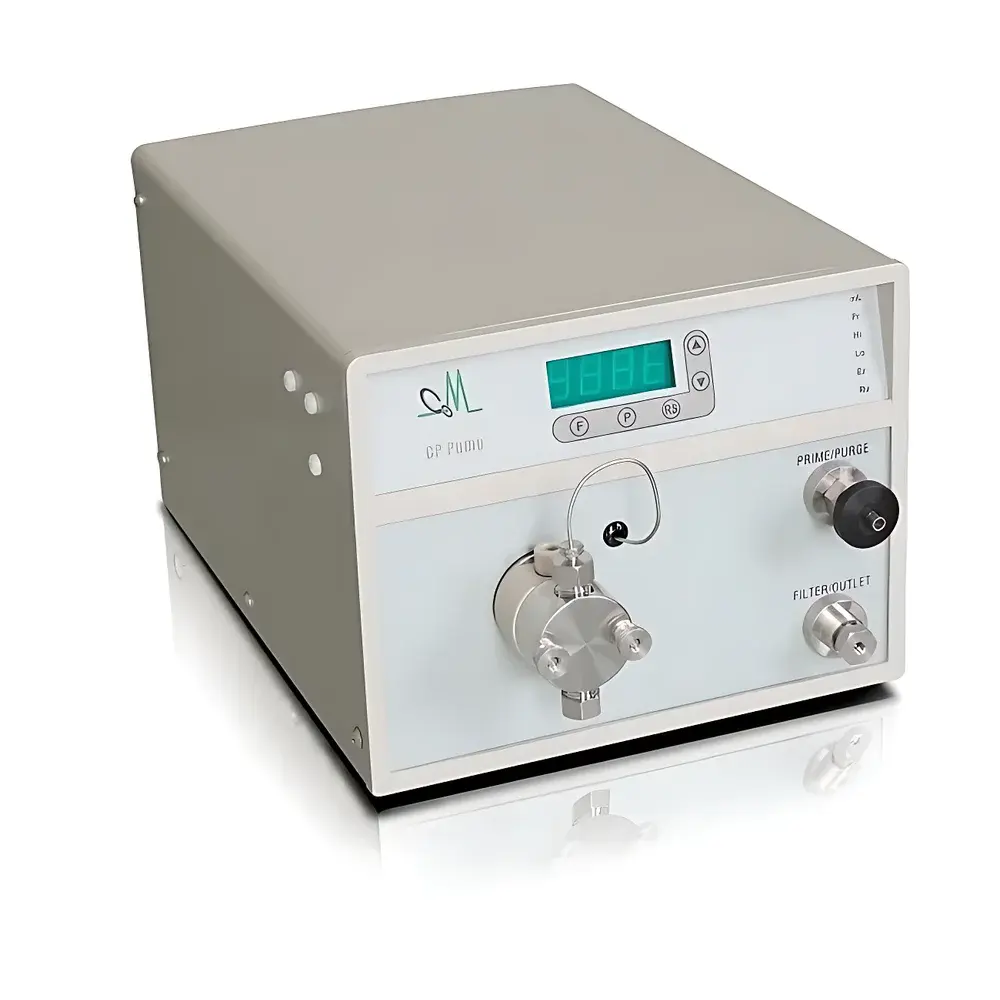
CoMetro CP-M Series Constant Flow Pump
| Brand | CoMetro |
|---|---|
| Model | CP-M Series |
| Flow Rate | 0.001–50 mL/min (model-dependent) |
| Maximum Pressure | 6000 psi |
| Accuracy | ±2% |
| Precision (RSD) | 0.2% |
| Dimensions | 175(H) × 225(W) × 305(D) mm |
| Weight | 11 kg |
| Power Supply | 115/230 V, 50/60 Hz |
| Fluid Path Materials | PEEK or 316 Stainless Steel |
| Control Interface | Keypad + RS232 digital communication |
| Pressure Sensing | Non-contact electronic transducer |
| Compliance | Designed for GLP/GMP-aligned workflows |
Overview
The CoMetro CP-M Series Constant Flow Pump is an engineered solution for precision liquid delivery in demanding laboratory and industrial process environments. Based on positive displacement peristaltic-free piston actuation, the CP-M series employs a high-stiffness motor-driven plunger system coupled with a low-volume accumulator-based flow stabilizer to eliminate pulsation—delivering true continuous flow across its operational range. Unlike conventional syringe or peristaltic pumps, the CP-M architecture integrates real-time electronic compensation for compressibility effects, thermal expansion, and backpressure fluctuations, enabling stable volumetric delivery under dynamic load conditions up to 6000 psi. This makes it suitable for applications requiring long-duration, unattended operation with minimal flow deviation—particularly in high-pressure synthesis, chromatographic eluent delivery, microfluidic calibration, and controlled reagent dosing.
Key Features
- Ultra-low pulsation flow (<0.2% RSD) achieved via integrated low-inner-volume accumulator and adaptive electronic compensation algorithm
- Non-contact pressure sensing enables real-time monitoring without fluid-path intrusion or diaphragm fatigue
- Dual-control architecture: local keypad interface for standalone operation and RS232 serial protocol for programmable integration into SCADA, LIMS, or custom automation platforms
- Modular pump head design with quick-release mechanism facilitates rapid maintenance and material-swapping between PEEK and 316 stainless steel fluid paths
- Built-in bypass valve and self-cleaning module reduce downtime during solvent transitions or particulate-laden media handling
- Programmable pressure limits (high/low), status feedback, and alarm triggers support fail-safe operation in regulated environments
Sample Compatibility & Compliance
The CP-M Series accommodates a broad spectrum of chemically aggressive, viscous, or particulate-containing fluids—including organic solvents, aqueous buffers, polymer solutions, and catalyst slurries—when configured with appropriate wetted materials (PEEK for general corrosion resistance; 316 SS for elevated temperature and chloride-rich media). All models meet CE marking requirements for electromagnetic compatibility (EMC Directive 2014/30/EU) and low-voltage safety (LVD Directive 2014/35/EU). While not inherently certified for hazardous area use, the pump’s intrinsically safe electronics architecture allows deployment in Class I, Division 2 environments when installed per NEC Article 500 guidelines. For pharmaceutical or clinical research use, the CP-M series supports validation documentation packages (IQ/OQ/PQ templates available upon request) and is compatible with FDA 21 CFR Part 11-compliant data acquisition systems when used with approved software controllers.
Software & Data Management
The CP-M Series communicates via standard RS232 protocol using ASCII command syntax, enabling seamless integration with LabVIEW, Python (PySerial), MATLAB, or third-party HMI systems. Optional CoMetro PumpControl Suite (v3.2+) provides full remote configuration, real-time flow/pressure trending, event logging with timestamped audit trails, and export to CSV or XML formats. All logged parameters—including setpoint deviations, pressure excursions, and fault codes—are time-stamped and digitally signed to satisfy GLP and GMP record-keeping requirements. Firmware updates are performed via secure serial bootload mode with SHA-256 signature verification to ensure integrity.
Applications
- High-pressure liquid chromatography (HPLC/UHPLC) mobile phase delivery where pulse-free flow minimizes baseline noise and column stress
- Catalytic reaction monitoring in flow chemistry reactors requiring precise stoichiometric reagent addition at >4000 psi
- Calibration of microfluidic flow sensors and particle image velocimetry (PIV) test benches
- Controlled infusion in preclinical pharmacokinetic studies adhering to ISO 14155:2020 biocompatibility guidelines
- Teaching laboratories demonstrating fundamental principles of fluid dynamics, pump efficiency, and pressure–flow relationships
- Continuous emission monitoring (CEM) sample introduction systems compliant with EPA Method 18 and ASTM D6348
FAQ
What flow rate ranges are supported across the CP-M Series?
The CP-M Series offers three primary flow configurations: CP-M205/CP-M305 (0.001–5 mL/min), CP-M210/CP-M310 (0.01–10 mL/min), and CP-M250/CP-M350 (0.1–50 mL/min), each rated for maximum pressures of either 6000 psi or 1500 psi depending on model.
Is the CP-M Series suitable for sterile or USP particulate testing applications?
Yes—when equipped with electropolished 316 stainless steel fluid paths and operated within validated cleaning protocols, the CP-M3xx variants (with pressure monitoring and alarm functions) are routinely deployed in cleanroom-integrated particulate counting systems.
Can the pump be operated in gradient or programmed flow profiles?
While the base firmware supports only constant-flow mode, external programmable logic controllers (PLCs) or PC-based software can dynamically update flow setpoints via RS232 at intervals ≥100 ms, enabling stepwise or ramped profiles suitable for method development.
What maintenance intervals are recommended for extended reliability?
Under normal lab use (≤8 hrs/day, non-abrasive media), seal replacement is recommended every 6,000 operating hours; accumulator calibration verification annually; and full metrological recalibration every 24 months or after any impact event affecting mechanical alignment.



