
Compact Temperature and Humidity Controlled Chamber – Customizable Entry-Level Environmental Test Chamber
| Brand | OEM / White-Label |
|---|---|
| Origin | Imported |
| Manufacturer Type | Authorized Distributor |
| Price | USD 2,950 (FOB) |
| Temperature Range | −65 °C to +150 °C |
| Humidity Range | 20–95 % RH |
| Temp. Uniformity | ±2.0 °C |
| Temp. Stability | ±0.5 °C |
| Humidity Uniformity | ±3.0 % RH |
| Humidity Stability | ±1.5 % RH |
| Heating Rate (20 °C → 85 °C) | <60 min (unloaded, non-linear) |
| Cooling Rate (20 °C → −40 °C) | <70 min (unloaded, non-linear) |
| Power Supply | 3-phase 5-wire AC 380 V, 50 Hz, PE grounded |
| Structural Compliance | ASTM E145, ISO 16750-4, IEC 60068-2-1/2/14/30, GB/T 5170.2 & GB/T 5170.5 |
Overview
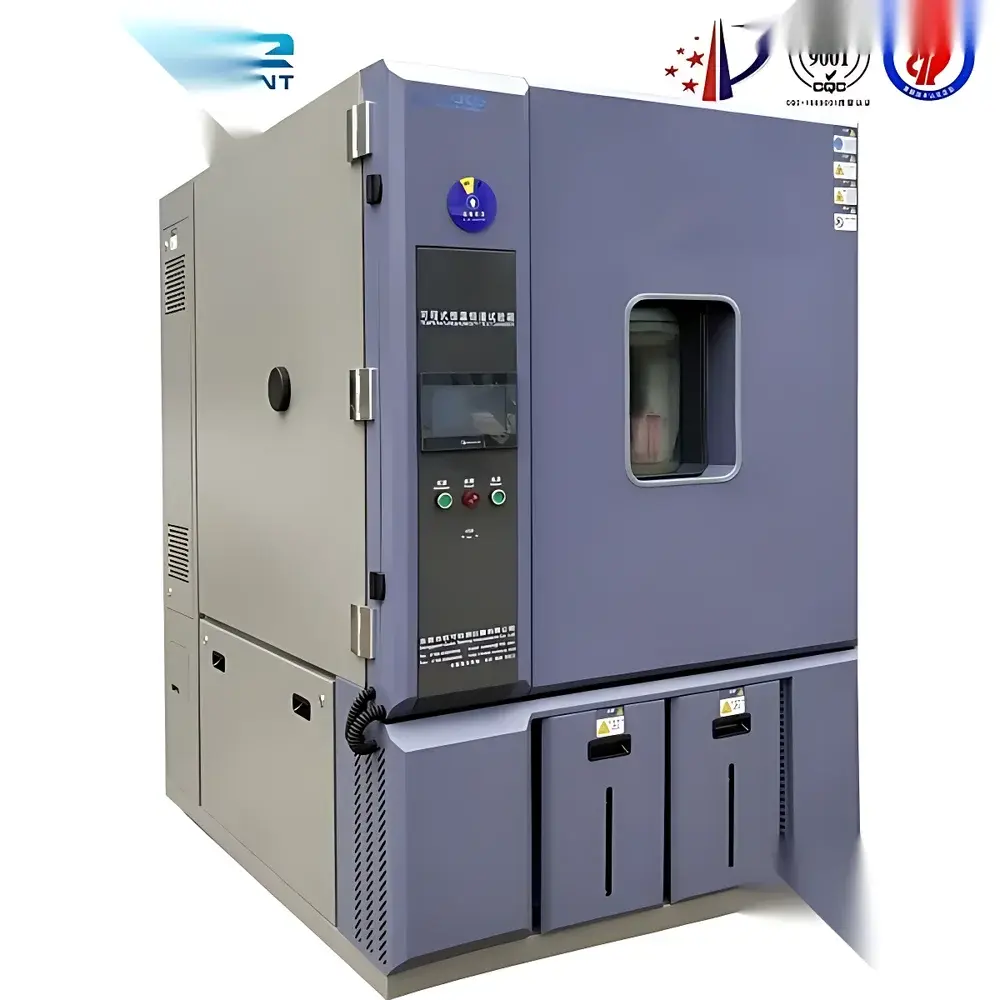
The Compact Temperature and Humidity Controlled Chamber is an entry-level, space-optimized environmental test chamber engineered for precision stability and operational reliability in constrained laboratory or QC environments. Designed around a dual-loop PID-controlled refrigeration and humidification system with forced-air convection, it delivers reproducible thermal and hygrothermal conditioning across a wide operational envelope—from deep-cryogenic (−65 °C) to high-temperature (+150 °C) and low-to-high relative humidity (20–95 % RH). Its measurement architecture complies with the fundamental metrological requirements of IEC 60068-2 series and GB/T 5170.2 (temperature) and GB/T 5170.5 (humidity) verification protocols. The chamber operates on a validated air-temperature-based control paradigm—meaning all specified ramp rates (e.g., heating/cooling times) refer strictly to chamber air temperature response under unloaded, no-load conditions per ASTM E145 Annex A1, not product-core temperature dynamics. This distinction is critical for test method validation and protocol alignment in GLP-compliant laboratories.
Key Features
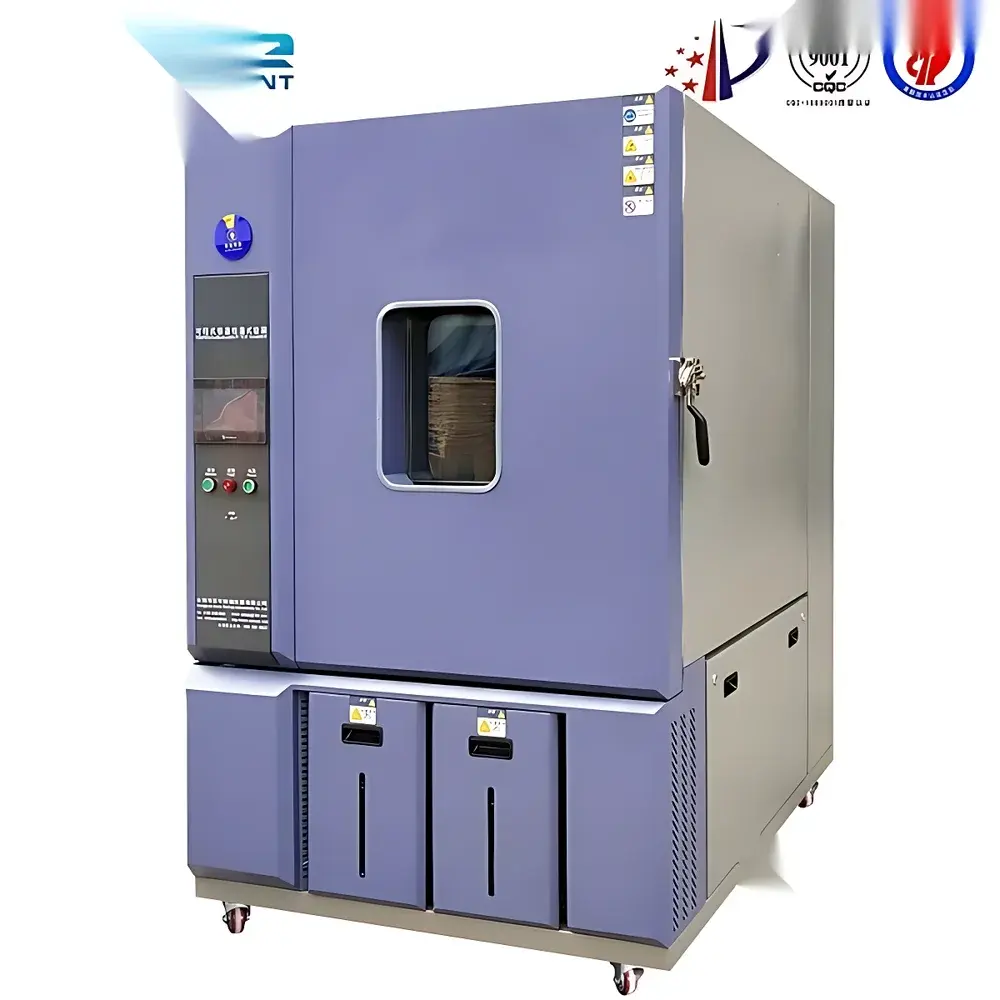
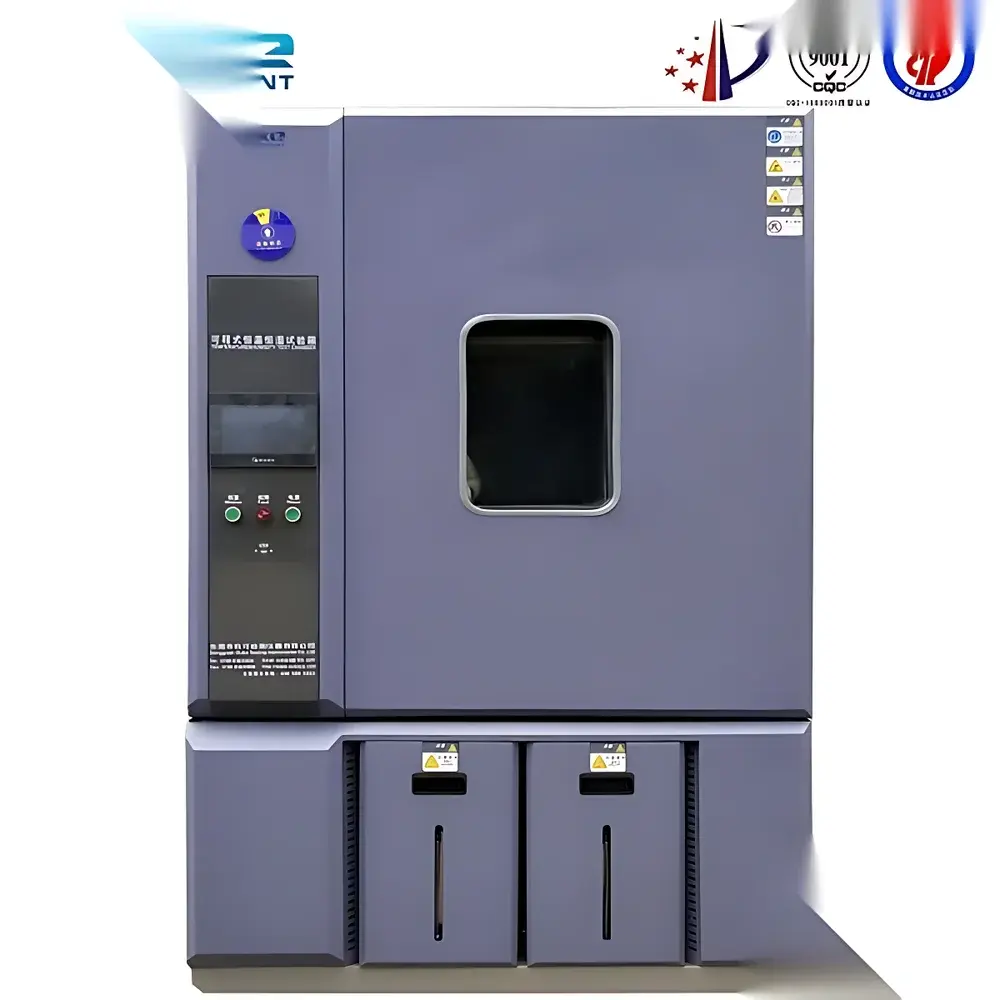
- Space-efficient footprint: Optimized external dimensions accommodate placement in small laboratories or quality control bays without structural modification.
- Large double-layer insulated observation window: Tempered glass with anti-condensation heating ensures unobstructed, real-time visual monitoring during extended test cycles.
- High-capacity, drawer-style water reservoir: Supports continuous humidity operation over extended durations; facilitates rapid draining, cleaning, and maintenance without disassembly.
- Dual-stage safety architecture: Includes independent over-temperature, over-humidity, compressor high-pressure, phase-failure, and door-open interlock circuits—each logged with timestamped event records.
- Intuitive controller interface: 7-inch color touchscreen with multi-language support (EN/DE/FR/ES), pre-loaded standard test profiles (GB/T 2423.1, GB/T 2423.2, GB/T 2423.30), and manual setpoint override capability.
- Modular insulation system: Rigid polyurethane foam (density ≥40 kg/m³, λ ≤0.022 W/m·K) sandwiched between inner 304 stainless steel (corrosion-resistant, electropolished finish) and outer pre-painted steel panels—ensuring long-term thermal integrity and moisture barrier performance.
Sample Compatibility & Compliance
This chamber accommodates standard-sized test specimens up to 300 mm × 300 mm × 300 mm (W×D×H) on adjustable stainless-steel shelves. It supports both static and dynamic test configurations—including cycling, step-stress, and dwell protocols—as defined in IEC 60068-2-1 (cold), IEC 60068-2-2 (dry heat), IEC 60068-2-30 (damp heat, cyclic), and ISO 16750-4 (road vehicles). All factory calibration certificates are traceable to NIM (National Institute of Metrology, China) or equivalent national metrology institutes. For regulated industries, optional audit-trail-enabled firmware (compliant with FDA 21 CFR Part 11 Annex 11 principles) and IQ/OQ documentation packages are available upon request. Structural design adheres to GB10589-89 (low-temp chambers), GB11158-89 (high-temp chambers), and GB10592-89 (combined temp/humidity chambers).
Software & Data Management
The embedded controller supports USB data export (CSV format) of time-stamped temperature/humidity readings at user-defined intervals (1s–600s). Optional Ethernet connectivity enables integration into centralized lab management systems via Modbus TCP or OPC UA. Remote monitoring and alarm notification (email/SMS) are configurable through the optional WebServer module. Raw data logs include sensor ID, measurement uncertainty estimates (±0.3 °C for PT100, ±2 % RH for capacitive hygrometer), and environmental metadata (ambient temp, supply voltage, coolant inlet temp). All exported files conform to ALCOA+ principles (Attributable, Legible, Contemporaneous, Original, Accurate, Complete, Consistent, Enduring, Available) for regulatory submissions.
Applications
- Electronics component qualification per AEC-Q200 and JEDEC JESD22-A104.
- Pharmaceutical packaging stability testing per ICH Q1A(R2) and USP <1151>.
- Automotive ECU and sensor validation under ISO 16750-4 (climate stress).
- Material aging studies for polymers, adhesives, and composites (ASTM D3045, ISO 4892-2).
- Calibration reference environment for secondary humidity/temperature standards.
- Pre-conditioning of samples prior to mechanical, electrical, or optical characterization.
FAQ
What does “air temperature change rate” mean—and why isn’t it equal to sample temperature change rate?
Air temperature change rate reflects the chamber’s ability to adjust its internal air mass per ASTM E145. Sample temperature lag depends on thermal mass, geometry, emissivity, and mounting—requiring separate characterization per MIL-STD-810H Method 501.5.
Is this chamber suitable for GMP-regulated pharmaceutical stability testing?
Yes—when equipped with Part 11-compliant firmware, calibrated sensors with NIST-traceable certificates, and full IQ/OQ documentation. Validation must be performed per WHO TRS 992 Annex 6.
Can the chamber operate continuously at −65 °C and 95 % RH simultaneously?
No. The full humidity range (20–95 % RH) is only guaranteed above −10 °C. Below −10 °C, maximum achievable RH decreases exponentially due to dew-point limitations—consult the psychrometric chart included in the technical manual.
What cooling water specifications are required for rated performance?
Coolant inlet temperature must be maintained between 10–28 °C; pressure 0.1–0.3 MPa; flow rate ≥2.5 L/min. Failure to meet these will degrade cooling capacity and extend ramp times beyond published values.
Do you offer custom chamber sizes or non-standard temperature ranges?
Yes. Bespoke engineering services include walk-in chambers, extended low-temp options (−70 °C), and integrated UV or CO₂ modules—subject to feasibility review and lead-time confirmation.



