
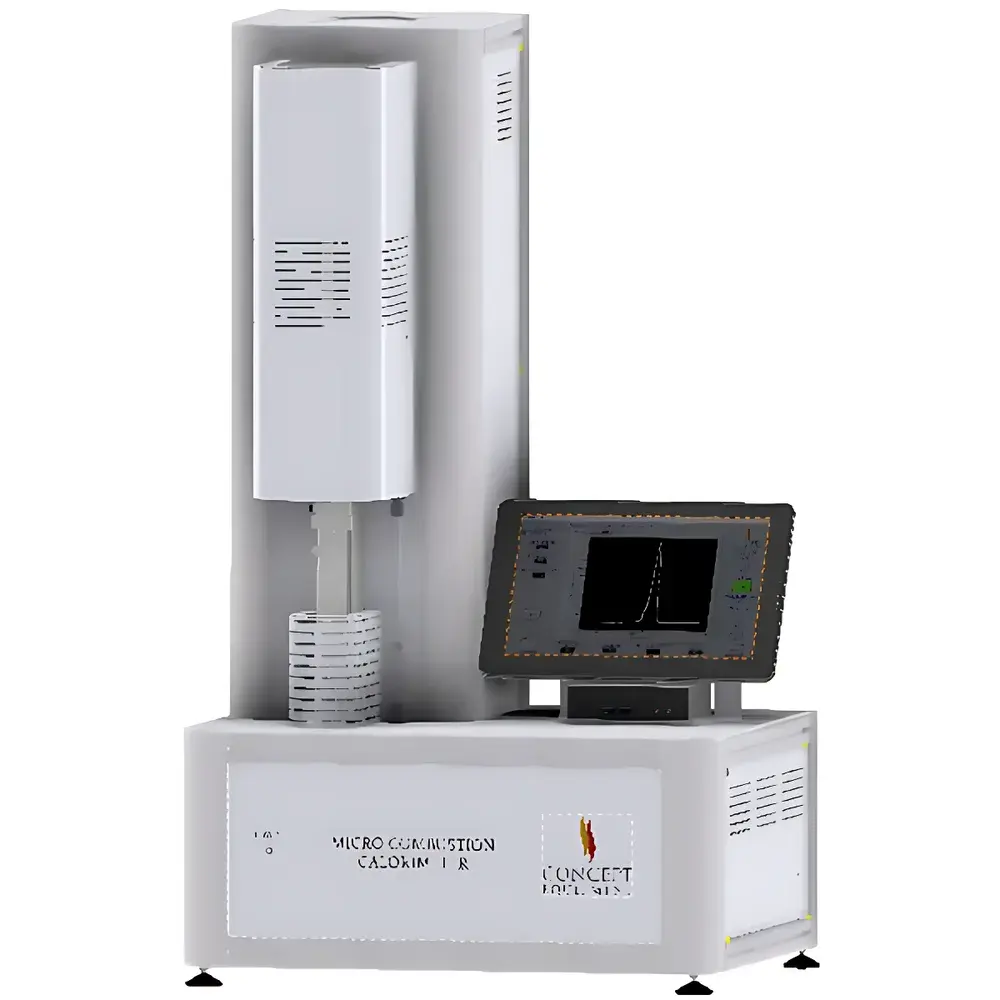
Concept Microscale Combustion Calorimeter (MCC)
| Brand | Concept |
|---|---|
| Origin | United Kingdom |
| Model | Microscale Combustion Calorimeter |
| Standard | ASTM D7309 |
| Heating Rate Range | 0.2–5 K/s (±5% accuracy) |
| Temperature Range | 0–1000 °C |
| Detection Limit | 5 mW |
| Repeatability | ±2% (for 5 mg sample) |
| Oxygen Measurement | Paramagnetic sensor, 0–100% O₂, accuracy ±0.1% |
| Gas Flow Control | High-precision mass flow controllers for N₂ (80 cm³/min, max 100 cm³/min) and O₂ (20 cm³/min, max 50 cm³/min) |
| Sample Mass Range | 0.5–10 mg |
| Furnace | 10 mm alumina tube with dual Kanthal heating elements |
| Power Supply | 230 V AC, 50 Hz, 10 A |
| Dimensions (W×H×D) | 600 mm × 1025 mm × 500 mm |
| Weight | 42 kg |
| Operating Ambient | 10–35 °C |
Overview
The Concept Microscale Combustion Calorimeter (MCC) is a precision benchtop instrument engineered for quantitative fire safety evaluation of solid materials using microscale combustion calorimetry—standardized as ASTM D7309. Developed originally by the U.S. Federal Aviation Administration (FAA) to accelerate material flammability assessment in aerospace applications, MCC measures the rate of heat release during controlled pyrolysis and subsequent combustion of milligram-scale samples under inert and oxidative atmospheres. The technique relies on oxygen consumption calorimetry: fuel gases evolved from thermal decomposition in a nitrogen stream are mixed with excess oxygen and combusted at high temperature; the instantaneous heat release rate (HRR) is calculated from the measured oxygen depletion, based on the fundamental thermochemical relationship that 13.1 kJ of heat is released per millimole of O₂ consumed. This principle enables highly reproducible determination of key fire parameters—including peak heat release rate (pHRR), total heat release (THR), and heat release capacity (HRC)—without requiring large specimens or extended test durations.
Key Features
- Compliant with ASTM D7309 Method A (inert pyrolysis) and Method B (oxidative pyrolysis), selectable via intuitive touchscreen interface
- Integrated 13.1-inch capacitive touchscreen running embedded Windows OS, enabling standalone operation without external PC
- High-stability paramagnetic oxygen analyzer (0–100% O₂ range, ±0.1% full-scale accuracy) — identical sensor technology used in cone calorimeters for trace-level O₂ quantification
- Dual-zone Kanthal-heated alumina furnace (10 mm ID) with precise temperature control up to 1000 °C and programmable heating rates from 0.2 to 5 K/s (±5% tolerance)
- Independent mass flow controllers for high-purity N₂ (99.9%, 80 cm³/min nominal) and O₂ (99.9%, 20 cm³/min nominal), each with calibrated ranges and 6 mm push-to-connect fittings
- Automated sample positioning system with sub-millimeter repeatability, optimized for consistent thermal contact and minimal thermal lag
- Detection limit of 5 mW ensures reliable quantification of low-energy decomposition events in flame-retardant polymers, bio-based composites, and thin coatings
- Robust mechanical architecture (42 kg total mass) minimizes vibration-induced signal noise during sensitive oxygen-consumption measurements
Sample Compatibility & Compliance
The Concept MCC accepts solid samples weighing 0.5–10 mg—including thermoplastics, thermosets, wood derivatives, textile fibers, nanocomposites, and intumescent coatings—without pelletization or binder addition. Its microscale approach eliminates the need for specimen conditioning per ISO 291 or ASTM D618, though users may apply standard ambient equilibration protocols when required for comparative studies. The instrument satisfies technical requirements for GLP-compliant data acquisition: audit-trail-enabled software logs all method parameters, calibration events, operator IDs, and timestamped raw signals. While not certified as GMP-grade hardware, its architecture supports 21 CFR Part 11 compliance when deployed with validated software configurations and access-controlled user accounts. All measurement outputs align with ISO 5660-1 derived fire modeling inputs and are routinely cited in peer-reviewed journals evaluating flame inhibition mechanisms and regulatory submissions to EASA, FAA, and UK CAA.
Software & Data Management
The included Concept MCC Analysis Suite provides real-time visualization of oxygen concentration, furnace temperature, gas flows, and calculated HRR curves. Raw data files (ASCII-encoded .csv) contain time-synchronized channels with metadata headers compliant with ASTM E1710 for inter-laboratory traceability. Post-acquisition processing includes baseline correction, derivative smoothing (Savitzky-Golay), pHRR/THR/HRC extraction, and automatic reporting templates aligned with ASTM D7309 Annexes A1–A3. Software licenses permit installation on multiple office workstations for offline data review and statistical comparison across sample sets. Export options include PDF reports with embedded graphs, Excel-compatible datasets, and XML-formatted results for integration into LIMS platforms supporting ASTM WK56222 data exchange schemas.
Applications
- Quantitative ranking of flame-retardant efficacy in halogen-free polymer formulations
- Structure–property correlation studies linking chemical architecture (e.g., phosphorus content, char yield) to heat release capacity
- Screening of bio-derived fillers and lignocellulosic fibers for reduced fire hazard in automotive interiors
- Validation of computational pyrolysis models (e.g., ThermaKin, FireFOAM) using experimentally derived HRR profiles
- Regulatory support for FAR 25.853, EN 45545-2, and GB 8624 classification testing where microscale screening precedes full-scale certification
- Teaching laboratories demonstrating fundamental combustion thermodynamics with minimal consumables and lab-space footprint
FAQ
What sample preparation is required prior to MCC analysis?
No grinding, pressing, or solvent treatment is necessary. Samples must be dry and representative; moisture content should be documented if >0.5 wt% to enable post-hoc normalization.
Can the MCC distinguish between condensed-phase and gas-phase flame inhibition mechanisms?
Indirectly—by comparing HRC values and char residue morphology (via post-test SEM/EDS) with complementary TGA-FTIR data, users infer dominant suppression pathways.
Is helium an acceptable carrier gas alternative to nitrogen?
No—ASTM D7309 specifies high-purity nitrogen (99.9%) to ensure consistent pyrolysis kinetics and avoid catalytic effects observed with He in certain carbonaceous systems.
How frequently must the oxygen sensor be calibrated?
Factory calibration is valid for 12 months under normal use; field verification with certified zero (N₂) and span (20.9% O₂ in N₂) gases is recommended before each analytical campaign.
Does the instrument support automated sequential analysis of multiple samples?
Not natively—the MCC is a single-sample-per-run platform; however, batch scripting via the Analysis Suite allows queued method loading and report generation for unattended post-run processing.



