
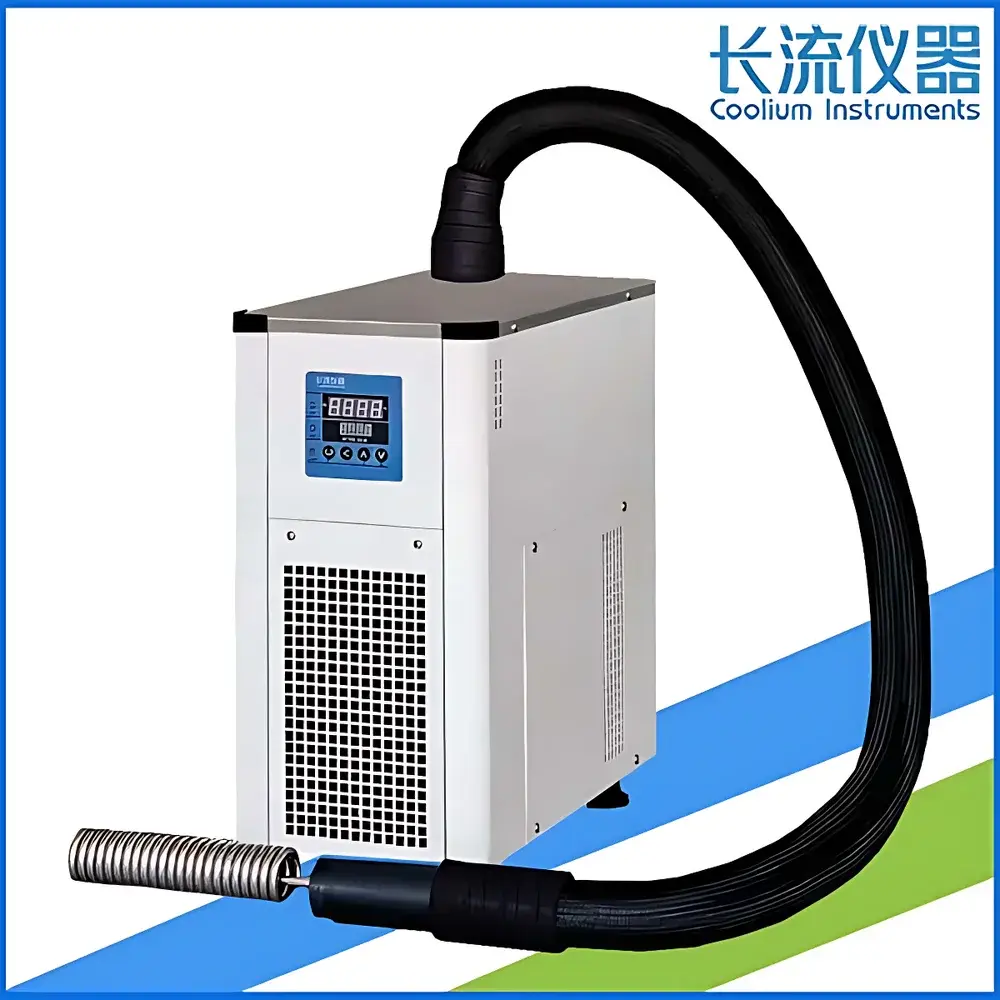
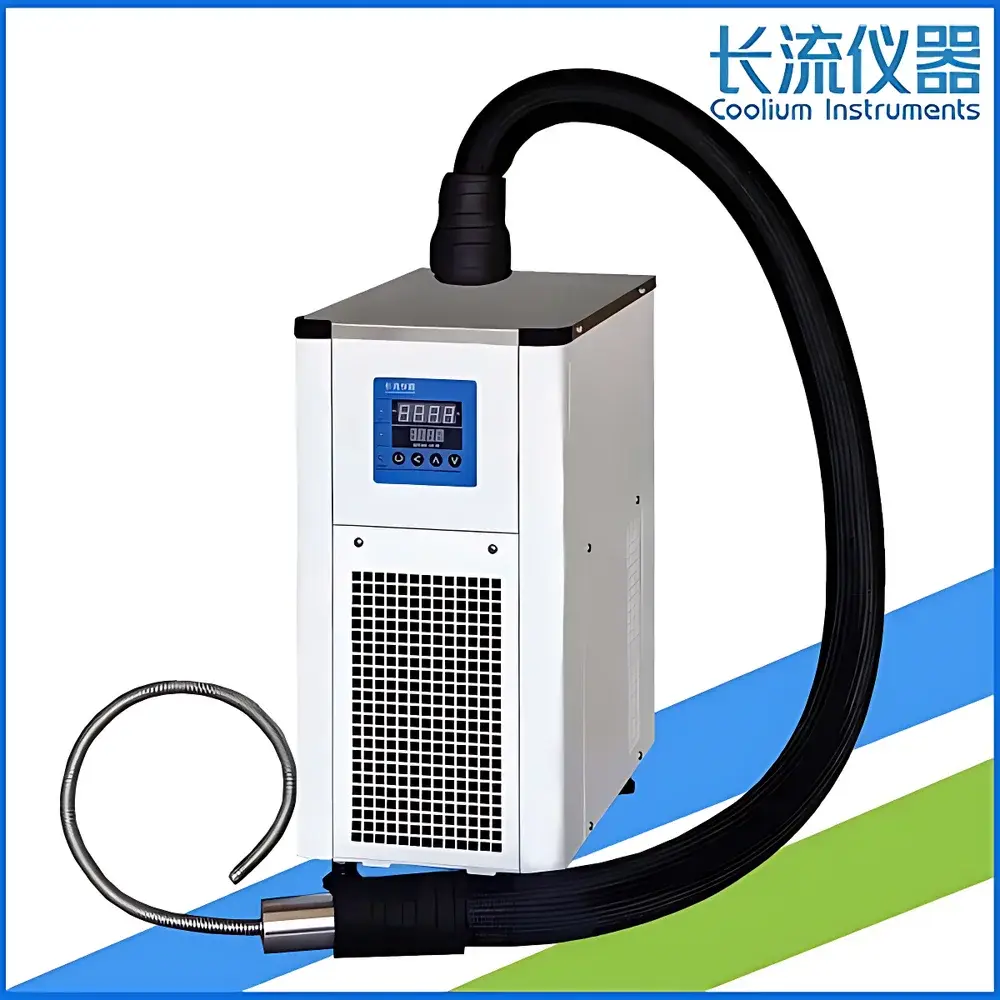
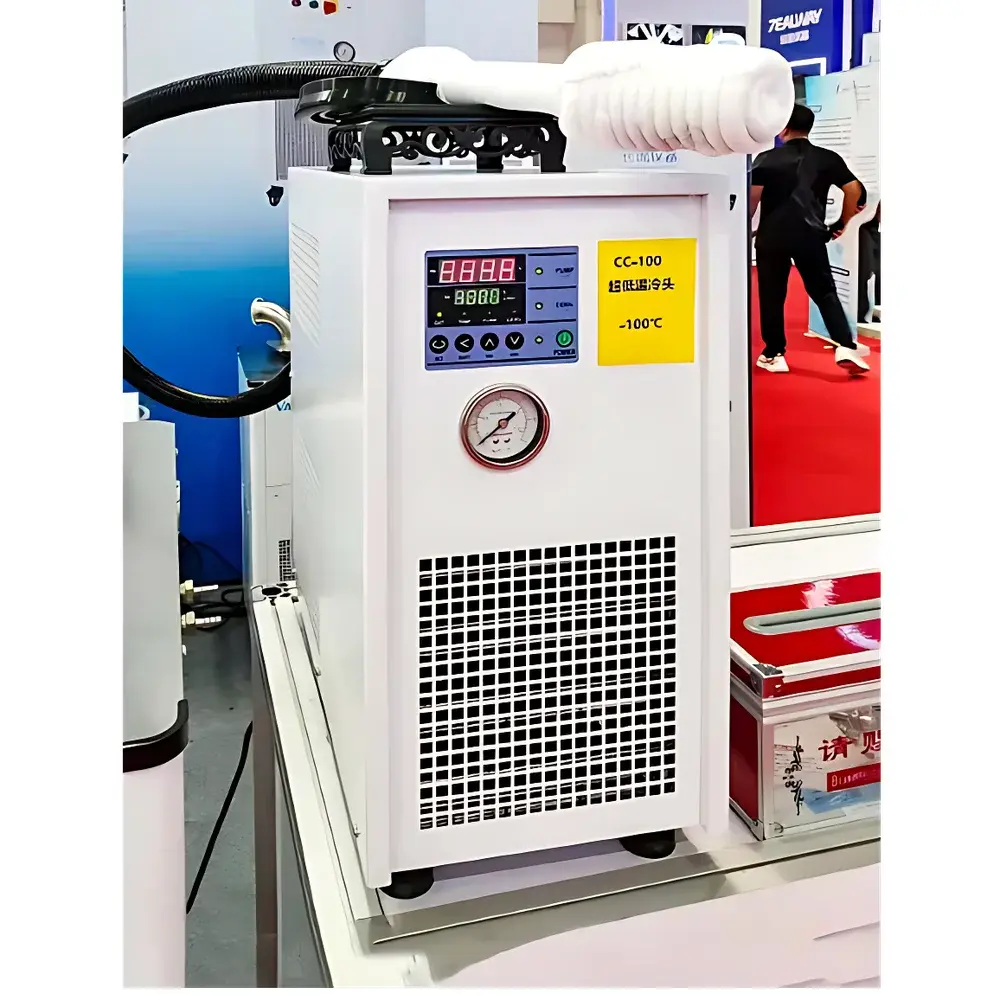
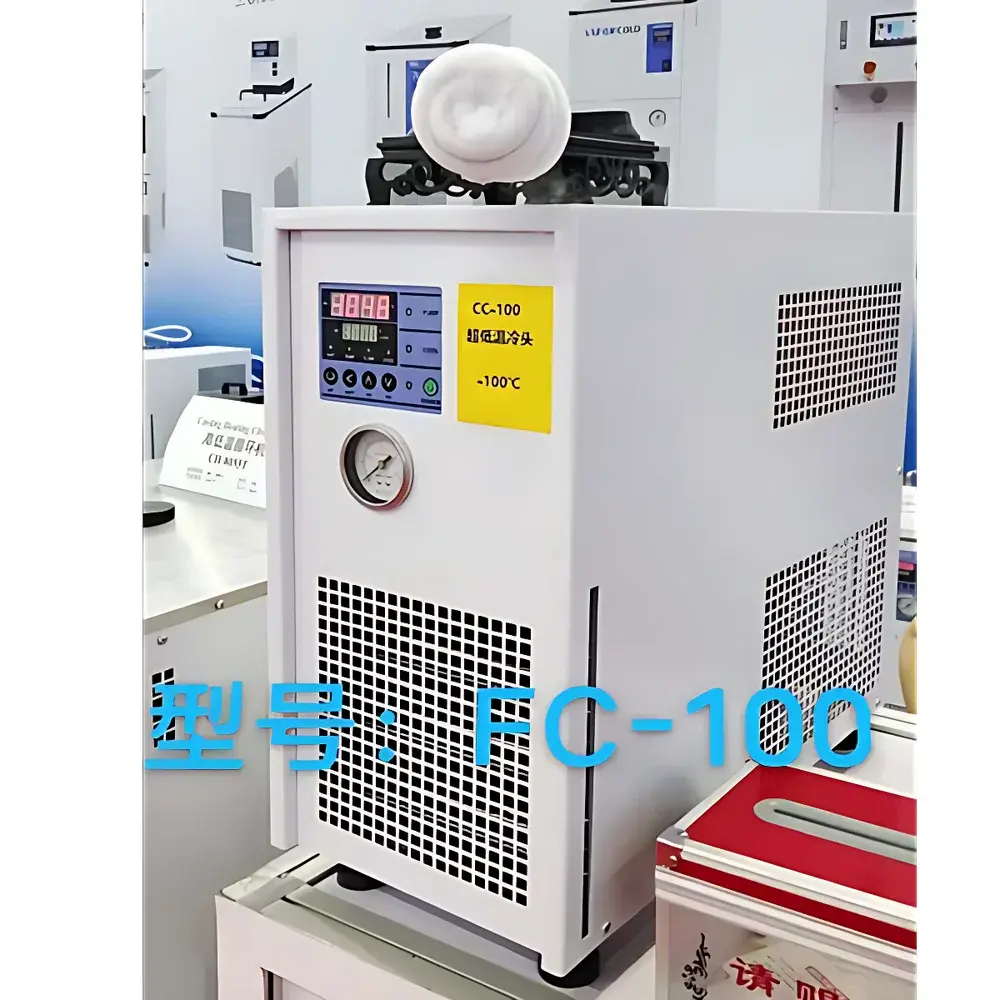
Coolium FC100 Ultra-Low Temperature Cryo-Cooling Circulating Chiller
| Brand | Coolium |
|---|---|
| Origin | Beijing, China |
| Model | FC100 |
| Cooling Method | Air-Cooled |
| Temperature Range | ≤ −100 °C (configurable down to −145 °C) |
| Refrigeration Capacity | 50 W @ −80 °C |
| Construction | Integrated Unit |
| Operation Mode | Continuous |
| Cold Head Dimensions | Φ12 × 600 mm or Φ38 × 255 mm |
| Unit Weight | 37 kg |
| Power Supply | 220 V / 50 Hz / 0.75 kW |
| Unit Dimensions | 230 W × 450 D × 490 H mm |
| Refrigerant | Multi-stage non-ozone-depleting zeotropic blend |
| Compressor Type | Single-stage auto-cascade |
Overview
The Coolium FC100 is an integrated ultra-low temperature circulating chiller engineered for precision thermal management in vacuum and analytical instrumentation environments. It employs a single-stage auto-cascade refrigeration cycle with a proprietary zeotropic refrigerant blend—designed to eliminate ozone depletion potential while maintaining high thermodynamic efficiency across extended sub-ambient operating ranges. Unlike conventional chillers limited to −40 °C or −60 °C, the FC100 achieves stable, continuous operation at ≤ −100 °C using direct-contact cold head architecture, enabling cryogenic heat extraction without reliance on bulk cryogens. Its modular cold head design—available in two standard configurations (Φ12 × 600 mm and Φ38 × 255 mm)—allows seamless integration into vacuum chambers, flange-mounted cold traps, or analytical instrument enclosures. The system operates as a closed-loop liquid coolant circulation unit, delivering consistent thermal load rejection while eliminating the logistical, safety, and purity constraints associated with liquid nitrogen supply chains.
Key Features
- Ultra-low temperature capability: Sustained operation at ≤ −100 °C, with optional configuration support down to −145 °C for specialized applications
- Auto-cascade compression architecture: Single-stage compressor driving multi-evaporator refrigerant staging for deep-cryo performance without mechanical complexity
- Air-cooled condensation system: Eliminates dependency on facility water cooling infrastructure; suitable for benchtop and mobile lab deployment
- Modular cold head interface: Flexible silicone-insulated flexible hose connection enables rapid installation into existing vacuum manifolds or instrument cold zones
- Cryogenic vapor capture optimization: Engineered thermal gradient profile enhances water and hydrocarbon vapor condensation efficiency in high-vacuum systems
- Stable continuous-duty operation: Rated for 24/7 thermal cycling with < ±0.3 °C temperature stability over 8-hour intervals under nominal load
- Integrated safety monitoring: Real-time pressure, temperature, and current sensing with automatic shutdown on overtemperature, low-flow, or refrigerant loss detection
Sample Compatibility & Compliance
The FC100 is compatible with standard silicone, Viton®, and PTFE-compatible coolant loops used in high-vacuum and UHV systems (≤10−9 mbar). Cold head materials conform to ASTM B117 salt-spray resistance standards for corrosion control in laboratory environments. While not certified to ISO/IEC 17025 as a metrological device, its temperature stability and repeatability meet requirements for GLP-compliant cold trap validation per ASTM E2877-22 (Standard Guide for Validation of Cryogenic Traps in Vacuum Systems). The unit complies with IEC 61010-1:2010 for electrical safety in laboratory equipment and meets CE marking requirements for EMC (EN 61326-1) and Low Voltage Directive (2014/35/EU).
Software & Data Management
The FC100 includes a local digital controller with LED display and tactile keypad for setpoint adjustment, real-time temperature readout, and status diagnostics. Optional RS-485 Modbus RTU interface enables integration into SCADA or LabVIEW-based supervisory systems for remote parameter logging and alarm notification. All operational data—including compressor run time, thermal cycle count, and fault history—are stored in non-volatile memory with timestamped entries. Audit trail functionality supports basic 21 CFR Part 11 compliance when paired with validated third-party data acquisition software, though native electronic signature or user-role management is not implemented.
Applications
- Cryogenic cold trapping in high- and ultra-high vacuum systems, replacing liquid nitrogen Dewars in helium leak detectors and residual gas analyzers
- Cooling baffle plates on rotary vane and scroll mechanical pumps to suppress oil backstreaming
- Gas-phase pre-concentration in GC cold-focus modules, supporting sub-ppb detection limits in environmental VOC analysis
- Thermal conditioning of DSC sample stages for low-temperature phase transition studies (e.g., polymer glass transitions, crystallization kinetics)
- Vapor condensation in Parylene C and N deposition chambers to improve film purity and adhesion uniformity
- Low-temperature calibration reference sources for infrared radiometry and bolometric sensor testing
- On-demand cryogenic cooling for small-bore superconducting magnet test fixtures and quantum device characterization rigs
FAQ
What is the lowest stable operating temperature achievable with the FC100 under continuous load?
The FC100 maintains ≤ −100 °C at 50 W cooling capacity; with reduced thermal load (<15 W), it reaches −120 °C. Factory-configured variants support −145 °C at <5 W load.
Can the FC100 be integrated into an existing vacuum chamber with a CF-63 flange?
Yes—the Φ38 × 255 mm cold head is designed for direct mounting via CF-63 or ISO-KF40 flanges using standard copper gasket seals.
Does the system require periodic refrigerant recharging?
No—hermetically sealed refrigeration circuit with lifetime lubrication; no scheduled maintenance interval for refrigerant replenishment under normal operating conditions.
Is deionized water required as the coolant medium?
Coolant must be ≥95% ethylene glycol/water mixture (typically 50/50) with corrosion inhibitor package compliant with ASTM D3306; pure DI water is not recommended due to galvanic corrosion risk.
How does the FC100 compare to liquid nitrogen in terms of ultimate vacuum performance?
Cold heads achieve lower base pressures (≤10−10 mbar) than LN2-cooled traps due to absence of nitrogen outgassing and superior thermal stability during pump-down sequences.



