
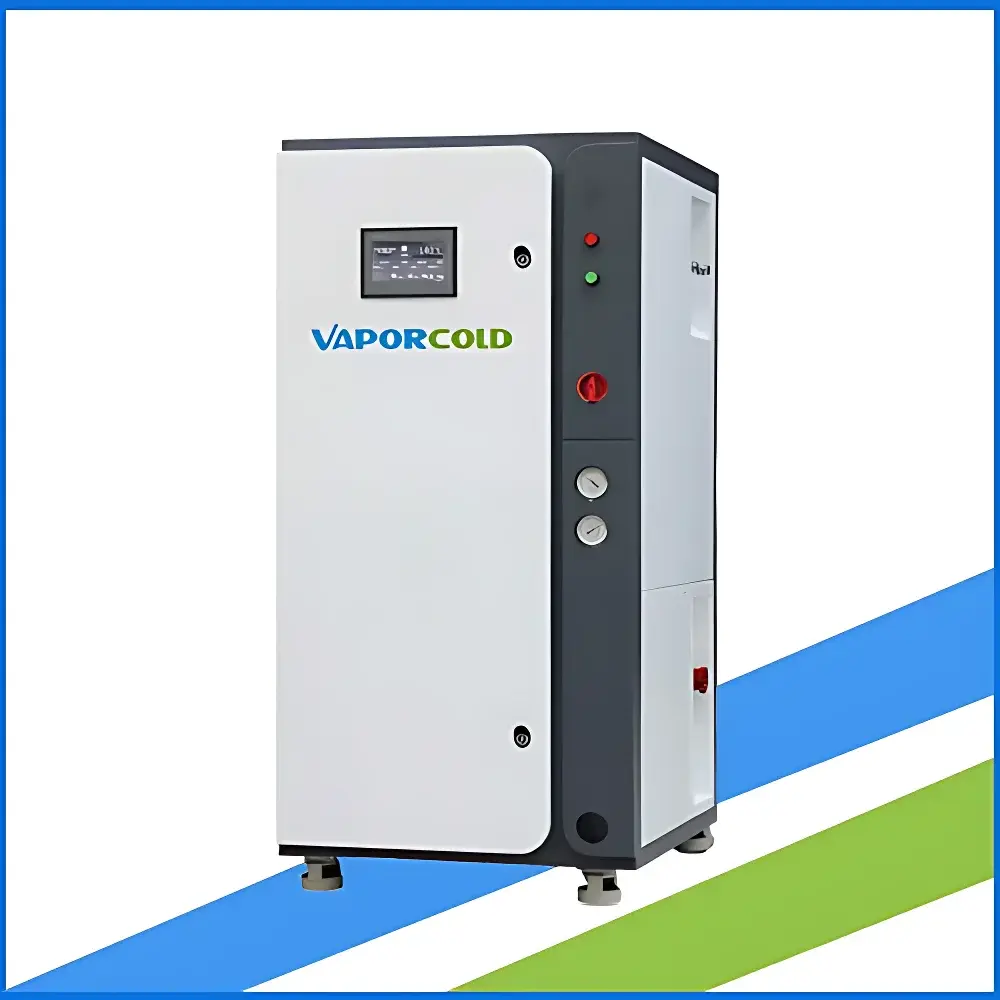
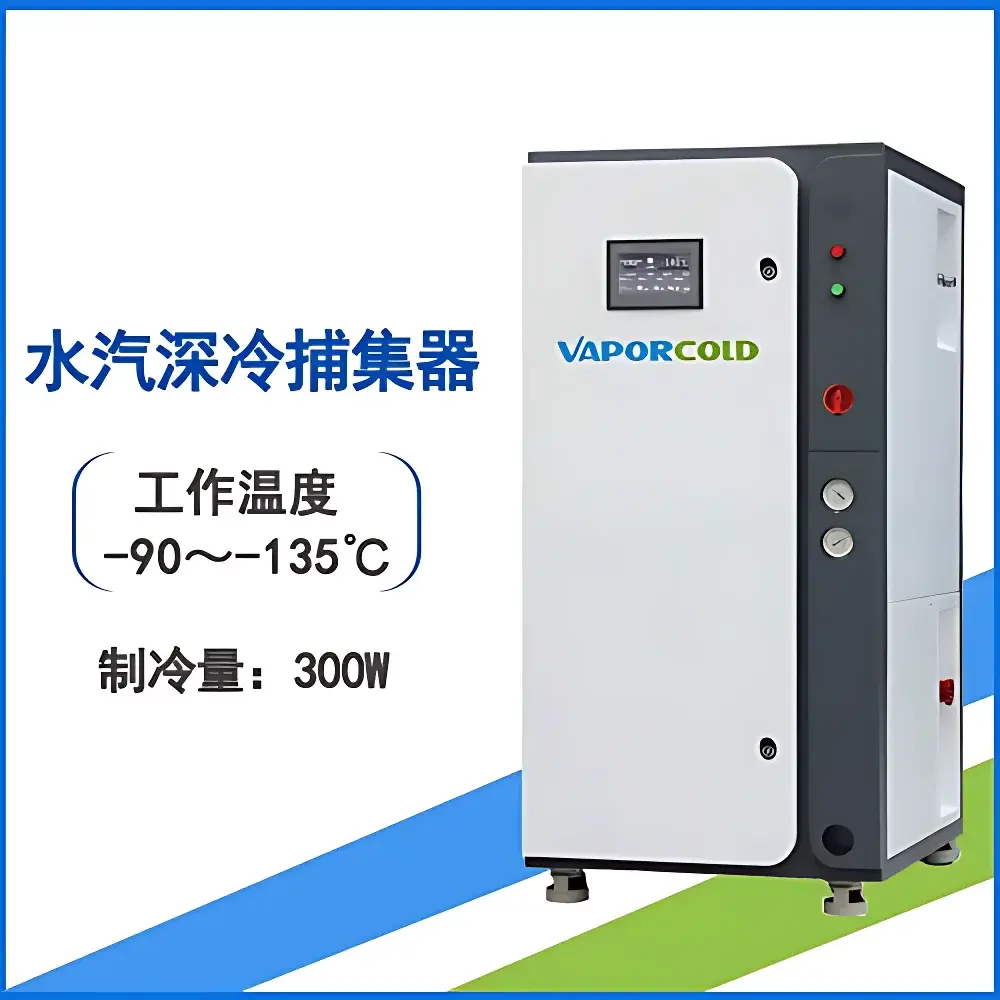
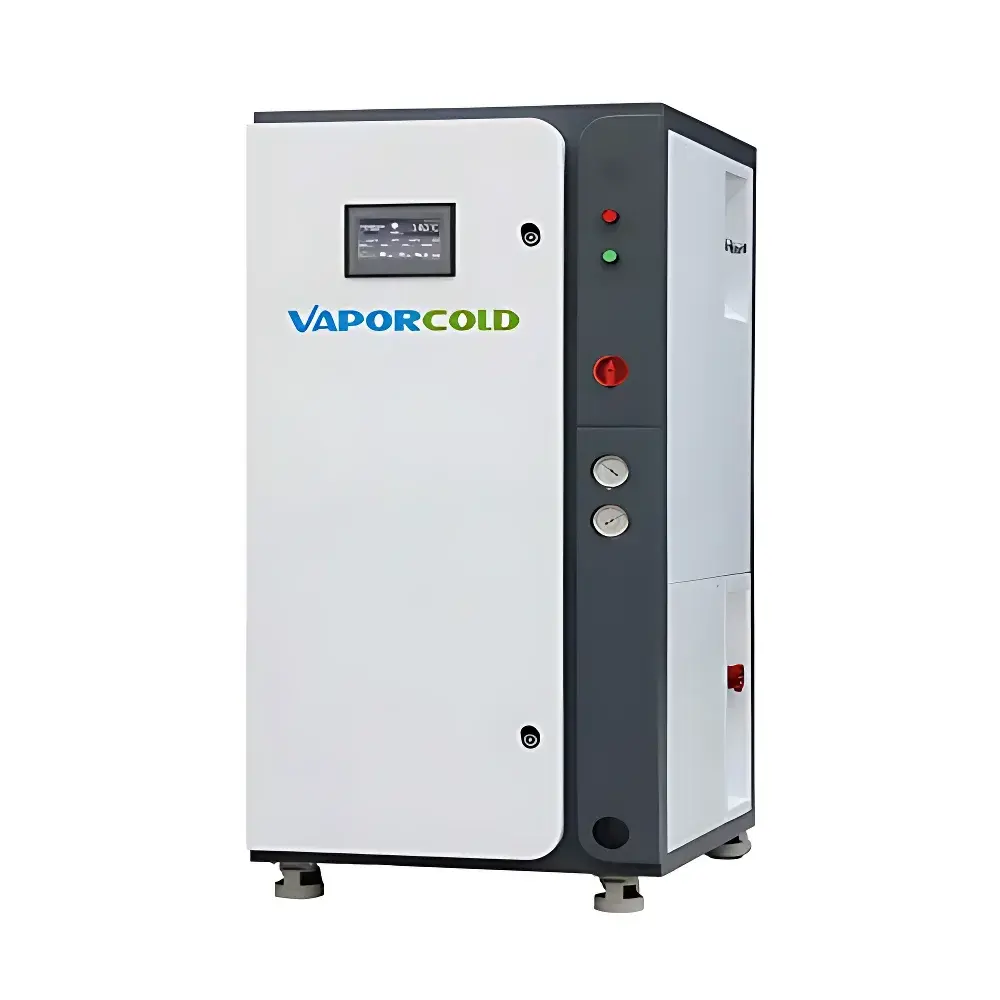
Coolium VPC-300 Vapor Polycooler Cryogenic Water Vapor Trap System
| Brand | Coolium |
|---|---|
| Origin | Beijing, China |
| Model | VPC-300 |
| Ultimate Vacuum | 1.5×10⁻⁹ torr |
| Maximum Water Vapor Pumping Speed | 250,000 L/s |
| Dimensions (W×D×H) | 500 × 550 × 1200 mm |
| Operating Temperature Range | −100 °C to −150 °C (down to −165 °C) |
| Refrigerant | Eco-friendly mixed refrigerant |
| Cooling Method | Air-cooled (ambient 5–35 °C) |
| Electrical Supply | 380 V / 3-phase / 50 Hz / 6.5 kW |
| Safety Protections | 6-channel (discharge pressure high/low, discharge temperature high, condensing temperature out-of-range, compressor overload/overheat, phase sequence error) |
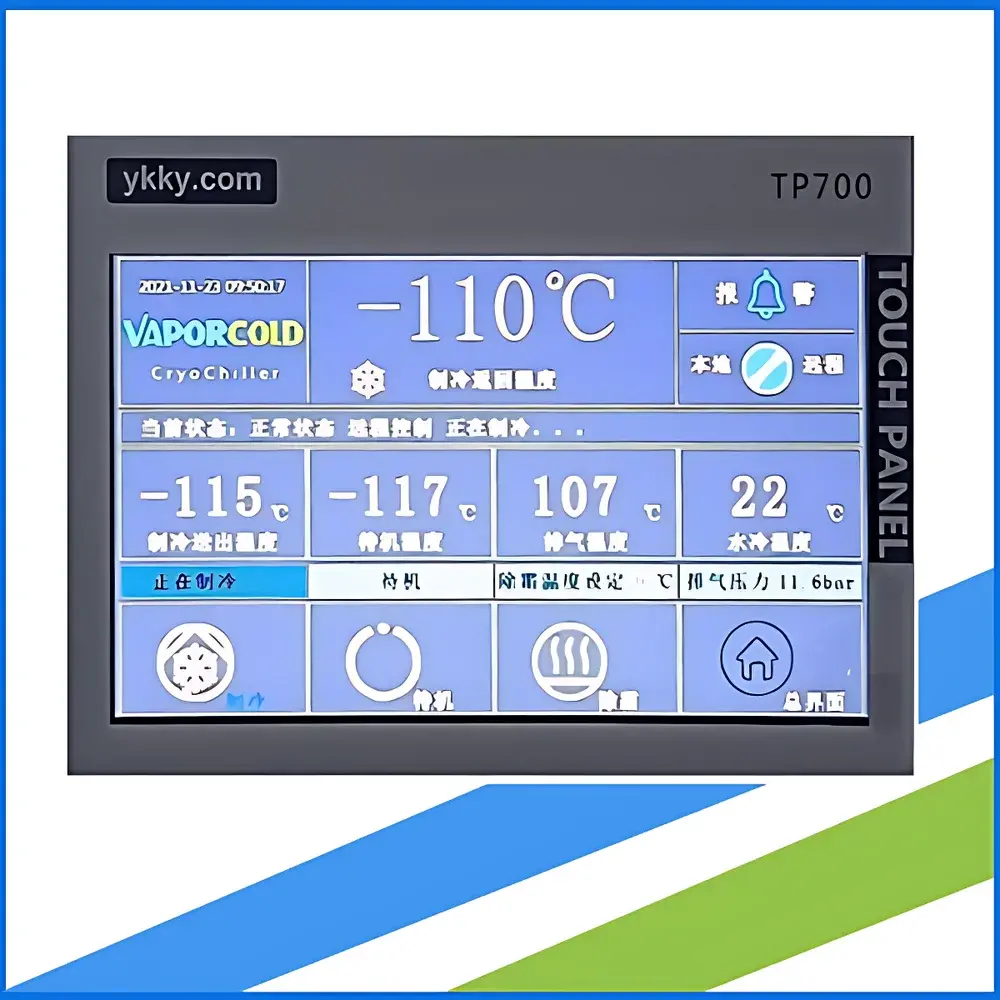
| Control Interface | Local HMI + RS485 remote communication |
| Dual-load capability | Yes |
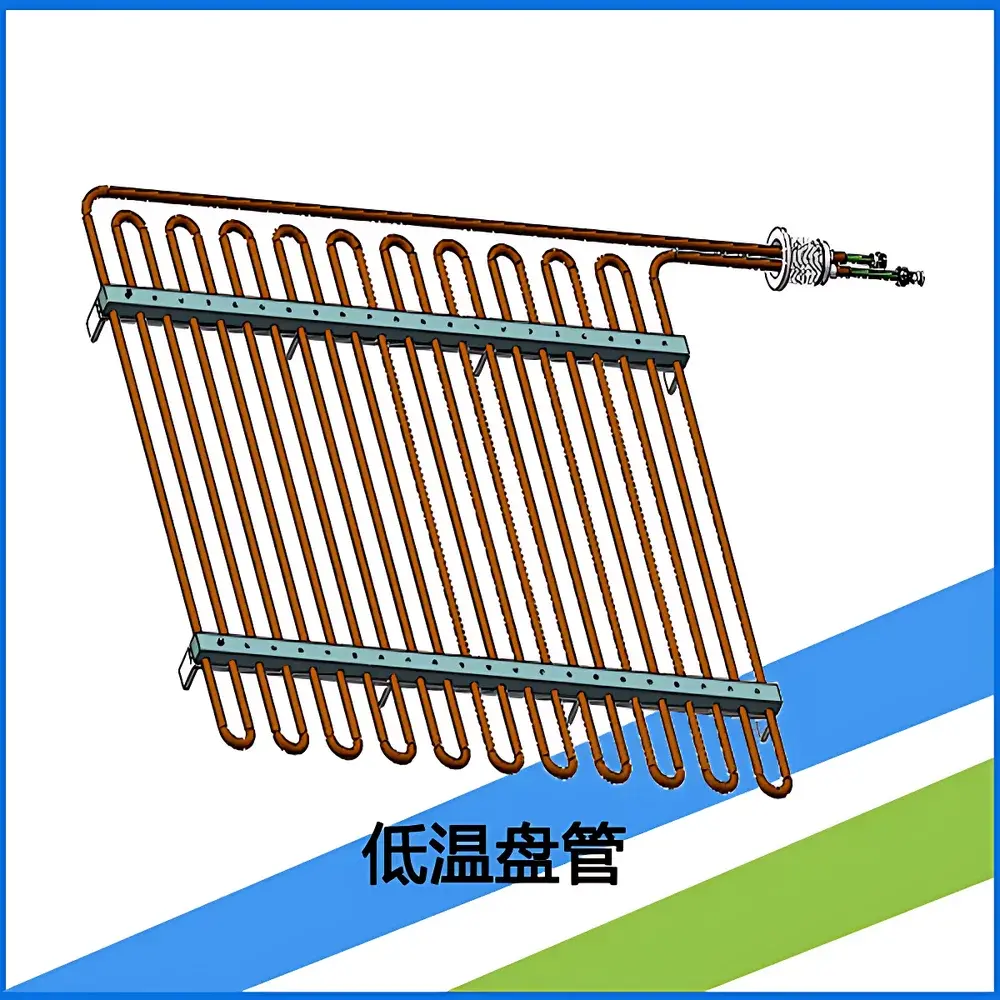
| Cryocoil surface area | 1.0 m² |
Overview
The Coolium VPC-300 Vapor Polycooler is a high-performance cryogenic water vapor trap system engineered for ultra-high vacuum (UHV) and high-vacuum (HV) applications where residual water vapor—constituting 65–95% of the residual gas load—must be rapidly and selectively removed. Unlike mechanical roughing pumps or diffusion pumps, which exhibit poor pumping efficiency for polar, condensable vapors, the VPC-300 employs cryosorption via a continuously cooled低温 surface (−100 °C to −150 °C, extendable to −165 °C) mounted either as a cryocoil inside the vacuum chamber or as a cryobaffle at the foreline or diffusion pump inlet. This principle leverages physical condensation and physisorption on ultra-cold metallic surfaces, achieving exceptional water vapor capture kinetics without chemical reaction or consumables. The system reduces pump-down time by 25–75% compared to conventional configurations, directly improving process throughput, film purity, and coating reproducibility in thin-film deposition systems.
Key Features
- Ultra-low operating temperature range: −100 °C to −150 °C (configurable down to −165 °C), enabling efficient condensation of H2O, hydrocarbons, and high-boiling-point organics
- Water vapor pumping speed of 250,000 L/s—among the highest in its class for air-cooled cryotrap systems
- Ultimate vacuum capability of 1.5×10⁻⁹ torr when integrated into a well-baked, leak-tight UHV system
- Single-stage auto-cascade refrigeration architecture using environmentally compliant mixed refrigerants (non-CFC, low-GWP)
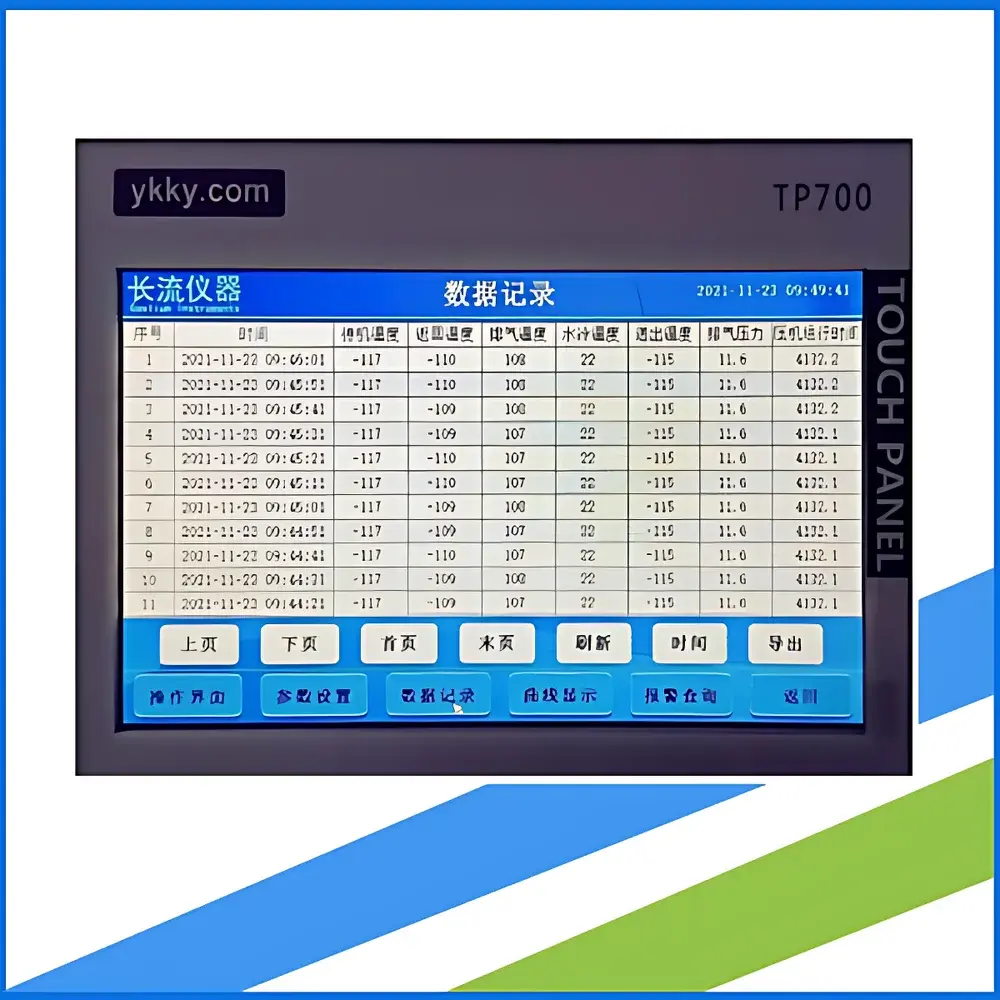
- Integrated 8-channel temperature monitoring: cryocoil inlet/outlet, multi-stage evaporator stages, exhaust, and cooling water loop
- Six independent safety interlocks: discharge pressure (high/low), discharge temperature (high), condensing temperature (out-of-range), compressor overload/overheat, and mains phase-sequence verification
- Dual-load configuration support—enabling simultaneous connection to two vacuum chambers or process zones via optional manifold
- Intuitive local HMI with real-time status logging; RS485 Modbus RTU interface for integration into SCADA or PLC-based facility control systems
- Air-cooled design (rated for ambient 5–35 °C); no external chiller or liquid nitrogen required—reducing operational cost and infrastructure complexity
Sample Compatibility & Compliance
The VPC-300 is compatible with standard ISO-KF, CF, and ISO-F flange interfaces (custom flanges available upon request). Its cryocoil (1.0 m² active surface area, Ø16 mm tube, 14 m length) is optimized for high-gas-load environments typical in optical, architectural, and flexible roll-to-roll sputtering and evaporation systems. The cryobaffle variant suppresses oil backstreaming from diffusion pumps while concurrently removing water vapor—supporting compliance with ISO 20483 (vacuum technology — terminology), ASTM F2438 (standard guide for vacuum system contamination control), and USP particulate matter testing prerequisites requiring low-humidity vacuum environments. All electrical components meet IEC 61000-6-2/6-4 immunity and emission standards; CE marking is provided per Machinery Directive 2006/42/EC and Low Voltage Directive 2014/35/EU.
Software & Data Management
The embedded controller logs timestamped temperature, pressure, compressor current, and alarm history with ≥30-day retention. Data export is supported via USB or RS485 to CSV-compatible formats for traceability under GLP/GMP frameworks. Optional firmware upgrade enables 21 CFR Part 11-compliant audit trails—including user login tracking, parameter change logging, and electronic signature support—for regulated R&D and production environments. Remote diagnostics and firmware updates are accessible via secure TCP/IP gateway (optional add-on).
Applications
- Optical coating systems: Reducing H2O-induced absorption bands in anti-reflective, high-reflector, and filter stacks
- Roll-to-roll metallization: Minimizing oxidation during aluminum or silver deposition on polymer substrates
- Surface analysis tools (XPS, AES): Maintaining base pressure <5×10⁻¹⁰ torr during sample transfer and analysis
- Accelerator beamlines and synchrotron front-ends: Mitigating electron-stimulated desorption (ESD) from water monolayers
- MEMS packaging and hermetic sealing: Ensuring low-hydrogen-content cavity environments prior to lid bonding
- Research-scale molecular beam epitaxy (MBE): Stabilizing background partial pressure of H2O below 10⁻¹¹ torr equivalent
FAQ
Can the VPC-300 replace liquid nitrogen cryopanels in existing UHV systems?
Yes—when retrofitted with appropriate flange adapters and thermal shielding, the VPC-300 provides comparable or superior water vapor conductance without LN₂ logistics, boil-off losses, or thermal cycling fatigue.
What is the expected maintenance interval for the refrigeration system?
Under continuous operation at rated ambient conditions, compressor and refrigerant service is recommended every 24 months; no routine oil changes or filter replacements are required due to hermetic scroll compressor design and sealed-loop architecture.
Is the cryocoil compatible with aggressive plasma cleaning cycles?
The stainless-steel cryocoil (316L grade) withstands repeated exposure to O2, Ar/O2, and N2/H2 plasmas when operated above −100 °C during plasma ignition; full defrost before plasma initiation is strongly advised.
How does the VPC-300 handle condensed oil vapors from diffusion pumps?
Oil vapors condense effectively at temperatures below −80 °C; however, long-term accumulation may reduce effective surface area. Scheduled thermal regeneration (defrost cycle) restores >98% of initial pumping speed for hydrocarbons.
Can the system be integrated into a vacuum interlock safety chain?
Yes—the unit provides dry-contact relay outputs for “Ready,” “Alarm,” and “Defrost Active” states, fully compatible with vacuum interlock logic controllers per ISO 13850 requirements.



