
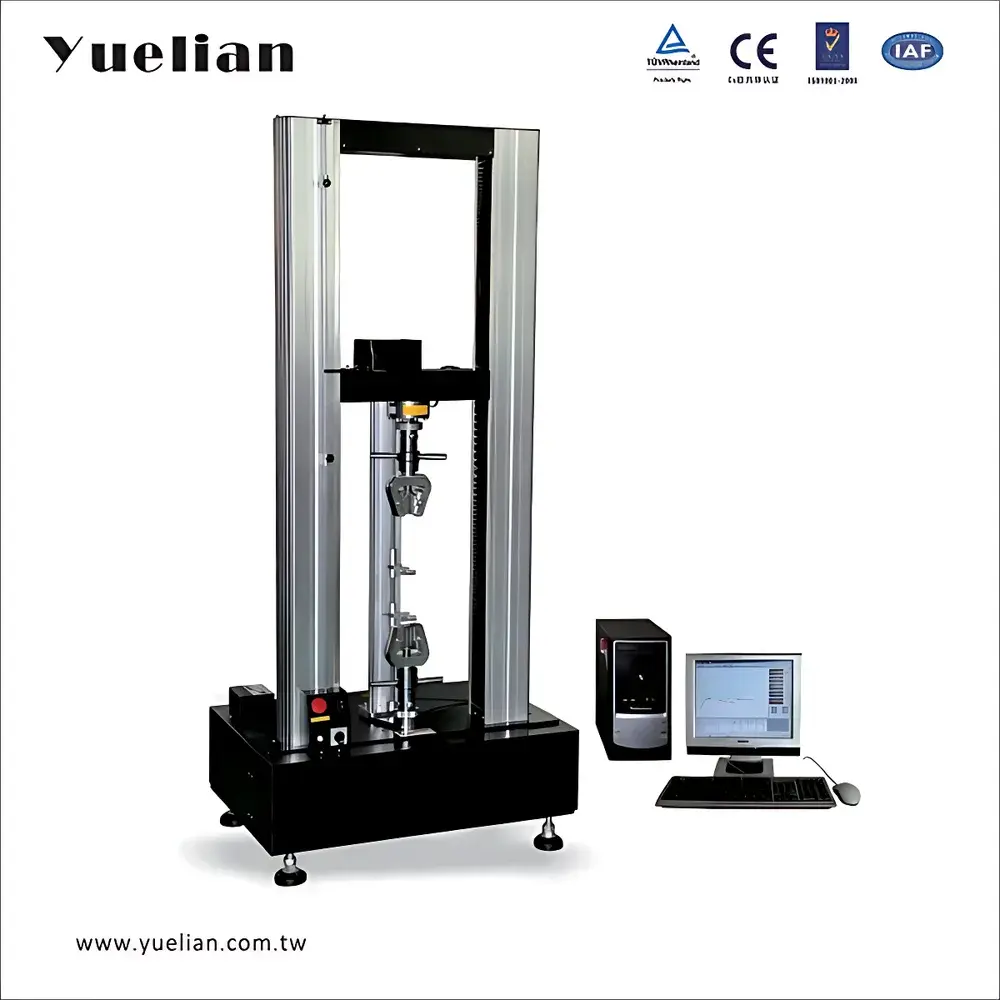
Copper Alloy Bending Tester – Yuelian YL-1125 Universal Testing Machine
| Brand | Yuelian |
|---|---|
| Origin | Guangdong, China |
| Manufacturer Type | Authorized Distributor |
| Country of Origin | China |
| Model | YL-1125 |
| Quotation | Upon Request |
| Capacity Options | 10 N to 50 kN (dual-range configuration available) |
| Force Resolution | 1/500,000 full scale |
| Force Accuracy | ±0.3% of reading |
| Displacement Resolution | 1/500,000 full stroke |
| Test Speed Range | 0.01–1000 mm/min (software-controlled) |
| Maximum Stroke | 1200 mm |
| Test Width | 420 mm |
| Drive System | Servo motor with precision ball screw and timing belt transmission |
| Power Supply | 220 V, 50/60 Hz, 10 A |
| Rated Power | 750 W |
| Dimensions (W×D×H) | 92 × 62 × 199 cm |
| Weight | ~422 kg |
| Compliance Standards | ISO 7500-1, ASTM E4, JJG 475-88, EN 10002-1, EN 10002-2, DIN 51221, JIS B7721/B7733, BS 1610, GB/T 228.1–2021, GB/T 1449–2005, GB/T 9341–2008, ASTM D6109–2010 |
Overview
The Yuelian YL-1125 Universal Testing Machine is an electromechanical static testing system engineered for high-reproducibility mechanical characterization of metallic and non-metallic materials under controlled uniaxial loading conditions. While commonly referenced as a “copper alloy bending tester,” its architecture supports standardized three-point and four-point flexural testing per ISO 178, ASTM D790, and GB/T 9341–2008—making it equally suitable for tensile, compressive, shear, peel, and tear evaluations. The system operates on the principle of load-cell-based force transduction coupled with high-resolution linear displacement measurement via precision ball-screw-driven crosshead motion. Its rigid C-frame construction, low-inertia servo drive, and real-time closed-loop control ensure minimal compliance error and consistent strain-rate fidelity across test protocols—critical for generating data compliant with ISO/IEC 17025-accredited laboratories.
Key Features
- Modular load capacity selection: 10 N to 50 kN, with optional dual-range sensor configurations enabling high-resolution measurement at low forces and robust overload tolerance at peak loads.
- High-fidelity motion control: Servo-motor-driven actuation with timing-belt-coupled precision ball screw delivers ±0.01 mm positioning repeatability and programmable ramp-hold profiles per ASTM E2309.
- Real-time data acquisition: 1/500,000 internal resolution for both force and displacement channels ensures detection of subtle yield transitions and post-yield plasticity in copper alloys and composites.
- Multi-standard test automation: Pre-configured test methods for GB/T 1449–2005 (three-point flexure), GB/T 9341–2008 (four-point flexure), ASTM D6109–2010 (flexural properties of wood-based panels), and ISO 12135 (fracture toughness).
- Full safety integration: Dual-channel overload protection, emergency stop circuitry, specimen rupture auto-stop, and software-defined upper/lower travel limits conform to EN ISO 13850 and ANSI B11.19 requirements.
- Thermal-stable mechanical design: Cast-iron base and reinforced steel frame minimize thermal drift and vibration coupling during long-duration creep or cyclic bending tests.
Sample Compatibility & Compliance
The YL-1125 accommodates standard flexural specimens per ISO 178 (plastics), ASTM D790 (rigid plastics), and GB/T 232–2010 (metallic materials), including rectangular cross-sections up to 420 mm wide and 1200 mm span length. It supports both fixed-support and roller-support boundary conditions required for ASTM D6109 four-point bending configurations. All force and displacement measurements are traceable to national metrological standards (JJG 475–2018 for universal testing machines) and certified per ISO 7500-1 Class 0.5 accuracy. The system meets mechanical safety requirements outlined in EN 1010-1 and supports GLP/GMP documentation workflows through audit-trail-enabled software logging aligned with FDA 21 CFR Part 11 principles.
Software & Data Management
The embedded PC-based control suite provides ISO/IEC 17025-compliant data handling: real-time curve plotting (stress–strain, load–deflection), automatic identification of proportional limit, yield point (0.2% offset method), ultimate flexural strength, and chord modulus calculation. Raw data is stored in encrypted MS-ACCESS databases with timestamped operator ID, environmental metadata (optional temperature/humidity input), and calibration history linkage. Export formats include CSV, PDF test reports with digital signature support, and XML for LIMS integration. Multi-sensor synchronization allows concurrent use of extensometers, video extensometry, or acoustic emission modules without hardware modification.
Applications
- Mechanical qualification of wrought copper alloys (e.g., C11000, C17200, C26000) per ASTM B152/B135 for electrical conductivity–strength trade-off analysis.
- Flexural rigidity assessment of copper-clad laminates used in PCB substrates under IPC-TM-650 2.4.14.1.
- Quality control of brazed copper joints in heat exchanger tubing per ASME BPVC Section IX.
- Development validation of copper–graphene nanocomposites where bending modulus correlates with interfacial load transfer efficiency.
- Comparative fatigue pre-screening via repeated three-point bending cycles under constant amplitude (ASTM E466).
FAQ
Does the YL-1125 comply with ASTM E4 calibration requirements for verification of force-measuring systems?
Yes—the system includes factory-certified calibration certificates traceable to NIM (China National Institute of Metrology) and supports user-performed verifications per ASTM E4 Annex A1 using Class E1 deadweight standards.
Can the machine perform ISO 12135-compliant fracture toughness testing on copper alloy CT specimens?
While not configured as a dedicated fracture mechanics tester, the YL-1125 can execute R-curve testing with clip-gauge extensometry and compliance calibration when equipped with appropriate fixtures and software modules.
Is the control software validated for regulated environments such as medical device material testing per ISO 10993-12?
The software architecture supports 21 CFR Part 11 compliance packages—including electronic signatures, change control logs, and role-based access—upon installation of optional validation documentation kits.
What is the maximum specimen thickness supported in four-point bending mode?
With standard support rollers (Φ10 mm), the effective maximum thickness is 50 mm; custom roller sets with larger diameters (up to Φ25 mm) are available for thicker structural copper sections.
Does the system provide real-time modulus calculation during bending tests?
Yes—tangent, secant, and chord moduli are computed dynamically from the initial linear region of the load–deflection curve, with user-definable slope thresholds and outlier rejection filters.



