
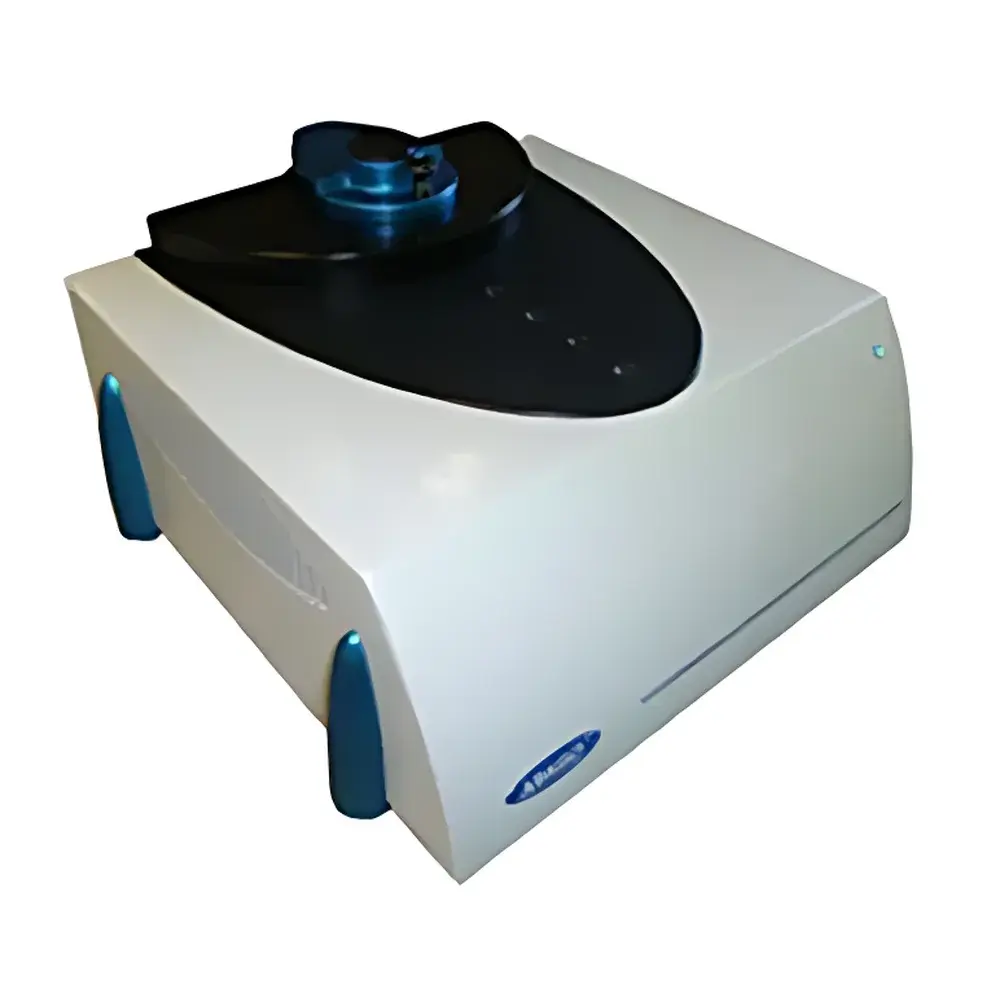
Cordouan-Arago ε Refractometer
| Origin | France |
|---|---|
| Manufacturer Type | Authorized Distributor |
| Origin Category | Imported |
| Model | Cordouan-Arago ε Refractometer |
| Quotation | Upon Request |
| Measurement Principle | Critical Angle Refraction at Prism-Sample Interface |
| Measuring Range (nD) | 1.25–1.51 or 1.51–1.75 |
| Resolution (nD) | ±0.00001 |
| Accuracy (nD) | ±0.0001 |
| Temperature Control | Peltier-Regulated, Ambient to 65 °C |
| Prism Material | BK7 Optical Glass |
| Wavelength | 635 nm |
| Light Source | Stabilized Laser Diode with Integrated Peltier Thermal Management |
| Sample Cell Material Options | 316 Stainless Steel or Inconel® Alloy |
| Interface | USB 2.0 (Bidirectional PC Communication) |
| Power Supply | 100–240 V AC, 50/60 Hz, 10–50 W |
| Dimensions (L×W×H) | 10 × 24 × 27 cm |
| Weight | 8 kg |
| Display & Control | Touchscreen Interface or PC-Based Software (English/French) |
| Brix Range | 0–95 % w/w, Uncertainty: ±0.002 %, Repeatability & Accuracy: ±0.01 % |
Overview
The Cordouan-Arago ε Refractometer is a high-precision, temperature-controlled critical-angle refractometer engineered for laboratory and industrial quality control applications requiring traceable, repeatable refractive index (nD) measurements. Based on the fundamental optical principle of total internal reflection at the prism–sample interface, the instrument determines nD by precisely locating the critical angle boundary between the calibrated BK7 prism and the liquid sample. This method eliminates reliance on empirical calibration curves and enables direct, first-principles-based determination of refractive index with metrological integrity. Designed and manufactured in France, the ε model serves as the entry-tier platform within the Arago series—offering full Peltier-assisted thermal stabilization (15–65 °C), laser diode illumination at 635 nm, and real-time digital signal processing for sub-microrefractive resolution. Its architecture meets core requirements for GLP-compliant environments, supporting audit-ready data capture when operated under validated software protocols.
Key Features
- Patented ergonomic housing with integrated thermal shielding and protective sample chamber cover for stable thermal equilibrium during volatile or low-boiling-point sample analysis
- Optically optimized BK7 prism with precision-polished surface geometry ensuring minimal Fresnel error—critical for accurate near-zero-angle approximation in high-index media
- Automated laser shutoff mechanism compliant with IEC 60825-1 Class 1 safety standards, eliminating operator exposure risk during idle or maintenance states
- Modular sample cell design available in electropolished 316 stainless steel or corrosion-resistant Inconel® alloy—suitable for aggressive solvents, concentrated acids/bases, and high-temperature process streams
- Integrated Peltier thermoelectric module enabling rapid, stable temperature control (±0.1 °C) across the 15–65 °C operating range without external chillers or baths
- Touchscreen HMI with multilingual (English/French) GUI or optional PC-hosted software for remote operation, parameter scripting, and SOP-driven measurement sequences
- USB 2.0 interface supporting bidirectional communication, firmware updates, and raw data export in CSV/ASCII format for LIMS integration
- Low-power architecture (10–50 W typical draw) optimized for continuous-duty deployment in QC labs and pilot-scale production lines
Sample Compatibility & Compliance
The Cordouan-Arago ε accommodates a broad spectrum of optically heterogeneous samples—including deeply colored, turbid, or highly viscous liquids—without dilution or filtration. Its robust optical path design mitigates scattering artifacts common in conventional Abbe-style refractometers. The instrument complies with ISO 21747:2020 (Refractometry — General principles and practice), ASTM D1218 (Standard Test Method for Refractive Index of Hydrocarbon Liquids), and USP (Refractometry). When operated with validated software and enabled audit-trail logging, it satisfies FDA 21 CFR Part 11 requirements for electronic records and signatures in regulated pharmaceutical and food manufacturing settings. All materials in contact with samples conform to FDA 21 CFR 177.2400 (food-contact polymers) and EU Regulation (EC) No 1935/2004.
Software & Data Management
The bundled Cordouan Control Suite provides full instrument orchestration via Windows-compatible desktop application. It supports customizable measurement templates, automated temperature ramping, multi-point calibration validation (NIST-traceable sucrose standards), and Brix-to-nD conversion per ICUMSA Methods Book. Raw angular data, temperature logs, and user annotations are timestamped and stored with immutable metadata—including operator ID, instrument serial number, and environmental conditions. Export formats include CSV, PDF reports (with digital signature fields), and XML for seamless ingestion into enterprise LIMS or ELN platforms. Optional 21 CFR Part 11 compliance package includes role-based access control, electronic signature workflows, and tamper-evident audit trails meeting GxP documentation standards.
Applications
- Petroleum & Petrochemicals: nD verification of light distillates (gasoline, kerosene), aromatic hydrocarbons (benzene, toluene, xylene), and olefin intermediates (cyclohexene, styrene) per ASTM D1218 and IP 170
- Fats & Oils: Quality assessment of edible oils (olive, palm, soybean, coconut) at 25 °C; detection of adulteration or oxidation-induced index shifts
- Pharmaceuticals & Fragrances: Identity testing and purity verification of high-value solvents, essential oils, and active pharmaceutical ingredients using minimal sample volume (≤0.5 mL)
- Fruit & Honey Analysis: Brix quantification for harvest timing optimization, honey authenticity screening (EU Directive 2001/110/EC), and jam/syrup solids content verification per AOAC 932.12
- Beverages & Condiments: Total soluble solids (TSS) monitoring in soft drinks, sauces (soy, ketchup), and dressings—correlating directly with formulation consistency and shelf-life stability
FAQ
What is the minimum sample volume required for measurement?
Typical volume is 0.3–0.5 mL, depending on cell configuration and surface tension characteristics.
Can the instrument measure opaque or dark-colored samples?
Yes—the critical-angle detection algorithm is insensitive to sample absorption or turbidity, unlike intensity-based photometric methods.
Is temperature calibration traceable to national standards?
The integrated Peltier sensor is factory-calibrated against NIST SRM 1474b (thermistor reference standard); certificate included with delivery.
How does the ε model differ from the ω and ∞ variants?
The ε variant uses BK7 prisms and covers 1.25–1.51 or 1.51–1.75 nD ranges; ω extends to 1.75 and adds silicon prism; ∞ supports up to nD = 3.10 with sapphire prism and enhanced resolution.
Does the system support automated calibration verification?
Yes—software-guided multi-point validation using certified sucrose standards is fully scripted and reportable.



