
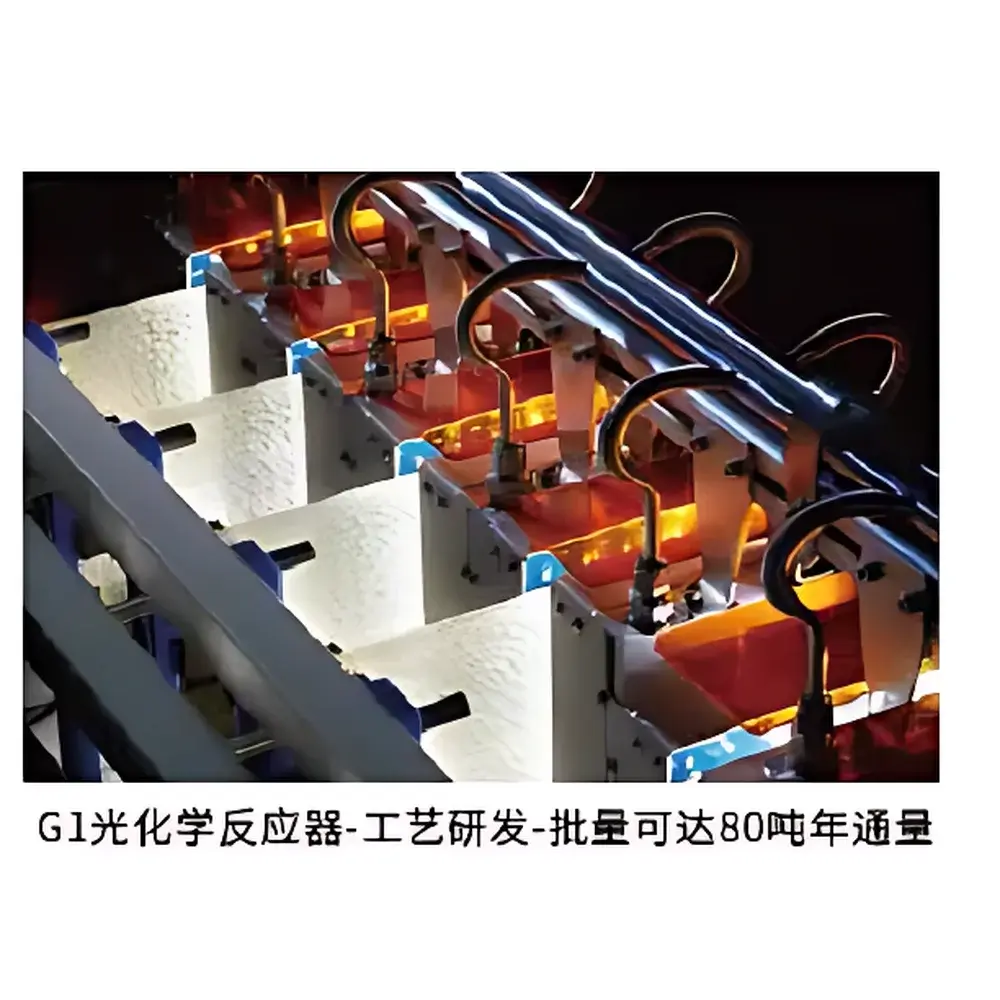
Corning Advanced-Flow® G1 Photochemical Reactor
| Brand | Corning |
|---|---|
| Origin | USA |
| Manufacturer Type | Authorized Distributor |
| Origin Category | Imported |
| Model | Advanced-Flow® G1 |
| Pricing | Upon Request |
Overview
The Corning Advanced-Flow® G1 Photochemical Reactor is an engineered continuous-flow platform designed for precise, scalable, and reproducible photochemical synthesis under controlled UV–visible irradiation. Built upon Corning’s proprietary Advanced-Flow® glass microstructure technology, the G1 integrates high-transmittance borosilicate glass reaction channels with a modular, multi-wavelength LED illumination system. Its core operating principle relies on uniform photon delivery across the entire flow cross-section—enabled by bilateral illumination geometry and optimized optical path length—thereby minimizing photon gradient effects common in batch photoreactors. This architecture ensures consistent photon flux density (typically up to 100 mW/cm²), enabling reliable quantum yield determination, kinetic studies, and process intensification of light-driven transformations including [2+2] cycloadditions, C–H functionalizations, arylations, and late-stage functionalizations. The reactor operates within a defined thermal envelope via integrated liquid cooling, maintaining stable LED output and channel wall temperatures below 40 °C during extended operation—critical for thermally sensitive substrates and catalysts.
Key Features
- Bilateral illumination design using high-purity borosilicate glass modules—maximizing photon penetration and minimizing shadowing or edge effects
- Modular, independently addressable LED arrays (up to 10 per unit) supporting discrete wavelength selection: 365 nm, 385 nm, 405 nm, 485 nm, 610 nm, and 4000 K white light—configurable per application need
- Adjustable irradiance control (0–100% intensity) with real-time monitoring and digital feedback stabilization for inter-experimental reproducibility
- Robust pressure rating up to 18 bar (260 psi), compatible with pressurized solvent systems and gas–liquid photochemistry (e.g., photooxidations, photocatalytic reductions)
- Continuous flow rate range: 10–150 mL/min—optimized for residence time control from seconds to minutes, supporting kinetic profiling and steady-state optimization
- Scalable architecture: Up to five G1 modules can be serially connected without re-optimization, preserving linear scale-up behavior from lab to pilot scale
- Liquid-cooled LED housing extends diode lifetime beyond 15,000 hours while maintaining spectral stability and thermal drift < ±0.5 nm over 100-h continuous operation
Sample Compatibility & Compliance
The G1 accommodates a broad range of organic solvents (e.g., acetonitrile, THF, DMF, methanol, dichloromethane), aqueous buffers, and heterogeneous slurries containing supported photocatalysts (e.g., TiO₂, Ru(bpy)₃²⁺ immobilized on silica). Its all-glass fluidic path eliminates metal leaching and adsorption artifacts, making it suitable for pharmaceutical intermediate synthesis under ICH Q5A/Q5D guidelines. The system complies with CE marking requirements for laboratory equipment (2014/30/EU EMC Directive and 2014/35/EU LVD Directive) and supports GLP-compliant operation when paired with validated data acquisition software. Optional integration with Corning’s G3 platform enables seamless tech transfer aligned with ASTM E2500-13 (Standard Guide for Specification, Design, and Verification of Pharmaceutical and Biopharmaceutical Manufacturing Systems) and FDA 21 CFR Part 11–ready audit trails.
Software & Data Management
The reactor interfaces with Corning’s Flow Control Suite™ (v3.2+), a Windows-based application supporting synchronized control of flow rates (via external syringe or HPLC pumps), LED intensity/wavelength selection, temperature logging, and pressure monitoring. All operational parameters—including photon fluence (J/cm²), residence time distribution (RTD) modeling outputs, and cumulative irradiation dose—are timestamped and exportable in CSV or .xlsx format. The software includes built-in calibration routines for radiometric validation using NIST-traceable photodiode sensors and supports IQ/OQ documentation packages for regulated environments. Audit trail functionality meets ALCOA+ principles, with user-level access control, electronic signatures, and immutable parameter history logs.
Applications
- Kinetic mapping of photoinduced electron transfer (PET) and energy transfer (EnT) pathways
- Development of visible-light-mediated C–N, C–O, and C–S bond formations under mild conditions
- Photocatalytic asymmetric synthesis using chiral iridium or ruthenium complexes
- Scale-down process validation for G3 commercial-scale photoreactors (1:10 geometric similarity)
- High-throughput screening of photocatalyst libraries with automated wavelength/intensity sweeps
- Photochemical degradation studies compliant with OECD 316 (abiotic photolysis testing)
FAQ
What wavelengths are standard on the G1 system?
The base configuration includes six discrete LED options: 365 nm, 385 nm, 405 nm, 485 nm, 610 nm, and 4000 K white light. Custom wavelengths (e.g., 312 nm, 525 nm) are available upon engineering review.
Can the G1 handle solid suspensions or heterogeneous catalysts?
Yes—channel dimensions (typically 1.5 mm hydraulic diameter) and smooth glass surface enable stable flow of slurries with particle sizes < 50 µm; optional inline ultrasonic assist modules are available for enhanced dispersion.
Is the system compatible with inert atmosphere operation?
Fully compatible—standard fittings support Schlenk-line integration or direct connection to nitrogen/purge gas manifolds; all wetted materials are rated for O₂-free operation down to <1 ppm residual oxygen.
How is photon flux calibrated and verified?
Each LED array undergoes factory radiometric calibration using a NIST-traceable spectroradiometer; users receive a certificate of conformance and may perform field verification using optional handheld photodiode sensors (Corning PFS-100 series).
Does the G1 support regulatory submissions for pharmaceutical development?
Yes—the hardware, software, and documentation package are designed to support ICH M4 Q5/Q8/Q9 submissions; full 21 CFR Part 11 compliance requires deployment with validated third-party LIMS or ELN integration.



