
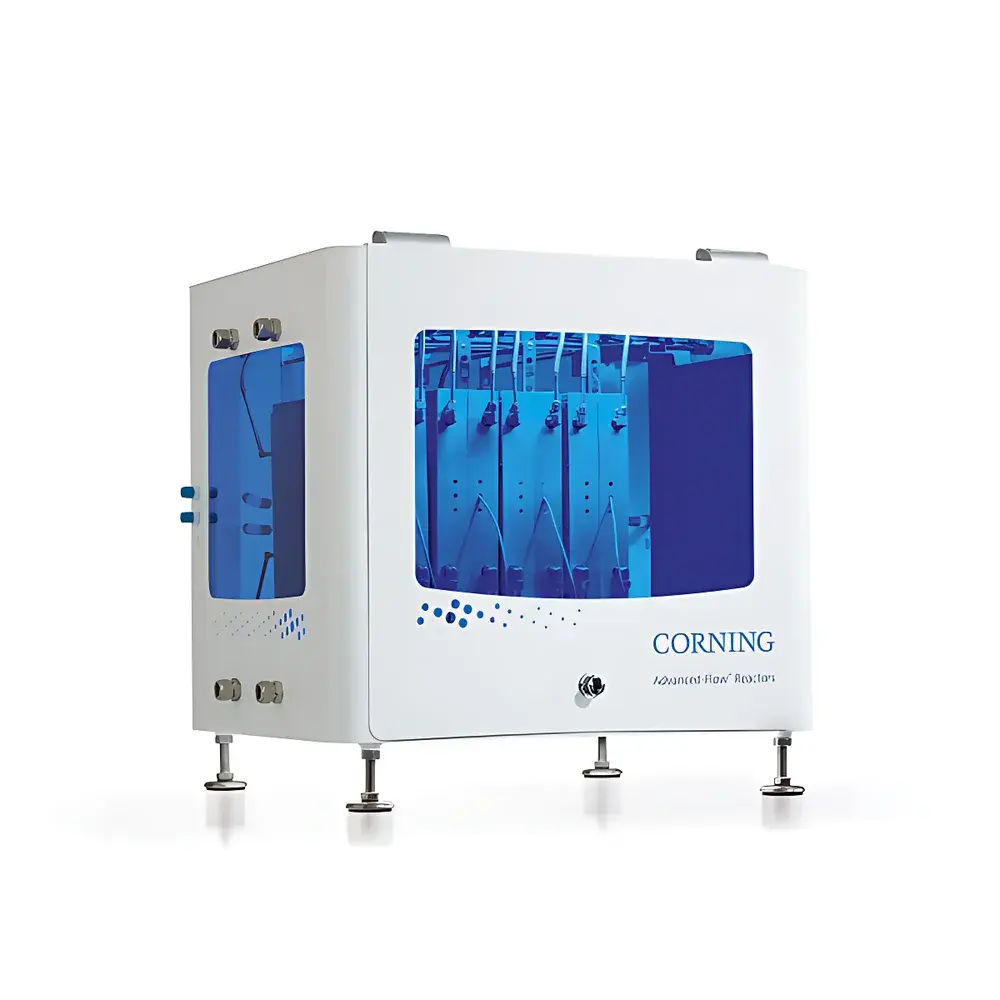
Corning G3 Glass Microchannel Reactor for Photochemistry
| Brand | Corning |
|---|---|
| Origin | France |
| Manufacturer Type | Authorized Distributor |
| Origin Category | Imported |
| Model | G3 |
| Instrument Category | Microchannel Reactor |
| Usable Volume | Small-scale |
| Material | Borosilicate Glass |
| Operating Pressure | Medium-pressure (up to 1.8 MPa) |
| Capacity | 63 mL |
| Temperature Range | −25 °C to 200 °C |
| Optical Transmission | Full-Visible to Near-UV |
| Light Source Compatibility | Corning-qualified LED arrays (6 discrete wavelengths) |
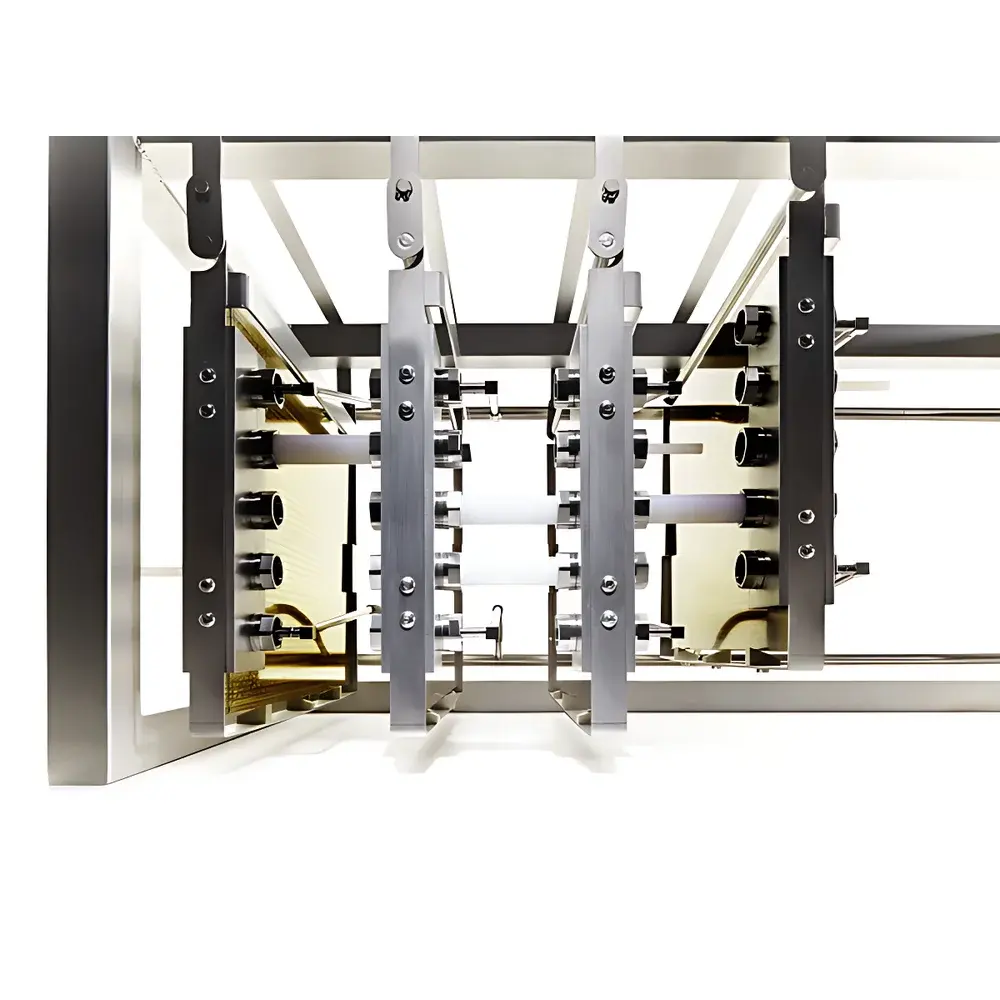
| Illumination Configuration | Dual-side planar illumination |
| Cooling Method | Integrated liquid-cooled heat sink for LED modules |
| Scalability | Direct process transfer from Corning G1 to G3 platform |
| Compliance | Designed per ISO 9001 manufacturing standards |
Overview
The Corning G3 Glass Microchannel Reactor is an engineered continuous-flow system designed for high-integrity chemical synthesis and photochemical transformation under controlled thermal, pressure, and photonic conditions. Built on Corning’s proprietary fused borosilicate glass architecture, the G3 platform leverages microfluidic principles—specifically laminar flow, high surface-area-to-volume ratios, and precisely defined channel geometries—to deliver exceptional mass and heat transfer performance. Unlike stainless-steel or PTFE-based reactors, its all-glass fluidic path eliminates metallic leaching and ensures intrinsic chemical inertness across aggressive reagent environments, including strong acids, halogens, oxidizers, and organometallics. The reactor operates within a validated temperature range of −25 °C to 200 °C and withstands sustained pressures up to 1.8 MPa (≈18 bar), enabling safe execution of exothermic, hydrogenation, ozonolysis, and nitration reactions in continuous mode. Its optical clarity supports real-time inline monitoring via UV-Vis spectroscopy and enables uniform photon delivery critical for reproducible photochemical outcomes.
Key Features
- Monolithic borosilicate glass construction with zero metal contact—ensures corrosion resistance and eliminates catalytic interference in sensitive syntheses.
- Dual-side planar illumination geometry optimized for photon penetration depth and irradiance uniformity across the entire 63 mL active reaction volume.
- Integrated liquid-cooled thermal management for LED light sources, maintaining stable junction temperatures and extending operational lifetime beyond 20,000 hours.
- Six factory-calibrated narrowband LED wavelengths (365 nm, 385 nm, 405 nm, 420 nm, 450 nm, and 525 nm) with ±5 nm spectral tolerance—each individually addressable and intensity-controllable.
- Modular interconnection design supporting serial/parallel configuration of multiple G3 units for capacity scaling without re-optimization of residence time or mixing profiles.
- Validated scalability pathway from laboratory-scale Corning G1 (1–5 mL) to pilot-scale G3 (63 mL), preserving dimensionless numbers (e.g., Reynolds, Péclet, Damköhler) to ensure kinetic fidelity during technology transfer.
Sample Compatibility & Compliance
The G3 reactor accommodates homogeneous solutions, suspensions (with particles 500 mPa·s at operating temperature). All wetted surfaces meet USP Class VI and ASTM F898 biocompatibility requirements. The system complies with CE marking directives (2014/30/EU EMC, 2014/35/EU LVD) and supports audit-ready documentation for FDA 21 CFR Part 11 compliance when integrated with validated SCADA or LIMS platforms. Pressure containment conforms to PED 2014/68/EU Category II design criteria.
Software & Data Management
While the G3 hardware operates as a standalone flow module, it is fully interoperable with third-party process control systems (e.g., Emerson DeltaV, Siemens Desigo, or LabVIEW-based DAQ). Corning provides I/O pinout schematics and Modbus TCP register maps for seamless integration. Optional Corning ReactorLink™ firmware (v2.4+) enables timestamped logging of inlet/outlet temperatures, pressure differentials, LED drive current, and coolant flow rate—data structured in CSV/Parquet format with SHA-256 checksums for integrity verification. Audit trails include user authentication, parameter change history, and electronic signatures aligned with ALCOA+ principles.
Applications
- Continuous-flow photoredox catalysis (e.g., [Ir(dF(CF₃)ppy)₂(dtbbpy)]PF₆-mediated C–N couplings)
- High-yield singlet oxygen ene reactions using 1270 nm-sensitized excitation
- Photoinduced electron transfer (PET) cyclizations under anaerobic conditions
- Thermally sensitive API intermediate synthesis requiring sub-zero residence time control
- Scale-up of flow hydrogenations where catalyst fouling limits packed-bed longevity
- In-line quenching and extraction sequences leveraging segmented flow stability
FAQ
What is the maximum allowable backpressure for continuous operation?
The G3 reactor is rated for continuous service at ≤1.8 MPa (18 bar); short-term excursions to 2.0 MPa are permissible for ≤5 minutes per cycle.
Can the G3 be used with corrosive halogenated solvents such as sulfuryl chloride or phosphorus oxychloride?
Yes—borosilicate glass exhibits negligible corrosion rates (<0.1 µm/year) in these media at ≤100 °C; O-ring selection (e.g., Kalrez® 6375) is required for static seals.
Is reactor cleaning validated for multi-product campaigns?
Corning provides a documented cleaning validation protocol (CV-03-G3) based on TOC recovery, HPLC residual assay, and visual inspection per ICH Q5A guidelines.
Does the system support automated wavelength switching during a single run?
Yes—via external TTL or Ethernet command triggering; minimum dwell time per wavelength is 100 ms with <10 ms transition latency.
How is residence time distribution (RTD) characterized for process qualification?
Corning supplies RTD test reports derived from pulse-response tracer studies (NaI/UV detection) conducted per ISO 22101:2021 Annex B protocols.



