
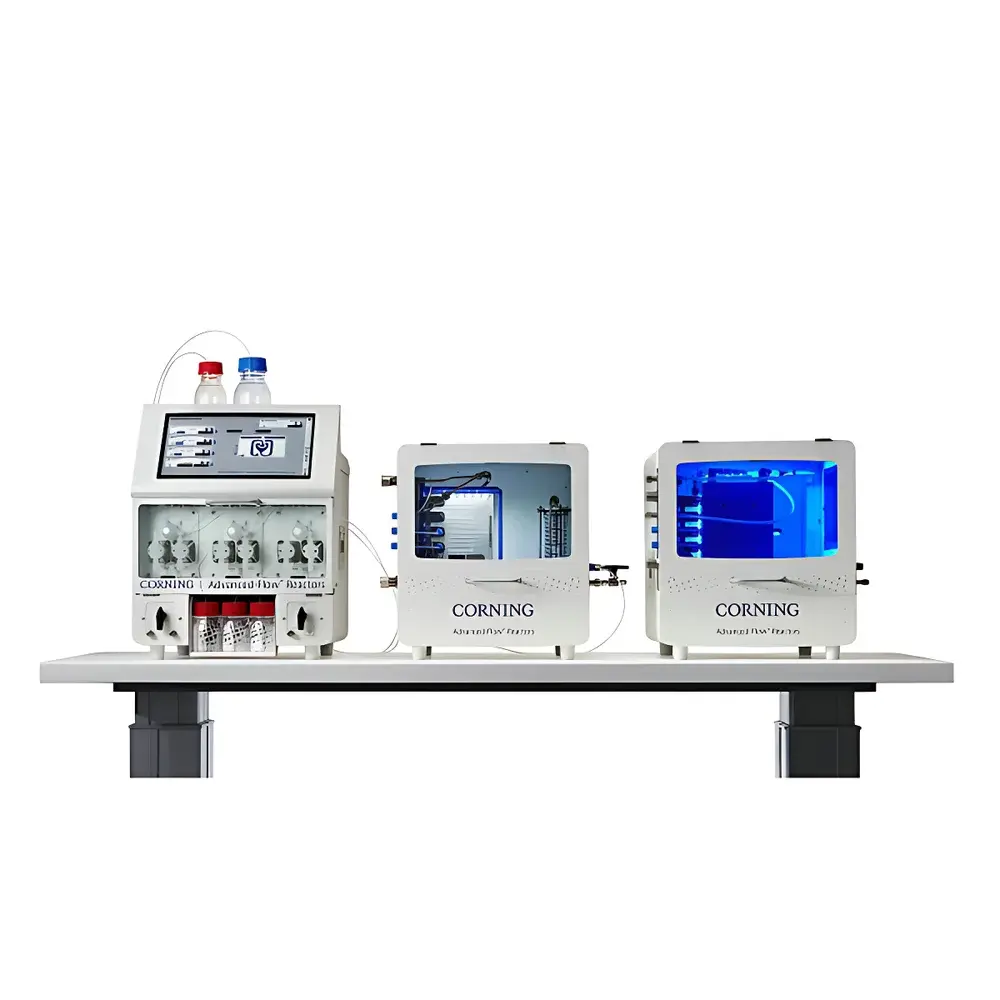
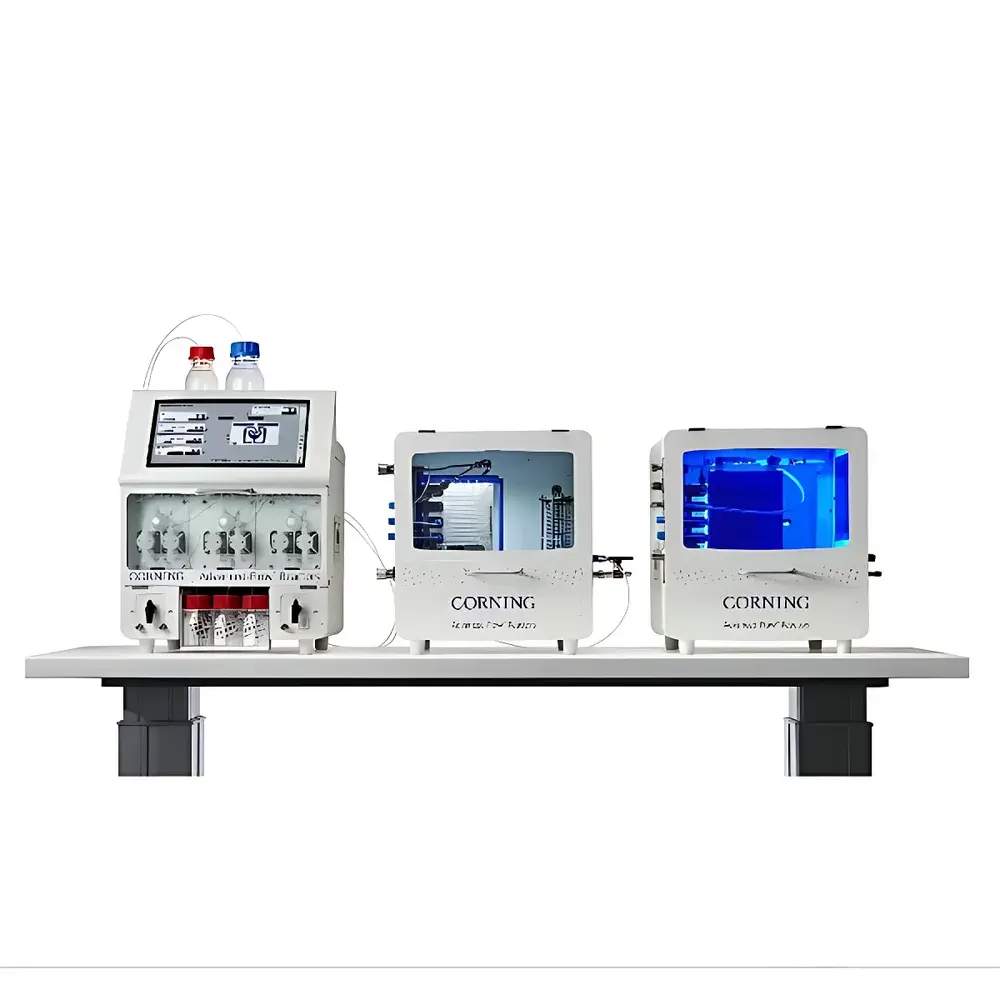
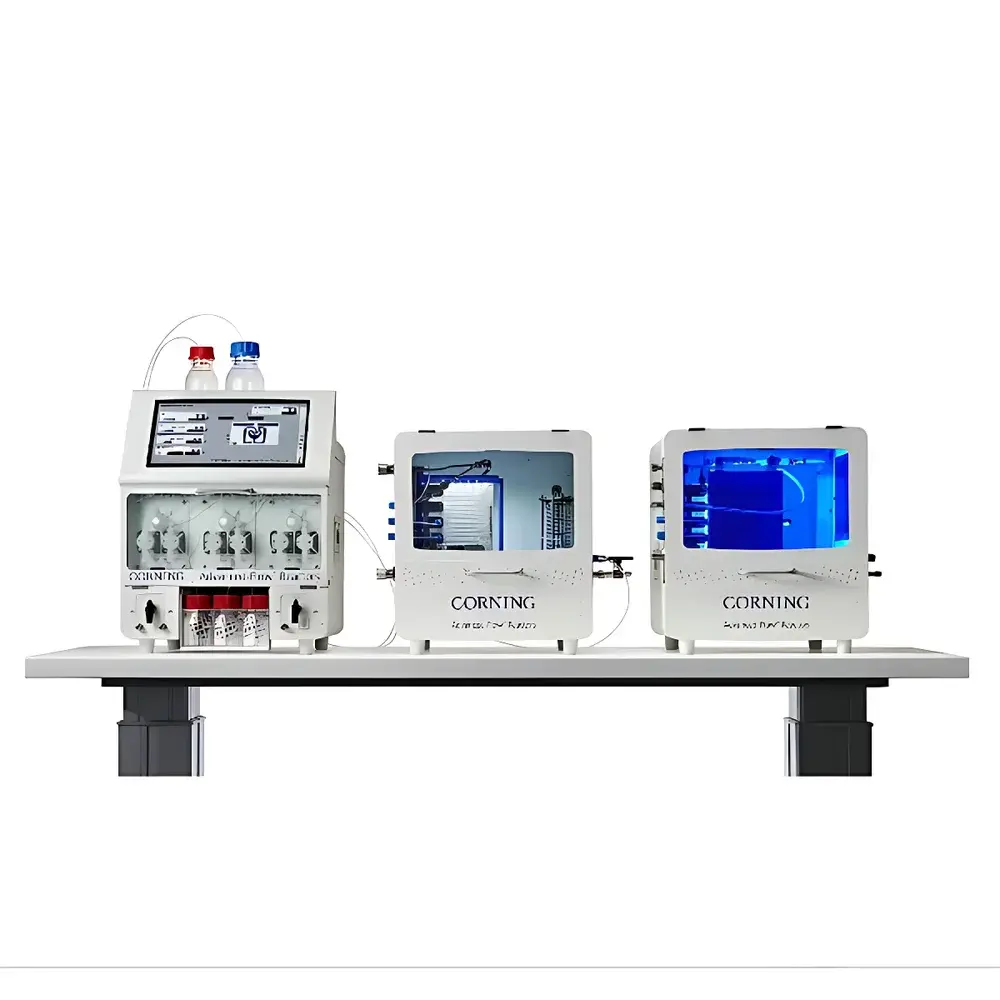
Corning Lab Reactor System
| Brand | Corning |
|---|---|
| Origin | USA |
| Manufacturer Status | Authorized Distributor |
| Origin Category | Imported |
| Model | Lab |
| Instrument Classification | Microchannel Reactor |
| Usable Volume | Small-Scale |
| Instrument Material | Specialty Glass |
| Operating Pressure | Low to Medium Pressure (0–18 bar g) |
| Capacity | 10 mL |
| Flow Rate Range | 0–10 mL/min |
| Operating Temperature Range | −40 °C to 200 °C |
| Reactor Module Internal Volume | 2.7 mL per module |
| Light Sources | 365 nm, 385 nm, 405 nm, 475 nm, 610 nm, and 4000 K white LED |
| LED Irradiance | >100 mW/cm² (adjustable) |
| Cooling | Liquid-cooled LED modules |
| Control Interface | Wireless wavelength & intensity selection |
| Sealing Materials | PFA, PETE, Perfluoroelastomer |
Overview
The Corning Lab Reactor System is a benchtop continuous-flow microreactor platform engineered for precision in process research, reaction optimization, and small-batch synthesis of high-value chemicals. Built upon Corning’s proprietary heart-shaped microchannel architecture, the system leverages laminar flow dynamics and enhanced interfacial mass transfer to deliver exceptional mixing efficiency, thermal uniformity, and residence time control—critical parameters in kinetic studies, exothermic reaction management, and photochemical transformations. Unlike conventional batch reactors, this system operates under continuous-flow conditions with precise fluidic control, enabling reproducible scalability from milliliter-scale screening to pilot production. Its all-glass fluidic path—constructed from chemically inert specialty glass and fluoropolymer wetted components—ensures full compatibility with aggressive reagents (e.g., strong acids, halogenated solvents, organometallics) without metal leaching or catalytic interference. Designed for integration into modern flow chemistry workflows, the Lab Reactor System serves as both a stand-alone discovery tool and a seamless entry point to Corning’s AFR® (Advanced-Flow Reactor) family, eliminating scale-up risk through geometric and dynamic similarity.
Key Features
- Modular microchannel reactor blocks with 2.7 mL internal volume per module—enabling safe, material-efficient screening with ≤10 mL total system holdup;
- Integrated temperature control unit with rapid thermal response (−40 °C to 200 °C), supporting cryogenic reactions and high-temperature catalysis;
- Multi-feed capability: one gas inlet and two or three independently controlled liquid inlets, each with calibrated mass flow control and real-time pressure monitoring;
- Back-pressure regulation (0–18 bar g) ensures consistent residence time and phase stability across gas–liquid and liquid–liquid systems;
- Dedicated photochemistry module featuring six independently addressable, liquid-cooled LED sources (365 nm, 385 nm, 405 nm, 475 nm, 610 nm, and 4000 K white), each delivering >100 mW/cm² irradiance with wireless, software-adjustable intensity and wavelength selection;
- Plug-and-play architecture with digital data logging, timestamped event tracking, and automated startup protocols compliant with GLP documentation requirements;
- Chemical resistance validated per ASTM D543 and ISO 15512; no metallic wetted surfaces—fluid path composed exclusively of Corning specialty glass, PFA, PETE, and perfluoroelastomer seals.
Sample Compatibility & Compliance
The Corning Lab Reactor System accommodates a broad spectrum of chemistries—including Grignard additions, nitration, diazotization, hydrogenations, photoredox catalysis, and enzymatic transformations—without degradation of performance or integrity of the fluidic path. Its construction meets USP Class VI biocompatibility standards for polymer components and complies with CE marking requirements for laboratory equipment (2014/30/EU EMC Directive and 2014/35/EU LVD). The system supports audit-ready operation under FDA 21 CFR Part 11 when paired with validated third-party data acquisition software, providing electronic signatures, change history, and user access controls. All reactor modules are designed to ASTM E2500-13 guidelines for verification of laboratory-scale continuous manufacturing equipment.
Software & Data Management
The system interfaces via USB or Ethernet with Corning’s LabControl™ software (v3.2+), which provides real-time visualization of temperature profiles, pressure transients, flow rates, and LED irradiance settings. Data is logged in .csv and .tdms formats with embedded metadata (operator ID, timestamp, method version, calibration status). Audit trails record all parameter changes, method executions, and user logins—fully traceable for GMP/GLP environments. Optional integration with LabArchives ELN or Thermo Fisher SampleManager LIMS enables automated metadata ingestion and structured reporting aligned with ISO/IEC 17025 analytical quality frameworks.
Applications
- Rapid screening of reaction parameters (temperature, residence time, stoichiometry, light dose) in pharmaceutical route scouting;
- Safe handling of highly energetic or thermally unstable intermediates (e.g., diazo compounds, azides) via precise thermal management and small holdup volume;
- Development of heterogeneous photocatalytic processes (e.g., TiO₂-mediated oxidation, Ru/Ir complex photoredox cycles);
- Continuous crystallization and nanoparticle synthesis with narrow residence time distribution (RTD);
- Process validation studies supporting ICH Q5, Q7, and Q13 guidance for continuous manufacturing;
- Academic and industrial training in flow chemistry fundamentals, including residence time distribution analysis and heat transfer coefficient measurement.
FAQ
Is the Corning Lab Reactor System compatible with corrosive reagents such as fuming nitric acid or anhydrous HF?
Yes—the entire fluidic path is constructed from Corning specialty glass and fluoropolymer components rated for continuous exposure to these agents per ASTM D543 testing protocols.
Can multiple Lab Reactor modules be operated in parallel or series?
Yes—modules support serial configuration for multi-step synthesis or parallel operation using Corning’s manifold kits, maintaining identical thermal and hydraulic boundary conditions across units.
Does the system meet regulatory requirements for use in GMP manufacturing environments?
While intended primarily for R&D, the system supports GMP-aligned operation when integrated with validated software, calibrated sensors, and documented IQ/OQ protocols—consistent with Annex 15 and ISPE Good Automated Manufacturing Practice (GAMP®) 5 principles.
What maintenance is required for the LED photochemistry module?
Liquid cooling and thermal throttling extend LED service life beyond 10,000 hours; no consumables or lamp replacements are needed—only periodic verification of irradiance output using NIST-traceable photodiode calibrators.
How does the “heart-shaped” channel design improve mixing compared to straight or serpentine microchannels?
The asymmetric, converging–diverging geometry induces secondary Dean vortices at Reynolds numbers >10, enhancing radial mass transfer by up to 4× versus conventional designs—verified via particle image velocimetry (PIV) and residence time distribution (RTD) analysis per ISO 22197-3.



