
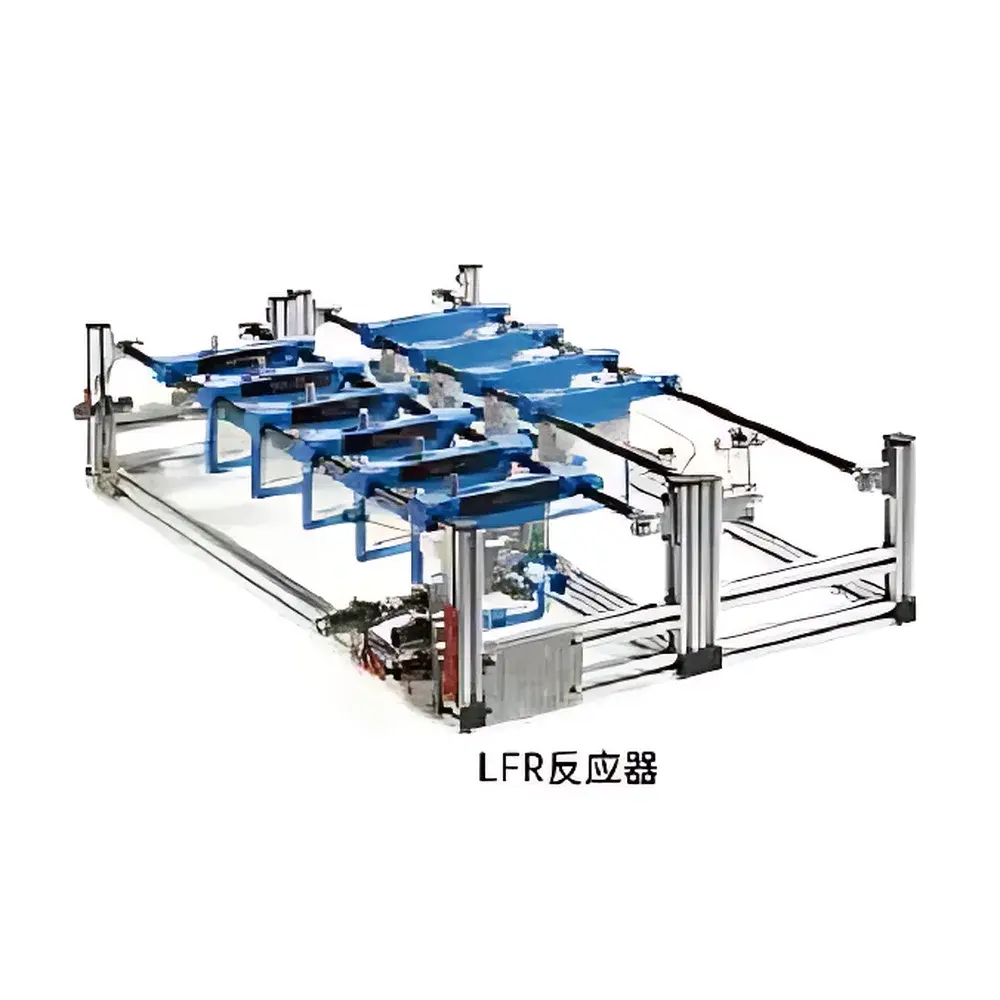
Corning Low-Flow Microchannel Glass Reactor (LFR)
| Brand | Corning |
|---|---|
| Origin | USA |
| Manufacturer Type | Authorized Distributor |
| Origin Category | Imported |
| Model | LFR |
| Flow Rate Range | 0–10 mL/min |
| Operating Temperature Range | −25 °C to 200 °C |
| Maximum Operating Pressure | 18 bar |
| Material | Chemically Resistant Borosilicate Glass |
| Pressure Class | Medium-Pressure |
| Volume Class | Medium-Scale |
| Metal-Free Fluid Path | Yes |
| Scalability | Linear Scale-Up Without Process Deviation |
| Optical Transparency | Full Visual Access for Reaction Monitoring and Photochemistry |
Overview
The Corning Low-Flow Microchannel Glass Reactor (LFR) is an engineered continuous-flow synthesis platform designed for precise, reproducible, and scalable chemical process development in academic, pharmaceutical, and fine chemical laboratories. Built upon Corning’s proprietary fused borosilicate glass microchannel architecture, the LFR operates on laminar flow principles with precisely defined residence time distribution, enabling high-fidelity kinetic studies and robust parameter screening. Unlike traditional batch reactors, the LFR eliminates thermal and concentration gradients through its monolithic glass structure—ensuring uniform heat transfer coefficients exceeding 1,500 W/m²·K and mass transfer coefficients (kLa) > 0.1 s⁻¹ under standard operating conditions. Its all-glass, metal-free fluid path guarantees compatibility with highly corrosive reagents (e.g., HF, oleum, anhydrous AlCl₃), strong bases, and photoactive species—making it suitable for fluorination, nitration, lithiation, and visible-light-mediated transformations.
Key Features
- Ultra-low flow operation (0–10 mL/min) minimizes reagent consumption—ideal for high-value intermediates and early-stage route scouting.
- Modular architecture allows independent or parallel use of Reactor A and Reactor B, supporting sequential multi-step synthesis, residence time variation, or comparative reaction screening.
- Integrated temperature control via external circulator-compatible jacketing; validated performance from −25 °C (with cryogenic coolant) to +200 °C (under pressurized silicone oil).
- Rated for continuous operation up to 18 bar (261 psi), compliant with ASME B31.3 process piping design guidelines for laboratory-scale pressure systems.
- Optically transparent borosilicate glass body enables real-time visual monitoring, in-line UV-Vis spectroscopy coupling, and homogeneous irradiation for photocatalytic reactions (e.g., [Ru(bpy)₃]²⁺-mediated C–N couplings).
- No scale-up discontinuity: geometric similarity and identical channel Reynolds numbers (Re = 10–200) ensure direct translation from lab (mg/h) to pilot (kg/h) without re-optimization.
Sample Compatibility & Compliance
The LFR accommodates organic solvents (THF, DMF, acetonitrile), aqueous acids/bases (up to 12 M HCl, 10 M NaOH), halogenated media (SOCl₂, PCl₅ slurries), and heterogeneous suspensions (catalyst loadings ≤ 5 wt%). All wetted parts conform to USP Class VI biocompatibility standards and ASTM E438 Type I, Class A specifications for borosilicate glass. The system supports GLP-compliant operation when integrated with validated data acquisition hardware and meets foundational requirements for FDA 21 CFR Part 11 readiness—including electronic signature support, audit trail logging, and user access controls via optional Corning ReactorLink™ software.
Software & Data Management
While the base LFR operates as a standalone hardware platform, it is fully compatible with third-party programmable syringe pumps (e.g., Chemyx Fusion 200), PID temperature controllers (Eurotherm 2408), and industrial SCADA systems via 4–20 mA or Modbus RTU interfaces. Optional Corning ReactorLink™ provides synchronized flow/temperature logging, automated method sequencing, and CSV/PDF report generation with timestamped metadata—enabling traceability per ISO/IEC 17025:2017 Clause 7.7. Raw sensor data (PT100, pressure transducer, flow meter) is recorded at ≥10 Hz sampling rate, supporting post-hoc residence time distribution analysis and Arrhenius parameter fitting.
Applications
- Rapid optimization of exothermic nitrations and diazotizations with intrinsic safety advantages over batch vessels.
- Photoredox catalysis requiring uniform photon flux across the reaction zone (e.g., decarboxylative arylations using blue LED arrays).
- Multi-phase hydrogenations using immobilized Pd/C microcartridges integrated upstream of the LFR core.
- Process analytical technology (PAT) integration for real-time FTIR or Raman endpoint detection.
- API intermediate synthesis under ICH Q5A–Q5E quality-by-design (QbD) frameworks, including Design Space mapping per ICH Q8(R2).
FAQ
Is the LFR compatible with solid catalysts or heterogeneous slurries?
Yes—slurry handling is supported up to 5 vol% solids loading; optional inline ultrasonic deagglomeration modules prevent channel fouling.
Can the LFR be operated under vacuum for solvent removal or low-boiling-point reagents?
No—vacuum operation is not rated; however, back-pressure regulators maintain stable sub-atmospheric vapor pressure for volatile reagents such as diethyl ether or dichloromethane.
What calibration documentation is provided with the system?
Each unit ships with NIST-traceable calibration certificates for temperature sensors and pressure transducers, plus dimensional verification reports for microchannel geometry.
Does Corning offer application support for reaction engineering studies?
Yes—Corning Advanced Flow Reactor Applications Team provides protocol development, kinetic modeling (using COMSOL Multiphysics®), and tech transfer documentation aligned with ASTM E2500-21 guidance.



