
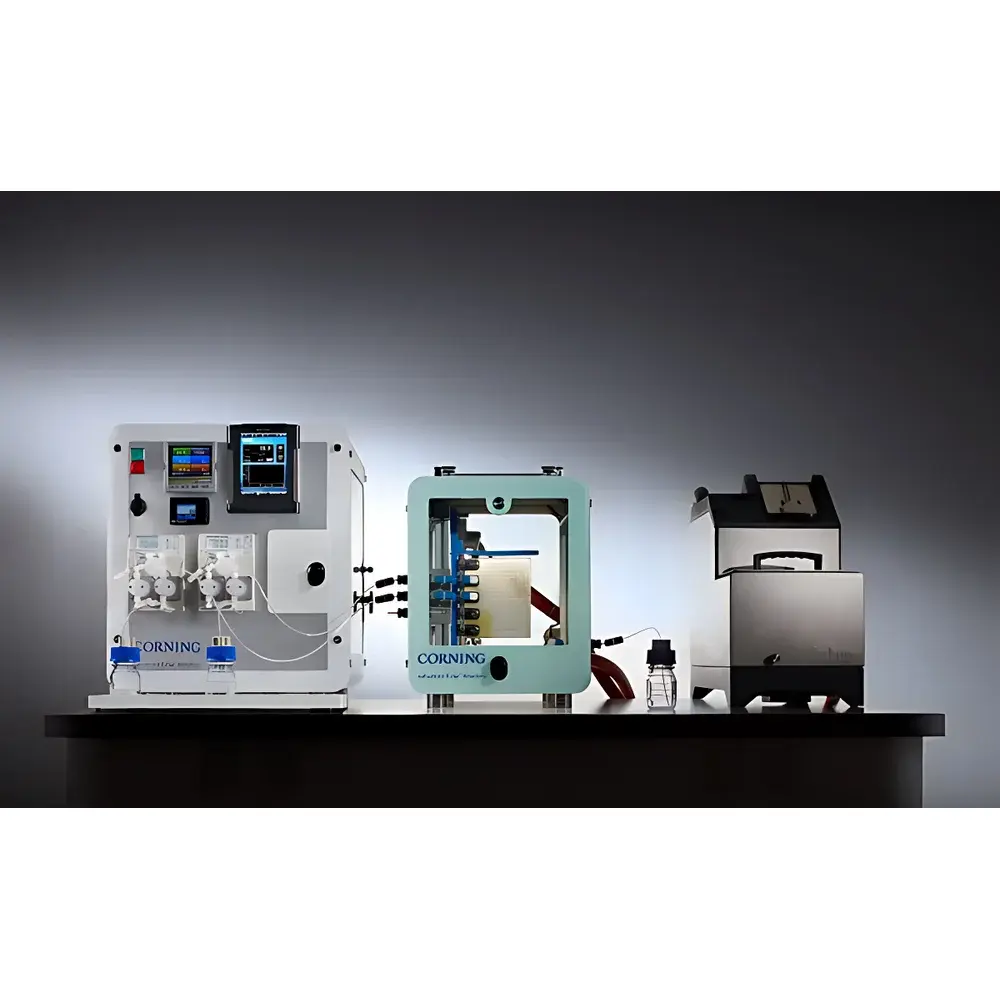
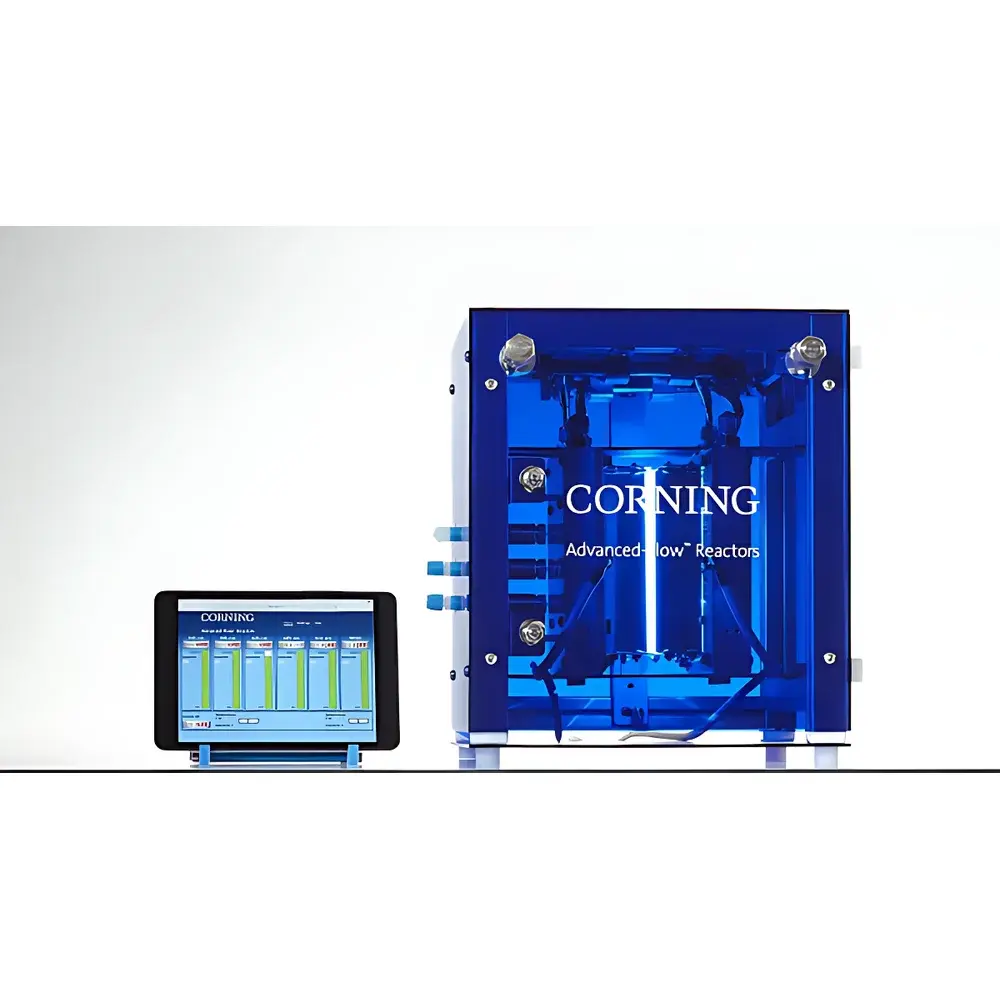
Corning LRS Lab-Scale Continuous Flow Microchannel Reactor
| Brand | Corning |
|---|---|
| Origin | France |
| Manufacturer Type | Authorized Distributor |
| Import Status | Imported |
| Model | LRS |
| Instrument Category | Microchannel Reactor |
| Usable Volume | Small-scale |
| Construction Material | Specialty Glass (DURAN®-grade borosilicate) |
| Operating Pressure | Medium-pressure (0–18 bar(g)) |
| Module Capacity | 2.7 mL per reactor module |
| Vacuum Capability | Up to 18 kPa (absolute) |
| Flow Rate Range | 0–10 mL/min |
| Temperature Range | –40 °C to +200 °C |
| Sealing Materials | PFA, PETE, Perfluoroelastomer |
| Light Sources (AFR® Photoreactor Variant) | 365 nm, 385 nm, 405 nm, 475 nm, 610 nm, and 4000 K white LED |
Overview
The Corning LRS Lab-Scale Continuous Flow Microchannel Reactor is an engineered platform for rapid process development, reaction screening, and small-batch synthesis of fine chemicals, pharmaceuticals, and advanced materials. Based on Corning’s proprietary heart-shaped microchannel architecture—fabricated from high-purity, chemically resistant borosilicate glass—the system enables precise residence time control, exceptional heat transfer (U-values >1,500 W/m²·K), and reproducible multiphase mixing (gas–liquid, liquid–liquid, solid-containing slurries). Unlike conventional batch reactors, the LRS operates under continuous flow conditions governed by laminar or transitional flow regimes, ensuring consistent shear history, minimized hot/cold spots, and intrinsic scalability via numbering-up—not scale-up. Its modular design supports seamless integration with Corning’s AFR® (Advanced-Flow Reactor) ecosystem, eliminating scale-dependent kinetic deviations and preserving reaction selectivity across development stages from milligram to multi-kilogram output.
Key Features
- Glass-based microfluidic architecture: Chemically inert, optically transparent, and compatible with aggressive reagents (e.g., HF,浓H₂SO₄, organolithiums) without metal leaching or catalytic side reactions.
- Heart-shaped channel geometry: Enhances radial mixing through controlled Dean vortices, achieving >95% homogenization in <100 ms at typical lab flow rates (1–5 mL/min).
- Integrated thermal management: Equipped with a portable chiller/heater unit enabling rapid temperature ramping (±0.1 °C stability) across –40 °C to +200 °C—validated per ASTM E2877 for thermal uniformity.
- Modular fluidic interface: Supports 1 gas inlet and 2–3 independent liquid inlets with calibrated mass flow controllers; back-pressure regulation maintains stable pressure profiles up to 18 bar(g), critical for exothermic or gas-evolving reactions.
- Plug-and-play operation: Pre-assembled, factory-leak-tested modules with standardized Swagelok®-compatible fittings reduce setup time to <15 minutes; digital I/O enables synchronization with external pumps, sensors, or PLCs.
Sample Compatibility & Compliance
The LRS accommodates a broad range of chemistries including Grignard additions, nitration, halogenation, hydrogenation, photochemical transformations (when coupled with AFR® photomodule), and crystallization-sensitive APIs. All wetted surfaces comply with USP Class VI and ISO 10993-5 biocompatibility standards. The system meets CE marking requirements for laboratory equipment (2014/30/EU EMC Directive, 2014/35/EU LVD). For regulated environments, optional audit-trail-enabled firmware supports 21 CFR Part 11-compliant electronic records when interfaced with validated data acquisition software. Reaction data—including temperature, pressure, flow rate, and residence time—is timestamped and exportable in CSV/Excel format for GLP/GMP documentation.
Software & Data Management
While the base LRS operates via analog controls and local PID interfaces, optional Corning FlowSuite™ software provides real-time monitoring, automated method sequencing, and historical data trending. FlowSuite logs all sensor inputs at 1 Hz resolution with SHA-256 checksum integrity verification. Exported datasets include metadata tags for operator ID, batch number, and environmental conditions—facilitating traceability in quality systems. Integration with third-party platforms (e.g., DeltaV, LabArchives, or Empower) is supported via OPC UA and RESTful API protocols.
Applications
- High-throughput reaction parameter screening (temperature, residence time, stoichiometry) for route scouting and DoE studies.
- Safe handling of hazardous intermediates (e.g., diazonium salts, azides) via confined volume operation (2.7 mL/module) and immediate quench capability.
- Photochemical synthesis using AFR®-integrated LED arrays—enabling wavelength-specific activation without filter changes or lamp degradation.
- Crystallization process intensification with controlled supersaturation generation and narrow residence time distribution (RTD σ/τ < 0.15).
- Process validation support for QbD (Quality by Design) frameworks in pharmaceutical development per ICH Q5, Q8, and Q9 guidelines.
FAQ
What is the maximum allowable operating pressure for the LRS reactor module?
The LRS is rated for continuous operation up to 18 bar(g) at 200 °C, verified per ASME B31.3 process piping standards for glass-lined systems.
Can the LRS be used for heterogeneous catalysis with solid catalysts?
Yes—slurry-compatible configurations are available with enlarged channel cross-sections and optional static mixers; recommended particle size <25 µm to avoid clogging.
Is the glass reactor body autoclavable?
No—borosilicate microchannels are not designed for steam sterilization; chemical cleaning with HNO₃/HF mixtures or piranha solution is recommended per Corning Technical Note TN-LRS-04.
How does the LRS ensure scalability to pilot production?
By maintaining identical channel geometry, surface-to-volume ratio, and thermal boundary conditions across modules, the LRS enables direct numbering-up to Corning’s AFR® Pilot (100 mL/min) and Production (1–5 L/min) systems—eliminating re-optimization.
Does Corning provide application support for reaction optimization?
Yes—Corning’s Global Application Engineering team offers remote and on-site technical assistance, including kinetic modeling, RTD analysis, and safety evaluation (RC1e, ARSST) for flow chemistry implementations.



