
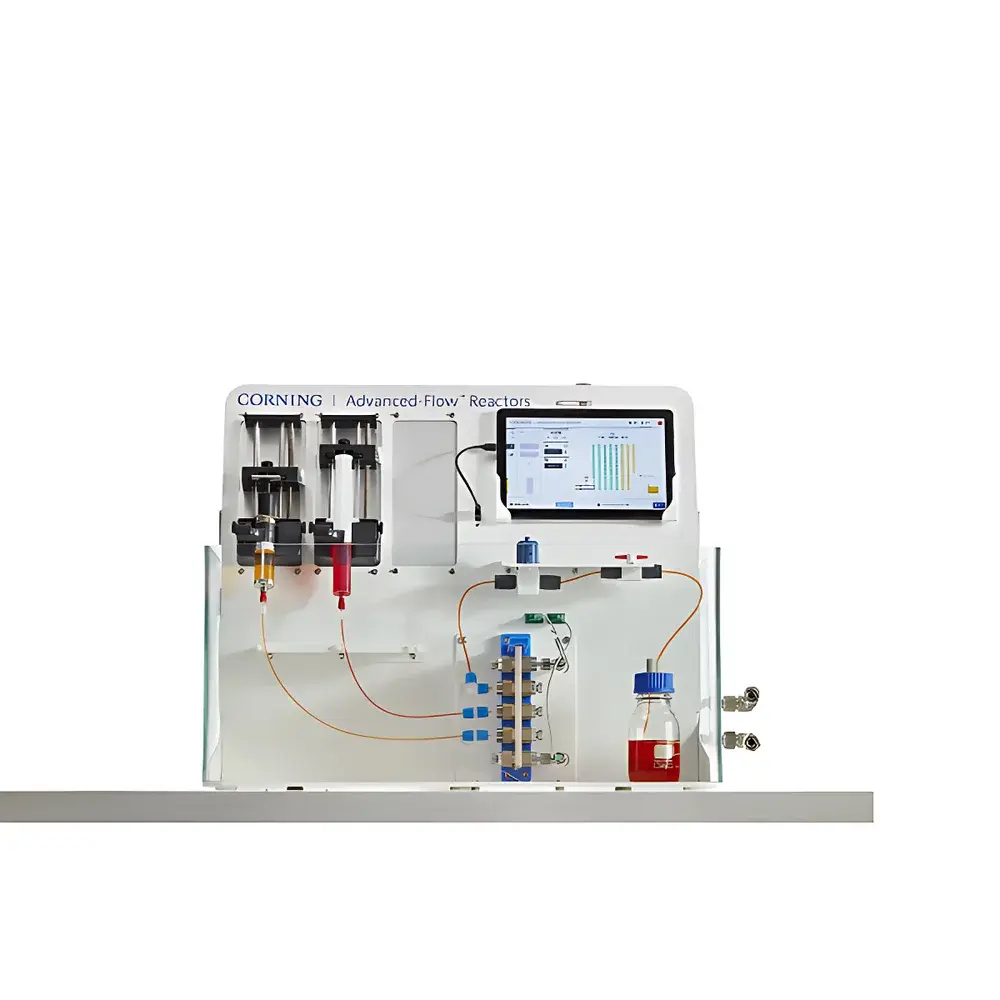
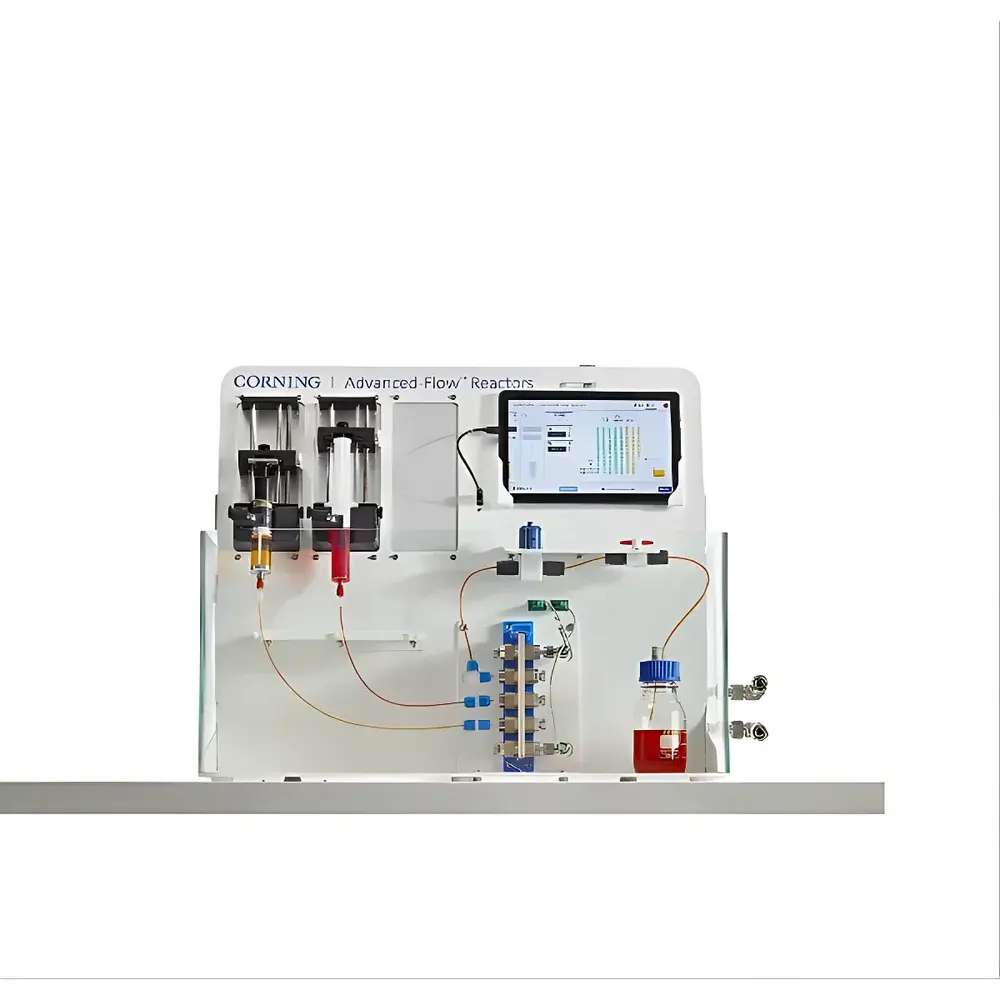
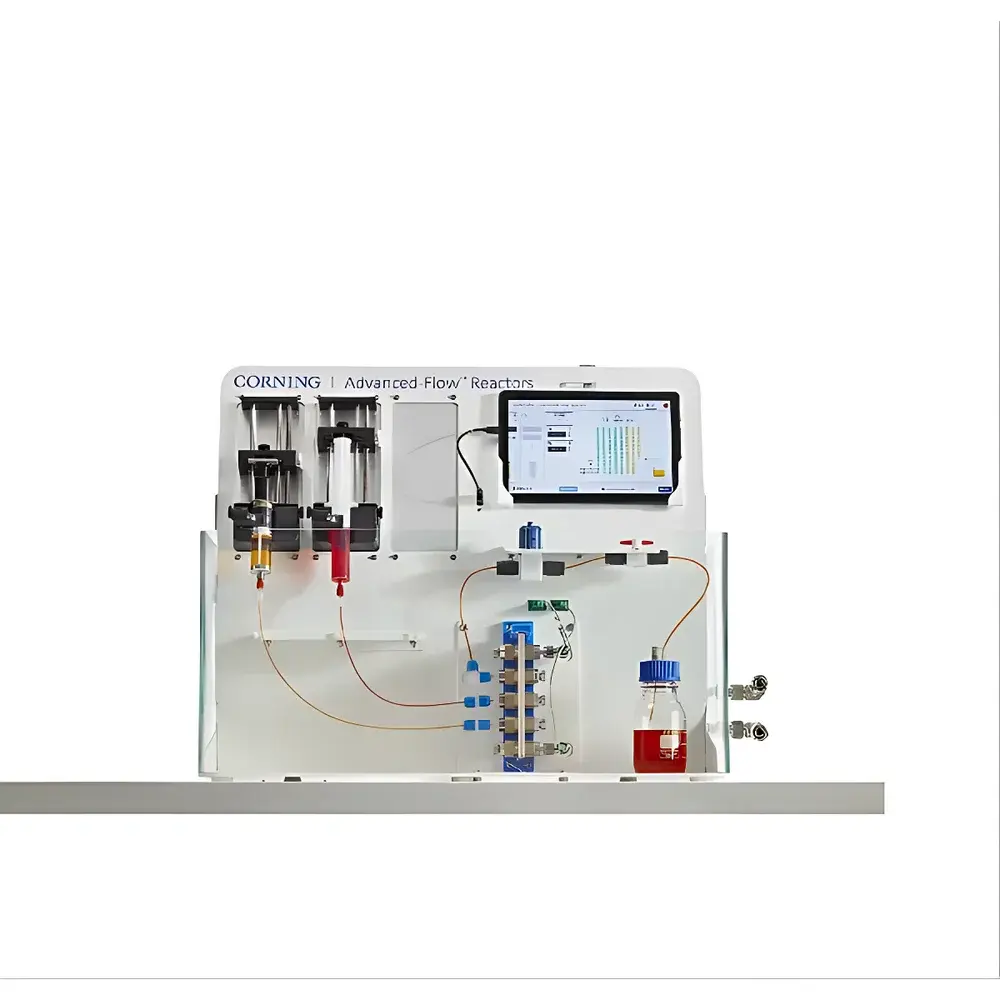
Corning Nebula™ Education Platform – Microchannel Continuous Flow Reactor
| Brand | Corning |
|---|---|
| Origin | USA |
| Manufacturer Type | Authorized Distributor |
| Origin Category | Imported |
| Model | Nebula |
| Pricing | Upon Request |
| Instrument Classification | Microchannel Reactor |
| Usable Volume | Small-scale |
| Material | Specialty Glass |
| Operating Pressure | Low-pressure |
| Capacity | 0.5 mL |
| Additional Application Fields | Food Science, Biotechnology, Agriculture, Petrochemicals |
| Vacuum Capability | 0.6 MPa |
Overview
The Corning Nebula™ Education Platform is a purpose-built, benchtop microchannel continuous flow reactor system engineered for pedagogical rigor and fundamental process understanding in chemical and biochemical engineering education. Based on Corning’s proprietary heart-shaped microchannel architecture fabricated from chemically resistant, optically transparent specialty glass, the platform operates under low-pressure conditions (≤0.6 MPa vacuum capability) with a nominal reaction volume of 0.5 mL. It leverages laminar flow hydrodynamics and enhanced surface-area-to-volume ratios to deliver precise residence time control, rapid heat exchange, and highly reproducible mixing—core physical principles underpinning modern continuous flow chemistry. Unlike traditional batch reactors, the Nebula platform eliminates scale-up discontinuities by preserving identical fluidic behavior across educational, lab-scale, and industrial Corning reactor formats. Its design reflects industry-aligned engineering priorities: intrinsic safety through minimized hazardous inventory, deterministic process control, and real-time visual monitoring of reaction progression—making it an authoritative tool for teaching flow chemistry fundamentals, reaction kinetics, mass/heat transfer phenomena, and process intensification concepts.
Key Features
- Corning-exclusive heart-shaped microchannel geometry—optimized for uniform shear distribution, minimized backmixing, and predictable residence time distribution (RTD)
- High-purity, borosilicate-based specialty glass construction—providing exceptional chemical compatibility (including with strong acids, bases, and organic solvents), thermal stability, and full optical transparency for in-situ observation
- Integrated digital interface with touchscreen operation and Bluetooth/Wi-Fi connectivity—enabling remote parameter setting, real-time flow rate monitoring, and synchronized data logging
- Dual-curriculum configuration—available in Chemistry and Chemical Engineering editions, each with discipline-specific experiment modules, safety protocols, and instructor guides aligned with ABET and IChemE learning outcomes
- Modular architecture supporting seamless transition—from classroom demonstration (0.5 mL) to pilot-scale Corning G1/G3 reactors—without re-optimization or empirical scaling factors
- Low-pressure operational envelope (rated for ≤0.6 MPa vacuum and moderate positive pressure)—ensuring inherent safety during student handling while accommodating gas–liquid and photochemical reactions
Sample Compatibility & Compliance
The Nebula platform accommodates a broad range of liquid-phase, gas–liquid, and photoactive reaction systems—including Grignard additions, nitrations, diazotizations, enzymatic transformations, and UV-mediated cyclizations. Its glass-wetted path ensures compatibility with corrosive reagents (e.g., HCl, HNO₃, NaOH) and high-polarity solvents (e.g., DMF, DMSO, water/acetonitrile mixtures). All hardware and firmware comply with IEC 61000-6-3 (EMC emission standards) and UL 61010-1 (laboratory equipment safety). The system supports GLP-aligned documentation practices through timestamped audit trails, user-access logs, and exportable CSV/CSVX data files—facilitating integration into university quality management systems and preparation for ISO/IEC 17025-accredited teaching labs.
Software & Data Management
The Nebula Control Suite is a Windows/macOS-compatible application delivering intuitive graphical workflow configuration, real-time visualization of pump status, temperature setpoints, and pressure trends, and automated generation of residence time histograms. Raw sensor data—including peristaltic pump RPM, inline pressure transducer output, and optional IR thermography overlays—are stored with ISO 8601 timestamps and SHA-256 checksum integrity verification. Export formats include CSV (for MATLAB/Python analysis), PDF (annotated experiment reports), and JSON-LD (semantic metadata tagging for LMS integration). The software adheres to FDA 21 CFR Part 11 principles via electronic signature support, role-based access control, and immutable audit logs—meeting requirements for regulated academic research environments.
Applications
- Undergraduate kinetics laboratories: Quantitative determination of activation energy via Arrhenius plots using temperature-controlled residence time variation
- Process safety training: Comparative hazard assessment of exothermic nitration in batch vs. continuous mode using thermal imaging and calorimetric proxies
- Reaction optimization modules: DoE-driven screening of stoichiometry, residence time, and mixing intensity for Suzuki coupling efficiency
- Biocatalysis instruction: Immobilized enzyme stability studies under continuous substrate feeding and product removal
- Green chemistry pedagogy: Solvent reduction metrics, E-factor calculation, and atom economy validation across flow vs. batch pathways
- Automation capstone projects: Integration with LabVIEW or Python APIs for closed-loop PID control of reaction temperature and flow ratio
FAQ
Is the Nebula platform compatible with third-party syringe or HPLC pumps?
Yes—standardized 1/16″ Swagelok fittings and analog 0–10 V / 4–20 mA I/O ports enable interoperability with major OEM pumping systems.
Can the system be used for gas–liquid reactions such as hydrogenations or oxidations?
Yes—equipped with T-mixers and gas-permeable membrane interfaces; recommended for low-flow H₂, O₂, or CO applications under controlled backpressure.
Does Corning provide curriculum materials and instructor training?
Yes—comprehensive pedagogical packages include 12 validated experiments, risk assessment templates, ABET-aligned learning objectives, and annual virtual instructor certification workshops.
What maintenance is required for long-term educational use?
Routine cleaning with 10% nitric acid followed by deionized water flush; no consumables or recalibration needed—glass channels exhibit negligible fouling or drift over 5+ years of academic use.
How does the Nebula platform align with industry workforce development needs?
It directly addresses the American Institute of Chemical Engineers (AIChE) “Continuous Manufacturing Competency Framework”, emphasizing hands-on proficiency in PAT, QbD, and digital twin-enabled process understanding—skills explicitly cited in FDA guidance documents and pharma hiring criteria.



