
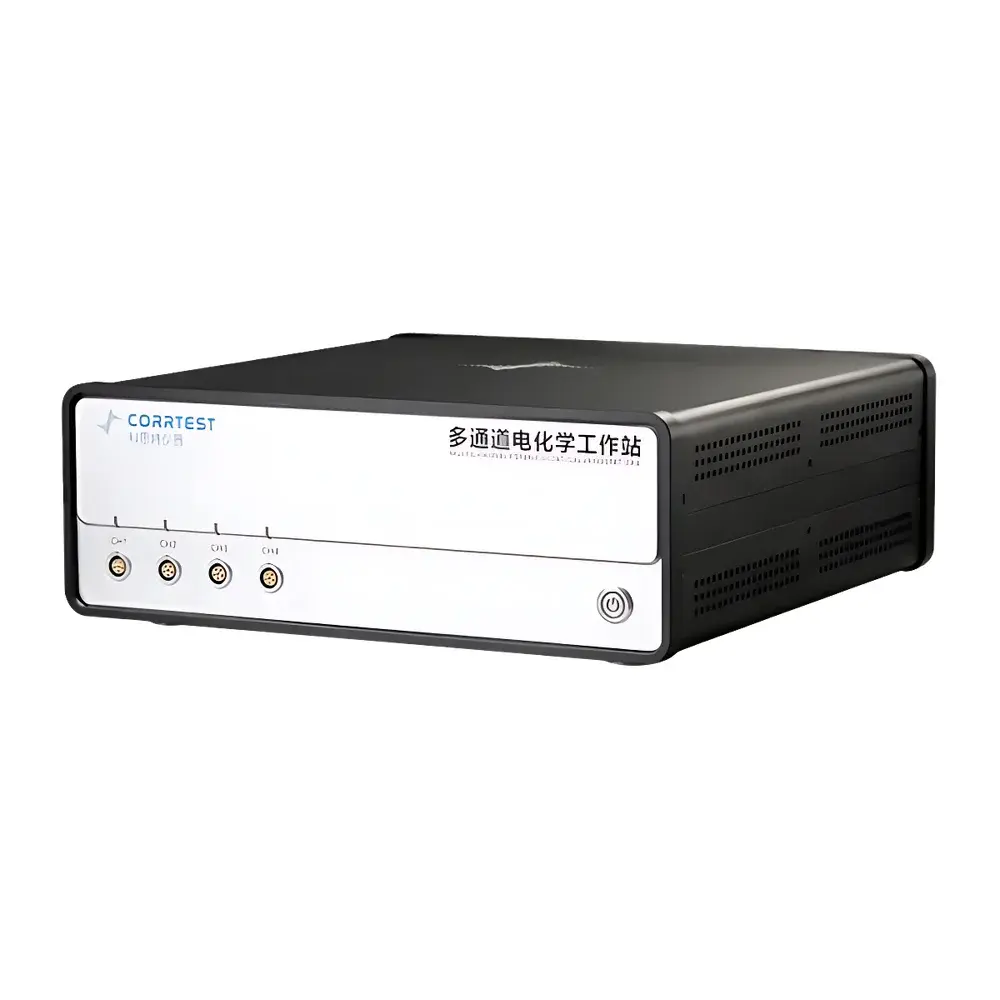
CorrTest CS310X Multi-Channel Electrochemical Workstation
| Brand | CorrTest |
|---|---|
| Origin | Hubei, China |
| Manufacturer Type | Authorized Distributor |
| Product Origin | Domestic (China) |
| Model | CS310X |
| Price Range | USD 14,000–28,000 |
| Instrument Type | Electrochemical Workstation |
| Current Range | ±200 mA (8-channel mode) / ±500 mA (4-channel mode) |
| Current Accuracy | 0.1% of full-scale reading |
| Potential Accuracy | 0.1% of full-scale reading ±1 mV |
| Potentiostatic Range | ±10 V |
| EIS Frequency Range | 10 mHz to 1 MHz |
| Input Impedance (Reference Electrode) | 10¹² Ω |
| Channel Isolation Resistance | >100 MΩ |
| Data Acquisition | 16-bit @ 1 MHz, 20-bit @ 1 kHz |
| ADC Resolution | 16-bit DAC with 1 ms settling time |
| Low-Pass Filter | 8 programmable stages |
| Communication Interface | Ethernet |
Overview
The CorrTest CS310X Multi-Channel Electrochemical Workstation is a modular, high-fidelity potentiostat/galvanostat system engineered for parallel electrochemical characterization across up to eight independent, galvanically isolated channels. Built upon the architecture of the CS150H single-channel platform, the CS310X extends experimental throughput without compromising measurement integrity—enabling simultaneous acquisition of chronoamperometry, cyclic voltammetry, electrochemical impedance spectroscopy (EIS), and transient polarization data from multiple working electrodes under identical environmental conditions. Its core operation adheres to classical three-electrode potentiostatic control principles, with digital signal generation and feedback loops implemented via high-speed 16-bit DACs and synchronized 20-bit ADCs. The system supports both potentiodynamic and potentiostatic control modes, with real-time current and potential monitoring at microsecond-level temporal resolution. Designed for laboratory-based fundamental and applied research, the CS310X delivers reproducible, traceable electrochemical measurements compliant with internationally recognized instrumentation standards for analytical electrochemistry.
Key Features
- Parallel multi-channel operation: Configurable for 4 or 8 fully isolated measurement channels, each with independent potentiostat/galvanostat control and dedicated analog front-end circuitry.
- High-precision analog performance: Potential accuracy of 0.1% of full scale ±1 mV; current accuracy of 0.1% of full scale; reference electrode input impedance ≥10¹² Ω || 20 pF.
- Broad dynamic range: Current ranging from 2 A to 2 nA (10 decades), auto-ranging capability, and programmable low-pass filtering (8-stage selectable bandwidth).
- Advanced EIS capability: Frequency sweep from 10 mHz to 1 MHz with RMS amplitude control (1–2500 mV), <1% sine wave distortion, and phase-resolved detection using digital lock-in algorithms.
- Rapid transient response: Potential step rise time <1 ms (for currents <10 mA); current step response optimized for kinetic studies requiring sub-millisecond resolution.
- Ethernet-based communication: TCP/IP interface enables remote instrument control, synchronization with external triggers (TTL), and integration into automated lab environments.
- Robust hardware architecture: Channel isolation resistance >100 MΩ ensures minimal crosstalk; ±12 V槽压 (compliance voltage) supports high-resistance electrolyte systems and coated electrode interfaces.
Sample Compatibility & Compliance
The CS310X accommodates standard three-electrode electrochemical cells (working, counter, reference) and supports common electrode configurations including rotating disk electrodes (RDE), microelectrodes, and thin-film sensors. It is compatible with aqueous and non-aqueous electrolytes, solid-state ion conductors, and corrosion test media per ASTM G5, G102, and ISO 16773-2. While not pre-certified for regulated GxP environments, the system’s software architecture supports audit trail generation, user access control, and electronic signature implementation—facilitating alignment with FDA 21 CFR Part 11 requirements when deployed with validated CorrTest software configurations. All hardware meets IEC 61010-1 safety standards for laboratory electrical equipment.
Software & Data Management
The workstation ships with CorrTest Electrochemical Analysis Software (v5.x or later), a Windows-based application supporting method scripting, real-time visualization, and post-acquisition Fourier analysis. The software implements over 30 standardized electrochemical techniques—including OCP, CA, CP, CV, LSV, Tafel, GITT, PITT, and Mott-Schottky EIS—and allows user-defined protocol sequencing. Raw data are stored in binary .DAT format with embedded metadata (timestamp, parameter set, channel ID, calibration coefficients). Export options include CSV, TXT, and MATLAB-compatible MAT files. Optional modules extend functionality to advanced pulse techniques (DPV, SWV, NPV) and harmonic analysis (SHACV, FTACV). Data integrity is maintained through checksum validation and version-controlled method templates.
Applications
- Electrocatalysis and reaction mechanism studies: Parallel screening of catalyst libraries via identical CV/EIS protocols across multiple electrodes.
- Energy storage materials evaluation: In situ/operando testing of battery electrodes (anode/cathode composites), solid-electrolyte interphase (SEI) formation kinetics, and Li-ion diffusion coefficient mapping via GITT/PITT.
- Corrosion science: High-throughput assessment of alloy passivation behavior, inhibitor efficiency ranking, and coating defect detection using localized EIS and noise analysis.
- Electrochemical sensor development: Multiplexed calibration and stability testing of enzymatic, immunosensor, or DNA-based transducers under controlled bias conditions.
- Electrosynthesis and electrodeposition: Precise current/potential control for nucleation studies, film thickness optimization, and Faradaic efficiency quantification.
FAQ
What is the maximum number of simultaneously active channels?
The CS310X supports up to eight independently controlled, galvanically isolated channels. Configuration is fixed at time of purchase (4-channel or 8-channel variants).
Does the system support true potentiostatic control on all channels during EIS acquisition?
Yes—each channel operates as a standalone potentiostat during frequency-domain impedance measurements, enabling multi-electrode EIS without shared reference or counter electrodes.
Can the CS310X be integrated into a custom LabVIEW or Python automation framework?
Yes—Ethernet-based SCPI command set and documented TCP/IP API allow third-party programmatic control, including trigger synchronization and real-time data streaming.
Is hardware calibration traceable to national standards?
Calibration is performed using NIST-traceable voltage and current references; certificate of calibration (with uncertainty budget) is provided upon request.
What is the minimum detectable current resolution in the lowest range?
At the 2 nA full-scale range, current resolution is <1 pA (RMS), limited by thermal noise and ADC quantization.
Related Products




