
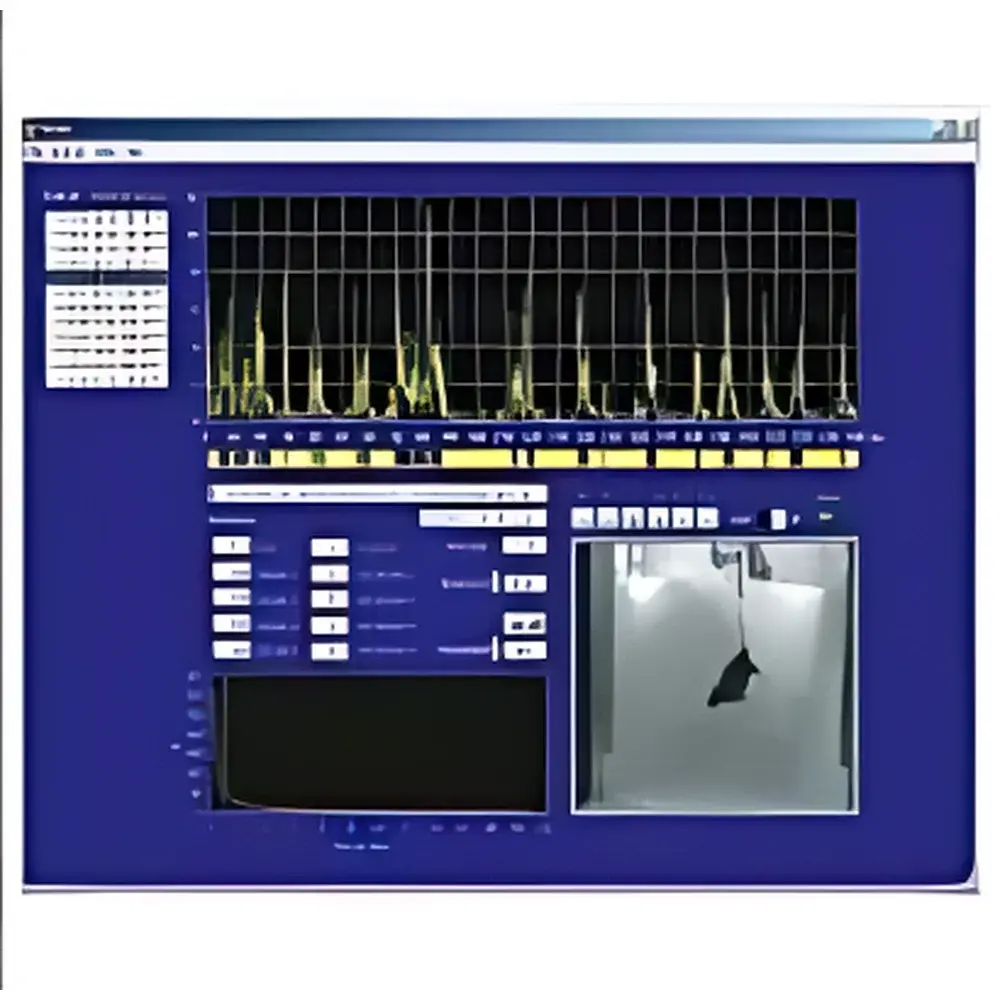
COULBOURN FREEZEFRAME-XW Tail Suspension Test System
| Brand | COULBOURN |
|---|---|
| Origin | USA |
| Model | FREEZEFRAME-XW |
| Application | Automated video-based behavioral analysis for murine tail suspension assay |
| Compliance | Designed for GLP-compliant preclinical neuroscience research |
| Data Output | CSV, Excel-compatible, QuickTime export |
| Camera Frame Rate | ≥4 fps |
| Multi-animal Support | Configurable for 4, 8, or 12 subjects simultaneously |
| Motion Detection Algorithm | Patented shadow- and noise-immune motion index computation |
| Software Architecture | Modular, Windows-based, FDA 21 CFR Part 11–ready audit trail optional |
Overview
The COULBOURN FREEZEFRAME-XW Tail Suspension Test System is a validated, computer vision–based behavioral phenotyping platform engineered for objective quantification of immobility in the murine tail suspension assay (TST). Rooted in ethologically grounded depression modeling, the TST induces a transient state of behavioral despair by suspending mice by their tails—eliciting characteristic escape-oriented struggling followed by passive immobility. This paradigm is mechanistically linked to serotonergic and noradrenergic pathways and exhibits high predictive validity for antidepressant efficacy, with strong correlation to clinical outcomes across pharmacological classes including SSRIs, SNRIs, and tricyclics. Unlike manual scoring—prone to inter-observer variability and fatigue—the FREEZEFRAME-XW system employs calibrated video acquisition and a proprietary motion index algorithm to distinguish active escape attempts from low-amplitude, pendular motion and true immobility. The system operates on standard-definition or HD USB cameras, requires no specialized lighting or reflective markers, and delivers frame-synchronized time-series data aligned with behavioral state classification (e.g., struggle vs. suspension).
Key Features
- Automated, real-time motion indexing at ≥4 frames per second with adaptive background subtraction and patented artifact rejection—immune to ambient light fluctuations, camera noise, and shadow artifacts.
- Configurable multi-subject capacity: supports concurrent analysis of up to 12 mice via modular camera array expansion (4-, 8-, or 12-channel configurations).
- Quantitative behavioral metrics: immobility duration (%), struggle count, struggle bout duration, inter-bout interval, motion amplitude index, and latency to first immobility episode.
- Full-video archival with synchronized timestamping; playback with frame-accurate behavioral annotation and export to QuickTime (.mov) for peer review or presentation.
- Modular software architecture compatible with Windows 10/11; supports FDA 21 CFR Part 11–compliant audit trails, electronic signatures, and user-access controls when deployed in regulated environments.
- Export-ready data structure: all metrics output as CSV or native Excel (.xlsx) files—including trajectory coordinates, motion index time series, and binned interval statistics—for downstream statistical analysis in SPSS, SAS, R, or Python.
Sample Compatibility & Compliance
The FREEZEFRAME-XW is optimized for C57BL/6, BALB/c, Swiss Webster, and CD-1 mice (18–30 g); validation studies confirm robust performance across common inbred and outbred strains. While primarily used in mice, the system’s adjustable mounting geometry and motion sensitivity threshold allow adaptation for juvenile rats (P21–P35) under protocol-specific calibration. All hardware components—including the optional acoustic isolation chamber—are CE-marked and RoHS-compliant. The system meets essential design criteria for Good Laboratory Practice (GLP) adherence: raw video retention, uneditable metadata logging, version-controlled software binaries, and traceable calibration records. It is routinely deployed in academic neuroscience labs, contract research organizations (CROs), and pharmaceutical discovery units conducting IND-enabling behavioral pharmacology studies.
Software & Data Management
FREEZEFRAME software provides a unified interface for experiment setup, real-time monitoring, post-hoc analysis, and report generation. Users define custom time bins (e.g., 60-s epochs), specify immobility thresholds (motion index <0.05 arbitrary units), and apply exclusion rules (e.g., exclude first 10 s post-suspension). Interval analysis generates histograms, cumulative immobility curves, and group-level ANOVA-ready summary tables. Batch processing enables parallel analysis of dozens of trials with consistent parameter application. All processed data retains provenance linkage to source video files and operator metadata. Optional modules include integration with EthoVision XT–style arena tracking for cross-assay correlation (e.g., TST + forced swim test + open field), and API access for automated ingestion into LIMS or ELN platforms.
Applications
- Primary screening of novel antidepressant candidates and dose–response characterization.
- Genetic phenotyping of transgenic/knockout mouse models relevant to mood disorders (e.g., BDNF, SERT, CREB mutants).
- Neuropharmacokinetic–behavioral correlation studies combining microdialysis or EEG with TST endpoints.
- Chronic stress model validation (e.g., CMS, social defeat) via longitudinal TST assessment.
- Drug interaction studies evaluating pro-depressant or anti-depressant effects of CNS-active compounds (e.g., opioids, antipsychotics, anesthetics).
- Regulatory submission support: data packages compliant with ICH S7A and FDA Guidance for Industry on Preclinical Assessment of Abuse Potential.
FAQ
What species and strain types are validated for use with the FREEZEFRAME-XW?
The system is fully validated for adult male and female mice (C57BL/6J, BALB/c, CD-1) aged 8–16 weeks. Strain-specific motion thresholds are preloaded; additional strains require empirical calibration using reference compounds (e.g., imipramine, fluoxetine).
Does the system require infrared illumination or specialized cameras?
No. Standard visible-light USB cameras (720p minimum resolution) are sufficient. The motion index algorithm is insensitive to illumination uniformity, eliminating need for IR LEDs or backlighting.
How is immobility objectively defined by the software?
Immobility is determined by pixel displacement velocity below a dynamically adjusted threshold derived from baseline motion variance during the first 5 seconds. This differs from fixed-pixel-threshold methods and improves specificity for true behavioral quiescence.
Can video files be reanalyzed with updated parameters?
Yes. Raw AVI or MP4 recordings are retained indefinitely. Users may reload archived videos and reprocess them with modified motion thresholds, binning intervals, or exclusion criteria without recapturing data.
Is technical validation documentation available for regulatory submissions?
COULBOURN provides a comprehensive Validation Package including IQ/OQ/PQ protocols, system suitability reports, and third-party concordance data (90% agreement vs. trained human observers, Kogan et al., Memory Pharmaceuticals).




