
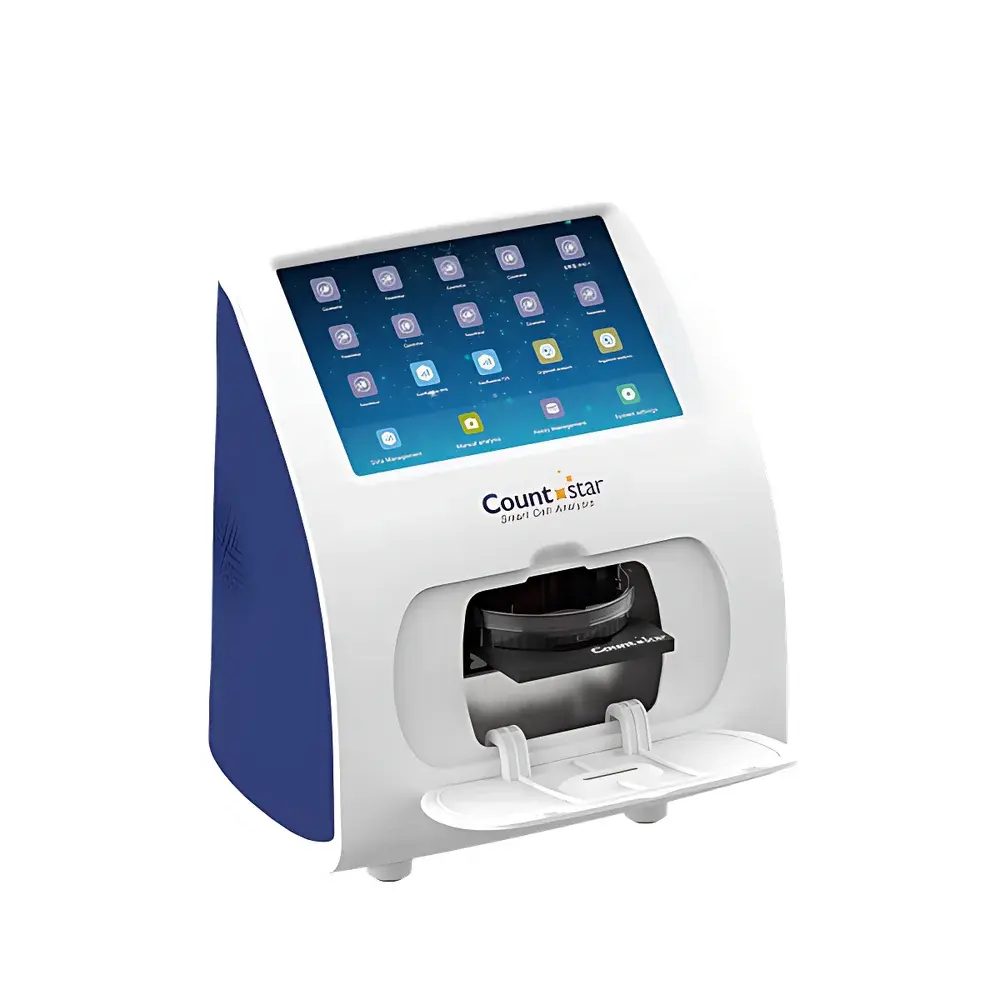
Countstar Mira BF Automated Cell Counter
| Brand | Countstar |
|---|---|
| Origin | Shanghai, China |
| Model | Mira BF |
| Detection Time | 20–50 s |
| Cell Concentration Range | 1×10⁴ – 3×10⁷ cells/mL |
| Sample Volume | 20 µL |
| Throughput | 5 samples per run |
| Detectable Cell Diameter | 2 – 180 µm |
Overview
The Countstar Mira BF Automated Cell Counter is a benchtop, all-in-one imaging-based cell analysis system engineered for rapid, label-free and fluorescence-enabled quantification of viable and non-viable cells in suspension. It operates on high-resolution brightfield (BF) and dual-channel fluorescence (AO/PI) imaging principles, combined with proprietary autofocus and optical zoom technology to maintain consistent focus across heterogeneous cell populations spanning 2–180 µm in diameter. Unlike flow cytometry or Coulter-based systems, the Mira BF relies on static image capture and AI-accelerated morphological segmentation—enabling accurate enumeration without hydrodynamic focusing or sheath fluid requirements. Its design targets routine QC in bioprocessing, academic cell culture labs, and early-stage therapeutic development where reproducible, low-volume, operator-independent cell counting is critical under GLP-aligned workflows.
Key Features
- Proprietary fixed-focus optics with dynamic optical zoom—ensures sharp, distortion-free imaging across wide cell size ranges without mechanical repositioning or user calibration.
- Dual-mode detection: simultaneous brightfield analysis for total count and morphology assessment, plus AO/PI fluorescence staining for viability discrimination (membrane integrity-based).
- AI-powered image analysis engine trained on >10⁶ annotated cell images; supports adaptive thresholding, cluster separation, and debris rejection without manual gating.
- Compact footprint (240 × 260 × 290 mm) with integrated touchscreen interface—no external PC or software installation required for basic operation.
- Standardized 20 µL sample volume requirement minimizes reagent consumption and enables compatibility with low-yield primary isolates and organoid dissociates.
- Five-sample cartridge-based workflow with automatic stage positioning and sequential imaging—reducing inter-run variability and enabling unattended batch processing.
Sample Compatibility & Compliance
The Mira BF accommodates mammalian suspension and adherent-derived cells (e.g., CHO, HEK293, Jurkat, PBMCs), yeast, algae, and microcarriers within the 2–180 µm range—including large aggregates and fragile spheroids that often fail in impedance-based counters. It supports standard AO/PI staining protocols compliant with ISO 20391-1:2018 (Biotechnology — Cell counting — Part 1: General guidance) and aligns with USP <788> particulate matter testing principles for morphological validation. While not FDA 21 CFR Part 11–validated out-of-the-box, its audit trail logging (timestamped image archives, parameter logs, user IDs) supports internal GxP documentation when deployed in controlled environments under defined SOPs.
Software & Data Management
The embedded firmware includes Countstar’s proprietary CellVision™ software suite, delivering real-time visualization, customizable report templates (PDF/CSV/XLSX), and raw image export for secondary review. All processed images and metadata are stored locally with optional network drive backup. Version-controlled firmware updates preserve analytical consistency across instrument lifecycles. For integration into LIMS or ELN ecosystems, the system supports HL7-compatible data export via Ethernet or USB, and includes configurable field mapping for sample ID, operator, date/time, and QC flags—facilitating traceability in regulated labs conducting routine cell passage monitoring or bioreactor inoculum verification.
Applications
- Bioprocess development: Inoculum density verification prior to bioreactor seeding and harvest timing optimization based on viability trends.
- Stem cell and iPSC culture: Monitoring expansion efficiency and detecting spontaneous differentiation via morphometric outliers (e.g., irregular perimeter-to-area ratio).
- Vaccines and viral vector production: Quantifying producer cell density and viability pre-transfection and post-harvest—critical for MOI calculation and yield normalization.
- Immunotherapy QC: Rapid PBMC recovery assessment after Ficoll separation or cryothaw, including CD3⁺ subset estimation when paired with surface marker immunofluorescence (requires optional filter set).
- Academic screening: High-throughput evaluation of cytotoxicity assays (e.g., drug dose-response), where dual AO/PI readouts provide parallel viability and proliferation metrics.
FAQ
Does the Mira BF require daily calibration or routine maintenance?
No routine calibration is needed—the fixed-focus optical architecture eliminates drift-related recalibration. Weekly cleaning of the sample chamber and objective lens with lint-free wipes and 70% ethanol is recommended.
Can it distinguish between live/dead cells without fluorescent dyes?
Brightfield-only mode provides total count and approximate viability via phase contrast–like edge definition, but AO/PI staining is required for statistically robust viability determination per ISO 20391-2.
Is the 20 µL sample volume compatible with low-cell-yield applications like primary T-cell isolation?
Yes—its high-sensitivity imaging and noise-suppressed algorithm enable reliable counting down to 1×10⁴ cells/mL using the full 20 µL volume, minimizing dilution errors common in low-input workflows.
How does it handle clumped or aggregated cells?
The AI engine applies adaptive watershed segmentation and texture-based cluster splitting, validated against manual hemocytometer counts for spheroid and neurosphere suspensions up to 80 µm aggregate diameter.
What data security and audit capabilities are built in?
All analyses generate immutable records containing timestamp, operator ID, image hash, and analysis parameters—supporting retrospective review and internal audit compliance under GLP and ISO 17025 frameworks.





