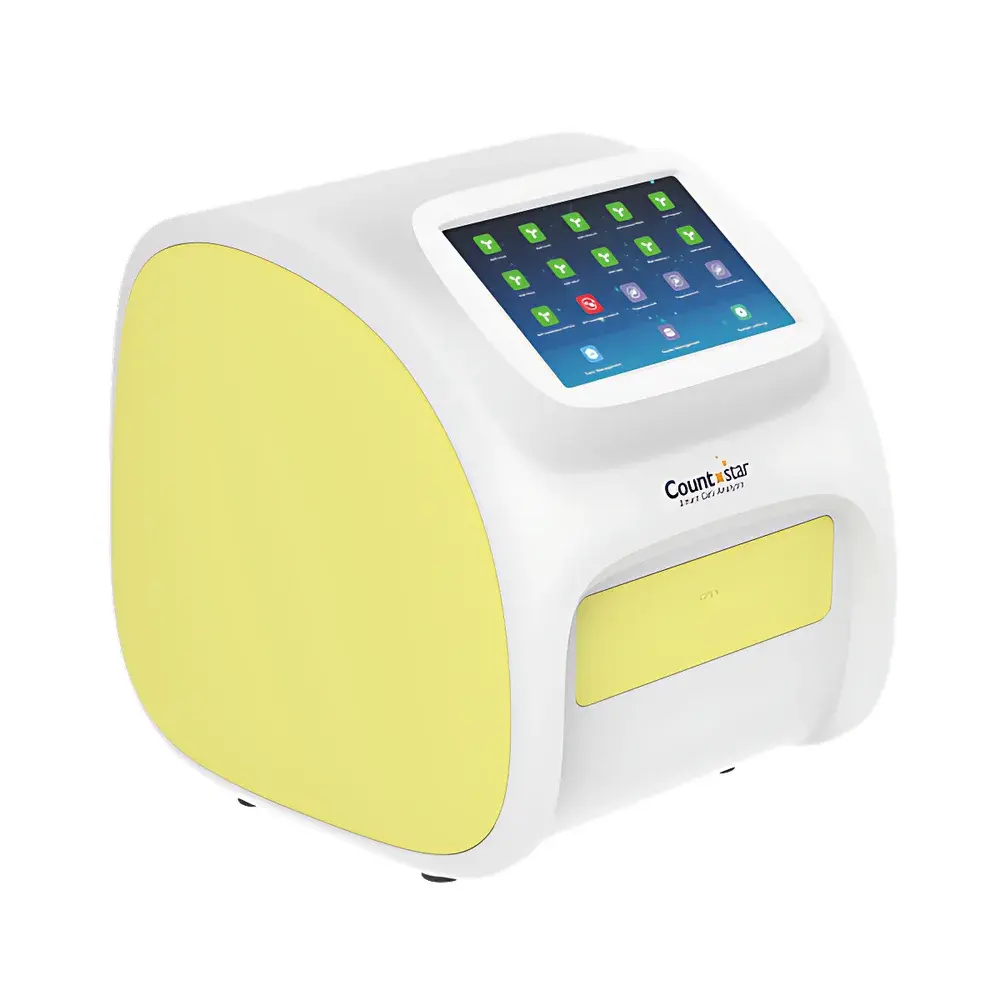
Countstar Mira HT High-Throughput Cell Analyzer
| Brand | Countstar |
|---|---|
| Origin | Shanghai, China |
| Model | Mira HT |
| Detection Concentration Range | 1 × 10⁴ – 3 × 10⁷ cells/mL |
| Sample Volume | 20 µL |
| Throughput | 24 samples (standard) / 15 samples (fluorescence mode) |
| Detectable Cell Size | 1–180 µm |
| Imaging Sensor | 8.3 MP CMOS |
| Optical Resolution | Optimized for ≥2× field area vs. standard hemocytometer |
| Trypan Blue Mode Acquisition Time | <10 s per image |
| AO/PI Dual-Fluorescence Mode Acquisition Time | <22 s per image |
| Total Analysis Time per Sample | <30 s (brightfield), <60 s (fluorescence) |
| Software Compliance | FDA 21 CFR Part 11, GLP/GMP-ready audit trail, 3Q validation support |
Overview
The Countstar Mira HT High-Throughput Cell Analyzer is an automated, dual-mode (brightfield and fluorescence) cell counting and viability assessment platform engineered for precision, reproducibility, and scalability in biopharmaceutical process development and quality control laboratories. Built upon a robust optical architecture integrating an 8.3-megapixel CMOS sensor and high-numerical-aperture optics, the system captures a field-of-view exceeding twice that of a conventional hemocytometer—enabling statistically representative sampling across heterogeneous cell populations. Its core measurement principle combines digital image acquisition with AI-driven morphological segmentation and classification algorithms trained on diverse mammalian, insect, and stem cell types. Unlike traditional flow cytometry or manual hemocytometry, the Mira HT performs label-free and dye-based (Trypan Blue, Acridine Orange/Propidium Iodide) analysis without fluidic sheath or pressure-dependent alignment, minimizing shear-induced artifacts and ensuring compatibility with fragile primary and iPSC-derived cells.
Key Features
- High-throughput sample processing: Simultaneous analysis of up to 24 samples in brightfield mode or 15 samples in AO/PI dual-fluorescence mode using standardized 24-well assay plates.
- AI-powered image analysis engine: Trained on >10⁶ annotated cell images, enabling adaptive recognition of irregular morphology (e.g., aggregated, elongated, or low-contrast cells) and reducing operator-dependent variability.
- Dual-modality detection: Supports both membrane integrity-based viability (Trypan Blue exclusion) and nucleic acid staining (AO/PI), with independent quantification of total concentration, viable concentration, and viability percentage.
- Transfection efficiency analysis: Integrated GFP/RFP channel detection with adjustable gain and exposure control, enabling quantitative assessment of transduction/transfection rates without external software.
- Fixed-focus optical design: Eliminates motorized Z-axis adjustment, enhancing measurement repeatability and reducing mechanical drift over extended operation cycles.
- Seamless automation integration: Equipped with standard RS-232 and Ethernet interfaces; compatible with liquid handlers (e.g., Tecan Freedom EVO), robotic arms (e.g., Hamilton STAR), and plate stackers for unattended 24/7 operation.
Sample Compatibility & Compliance
The Mira HT accommodates a broad spectrum of suspension and adherent cell types—including CHO, HEK293, Jurkat, PBMCs, CAR-T, MSCs, and organoid-derived single-cell suspensions—across size ranges from 1 µm (e.g., exosomes in conditioned media) to 180 µm (e.g., large spheroids or clumps). It accepts standard 24-well plates, custom chamber slides, and disposable counting chambers (e.g., Countstar ISF series). All software modules comply with regulatory requirements for data integrity: full 21 CFR Part 11 compliance is implemented via electronic signatures, role-based access control, immutable audit trails, and encrypted local/server backup. The system supports IQ/OQ/PQ documentation packages and has been validated per ASTM E2877-22 (Standard Guide for Validation of Automated Cell Counting Systems) and ISO 20387:2018 (Biobanking requirements).
Software & Data Management
The embedded Countstar Analysis Suite v4.x provides real-time image preview, batch processing, and customizable reporting templates. Users can define pass/fail criteria per parameter (e.g., viability >85%, CV <5% across replicates), trigger automatic alerts, and generate compliant PDF reports containing raw images, histograms, scatter plots, and growth curve modeling (log-phase slope, doubling time, lag phase duration). Export options include CSV (for LIMS integration), TIFF (high-fidelity imaging), PNG (presentation-ready), and Excel-compatible XLSX. Data storage supports network-attached storage (NAS), SQL Server databases, and cloud-synced repositories with TLS 1.2 encryption. Audit logs record every user action—including parameter edits, result overrides, and report generation—with timestamps and operator IDs.
Applications
- Bioprocess development: Rapid optimization of seeding density, feed strategies, and harvest timing in upstream bioreactor campaigns.
- Cell therapy QC release testing: Quantitative assessment of final product concentration, viability, and transfection efficiency prior to cryopreservation or infusion.
- Stem cell manufacturing: Monitoring differentiation status and population homogeneity via morphology-based clustering and fluorescent reporter expression.
- Contract research organization (CRO) service labs: Scalable throughput for client-driven assays requiring >100 samples/day under GLP conditions.
- Viral vector production: Enumeration of producer cells pre-transduction and post-harvest, correlating cell health metrics with titers (IU/mL).
FAQ
Does the Mira HT require daily calibration or routine maintenance?
No routine optical recalibration is required due to its fixed-focus design; only periodic verification using NIST-traceable microsphere standards (recommended quarterly) is advised.
Can the system distinguish between live/dead cells in mixed populations without dyes?
Brightfield-only analysis provides total count and morphological metrics but cannot determine viability without membrane-impermeant dyes; AO/PI or Trypan Blue staining remains necessary for viability discrimination.
Is remote monitoring or cloud-based data review supported?
Yes—via optional Countstar Connect module, enabling secure web-based access to instrument status, queued runs, and historical datasets from any authorized workstation.
What validation documentation is provided for GMP environments?
A complete 3Q package (IQ/OQ/PQ protocols and reports), traceable to manufacturer’s factory acceptance tests, is included with each system shipment and updated annually per change control procedures.
Related Products