
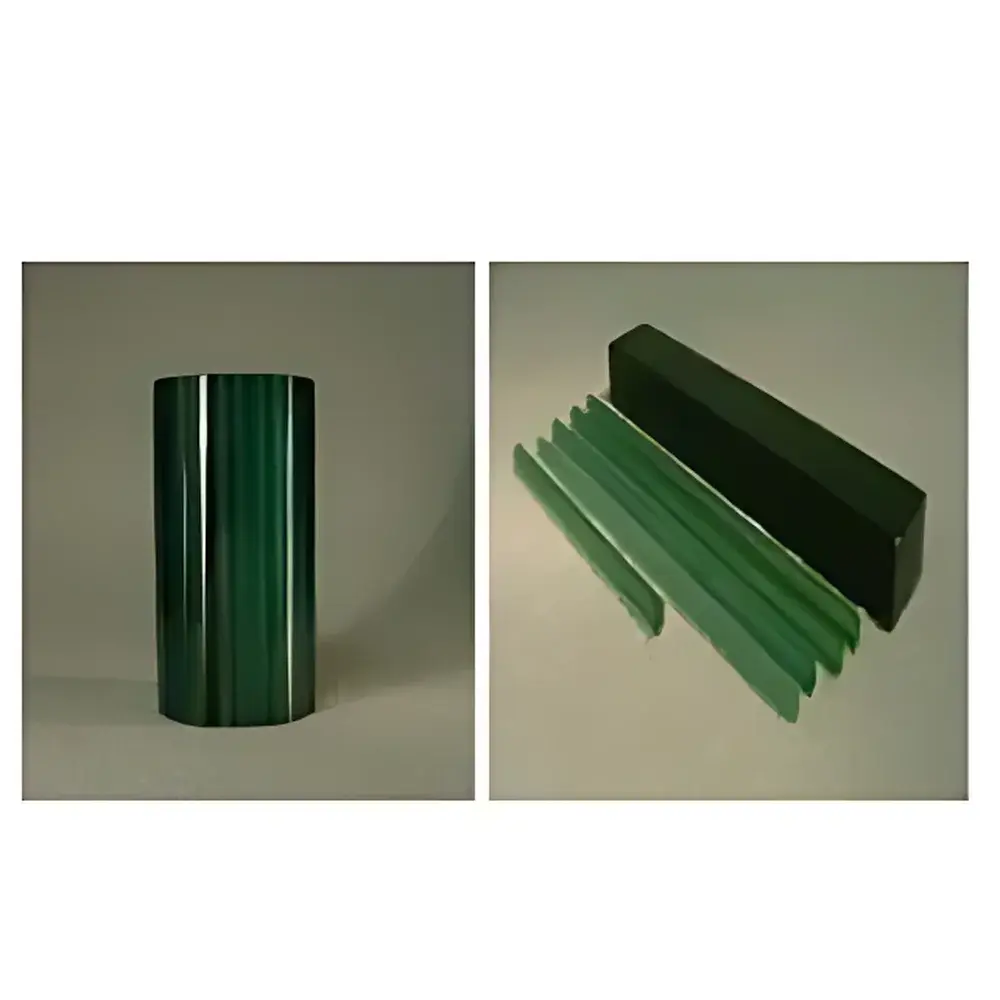
Cr, Tm, Ho:YAG Laser Crystal by SYNOPTICS
| Brand | SYNOPTICS |
|---|---|
| Origin | USA |
| Manufacturer Type | Authorized Distributor |
| Import Status | Imported |
| Model | Cr,Tm,Ho:YAG |
| Wavelength | 2080 nm |
| Matrix | Y₃Al₅O₁₂ (YAG) |
| Doping Concentrations | Cr³⁺ 0.85 at.%, Tm³⁺ 5.90 at.%, Ho³⁺ 0.36 at.% |
| Crystal Orientation | [111] ± 5° |
| Wavefront Distortion | < λ/2 per inch @ 1064 nm |
| Surface Flatness | λ/10 @ 633 nm |
| Parallelism | < 30 arcsec |
| Perpendicularity | < 5 arcmin |
| Surface Quality | 10-5 (MIL-O-13830A) |
| AR Coating | R < 0.25% @ 2080 nm |
| Damage Threshold | > 10 J/cm² (ns pulse) |
| Pump Band | 400–800 nm |
| Diode Pump Wavelength | 781 nm |
| Absorption Bandwidth | 4 nm FWHM @ 781 nm |
| Fluorescence Lifetime | 8.5 ms |
| Stimulated Emission Cross-Section | 7 × 10⁻²¹ cm² |
| Refractive Index | ~1.8 @ 2080 nm |
Overview
The Cr, Tm, Ho:YAG laser crystal is a solid-state, trivalent-ion co-doped gain medium engineered for efficient 2.08 µm laser emission via resonant energy transfer cascades. Unlike conventional Nd:YAG or Er:YAG systems, this crystal leverages a three-stage photonic energy transfer process: Cr³⁺ ions absorb broadband pump radiation (400–800 nm), rapidly transfer excitation to Tm³⁺ via non-radiative relaxation, and subsequently enable cross-relaxation between neighboring Tm³⁺ ions—each producing two excited Tm³⁺ states. One of these then transfers energy to Ho³⁺, populating the upper laser level (⁵I₇) with near-unity quantum efficiency (~2 photons per absorbed pump photon). The resulting laser transition occurs between the ⁵I₇ → ⁵I₈ manifolds, emitting at 2080 nm—a wavelength strongly absorbed by water and hemoglobin while exhibiting low atmospheric scattering and high eye-safety (Class 1M per IEC 60825-1). This makes Cr,Tm,Ho:YAG particularly suitable for continuous-wave (CW) and Q-switched operation in medical ablation, remote sensing, and military countermeasure applications.
Key Features
- High optical-to-optical conversion efficiency (>50% demonstrated under flashlamp pumping; >35% under diode pumping at 781 nm)
- Room-temperature operation without cryogenic cooling
- Broadband pump absorption (400–800 nm), compatible with both flashlamps and high-power laser diodes
- Narrow 4 nm FWHM absorption bandwidth at 781 nm—four times wider than Nd:YAG’s 808 nm band—enabling relaxed thermal management of pump sources
- Low thermal lensing due to uniform doping distribution and optimized crystal growth (Czochralski method)
- Wavefront distortion < λ/2 per inch @ 1064 nm ensures minimal beam degradation in resonator configurations
- Surface quality compliant with MIL-O-13830A (10-5 scratch-dig) and AR coating durability certified to MIL-C-48497A
- Pulse damage threshold >10 J/cm² (10 ns, 10 Hz), validated per ISO 21254-1
Sample Compatibility & Compliance
This Cr,Tm,Ho:YAG crystal is fabricated exclusively from high-purity, stoichiometric Y₃Al₅O₁₂ (YAG) single crystals grown under controlled oxidizing atmosphere to minimize oxygen vacancy formation. All substrates are oriented along the [111] crystallographic direction (±5° tolerance) to maximize polarization stability and minimize birefringent losses in linearly polarized cavities. Each crystal undergoes full metrological validation—including interferometric flatness mapping, spectral absorption profiling (UV-VIS-NIR), fluorescence lifetime decay analysis (TCSPC), and laser-induced damage testing—per ASTM F2656 and ISO 11551 standards. Final inspection includes GLP-aligned documentation traceable to NIST-calibrated reference instruments. The material complies with RoHS Directive 2011/65/EU and is certified for use in FDA-regulated Class II laser systems (21 CFR 1040.10/1040.11).
Software & Data Management
While Cr,Tm,Ho:YAG is a passive optical component, SYNOPTICS provides full digital traceability for each delivered crystal unit. Customers receive a secure PDF certificate containing: raw absorption spectra (200–2500 nm), fluorescence decay curve (⁵I₇ lifetime), wavefront error map (Zernike decomposition), surface roughness profile (AFM-derived RMS), and coating reflectance data (2000–2200 nm). All datasets are timestamped, digitally signed, and archived in accordance with ISO 9001:2015 Clause 8.5.2 (Identification and traceability). Optional integration with laboratory LIMS platforms is supported via CSV/XML export protocols aligned with ASTM E1469-19 for instrument calibration metadata exchange.
Applications
- Medical: Soft-tissue ablation, lithotripsy, and minimally invasive surgery—leveraging strong water absorption at 2080 nm for precise thermal confinement and reduced collateral damage
- Industrial: Polymer welding, ceramic marking, and selective laser sintering where mid-IR absorption improves coupling efficiency over 1 µm sources
- Military: Eye-safe LIDAR transmitters, infrared countermeasures (IRCM), and directed-energy testbeds operating within NATO STANAG 4671-compliant safety envelopes
- Scientific Research: Pump source for optical parametric oscillators (OPOs) targeting the 3–5 µm atmospheric window, frequency conversion studies, and time-resolved spectroscopy of vibrational modes in biomolecules
- Environmental Sensing: Differential absorption LIDAR (DIAL) for CO₂ and H₂O vapor profiling, benefiting from low Rayleigh scattering and high molecular absorption cross-sections at 2.08 µm
FAQ
What is the primary laser transition wavelength of Cr,Tm,Ho:YAG?
The dominant stimulated emission occurs at 2080 nm, corresponding to the ⁵I₇ → ⁵I₈ electronic transition of Ho³⁺.
Can this crystal be pumped by laser diodes?
Yes—optimized for 781 nm diode pumping with 4 nm spectral bandwidth tolerance; also compatible with broadband flashlamps (400–800 nm range).
Is the crystal suitable for Q-switched operation?
Yes—its 8.5 ms upper-state lifetime supports high-energy nanosecond pulse generation with standard acousto-optic or electro-optic modulators.
What coating specifications are standard on the end faces?
Anti-reflection (AR) coating with R < 0.25% at 2080 nm; custom dual-band coatings (e.g., HR @ 781 nm / AR @ 2080 nm) available upon request.
Does SYNOPTICS provide full metrology reports?
Yes—each unit ships with a NIST-traceable calibration dossier including absorption, fluorescence, wavefront, surface, and coating performance data.





