
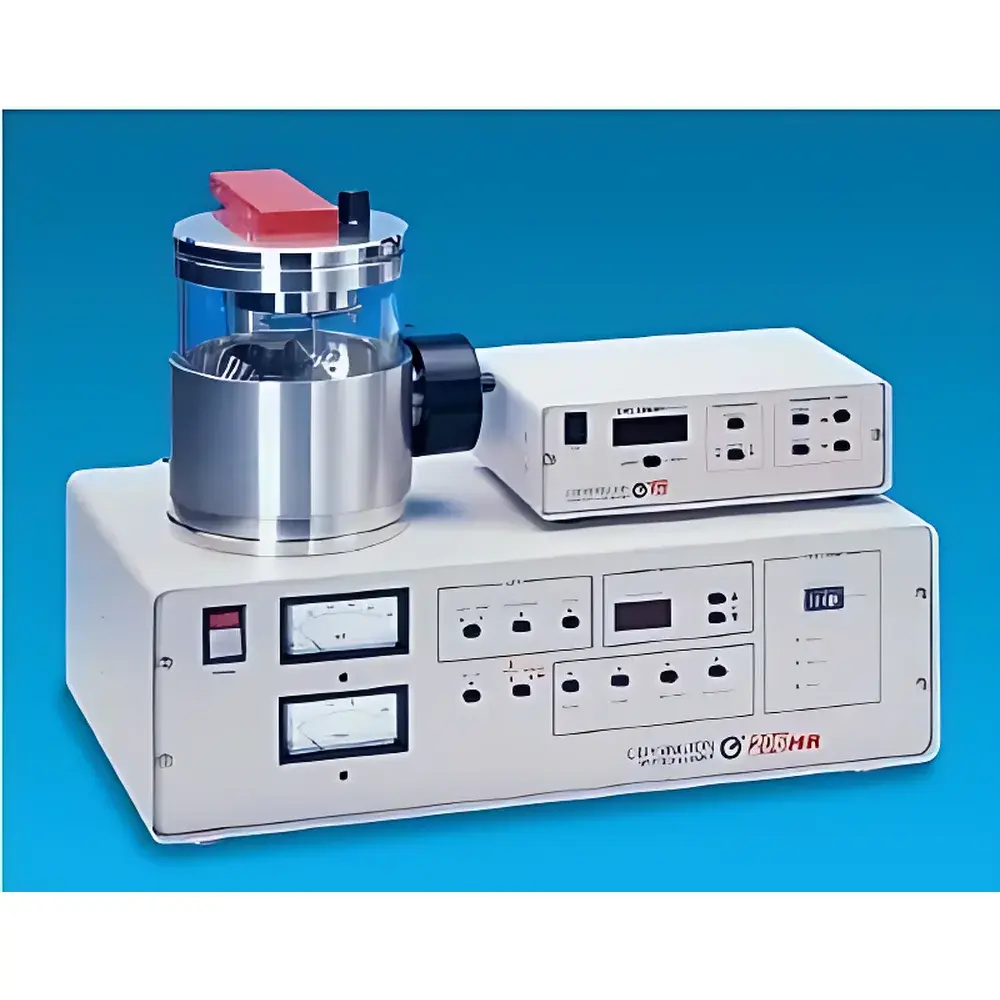
Cressington 208HR High-Resolution Multi-Target Ion Sputter Coater
| Brand | Cressington |
|---|---|
| Origin | United Kingdom |
| Model | 208HR |
| Target Materials | Au, Pt, Pt/Pd, AgI, Ir |
| Target Diameter | 57 mm |
| Control Mode | Automatic |
| Chamber Diameter | 150 mm |
| Sample Stage | 100 mm diameter, rotatable and tilt-adjustable |
| Sputtering Gas | Argon |
| Vacuum System | Integrated turbomolecular pumping (implied by HR designation and industry standard) |
| Cooling | Cold-stage sputtering architecture |
| Compliance | Designed for SEM/EPMA sample preparation per ISO 16700 and ASTM E1558 practices |
Overview
The Cressington 208HR High-Resolution Multi-Target Ion Sputter Coater is an advanced vacuum-based thin-film deposition system engineered specifically for high-fidelity conductive coating of non-conductive specimens prior to scanning electron microscopy (SEM), energy-dispersive X-ray spectroscopy (EDS), and electron probe microanalysis (EPMA). Operating on the principle of magnetron-enhanced direct-current (DC) ion sputtering, the 208HR utilizes a precisely controlled argon plasma to eject atoms from solid metallic or ceramic targets—such as Au, Pt, Pt/Pd, AgI, and Ir—onto sample surfaces. Its defining technical distinction lies in its cold-state sputtering architecture: unlike conventional thermal sputter coaters, the 208HR minimizes radiative and conductive heat transfer to the specimen during deposition, thereby eliminating thermal damage, beam-induced deformation, and topographic artifacting in beam-sensitive materials including polymers, biological tissues, and hydrated or cryo-prepared samples. This capability is essential for preserving nanoscale surface morphology and enabling quantitative backscattered electron (BSE) contrast in low-voltage SEM imaging.
Key Features
- Multi-target configuration with up to four independently selectable 57 mm-diameter sputter targets, enabling rapid switching between conductive and high-Z contrast coatings without venting the chamber.
- Automated process control via integrated microprocessor, supporting programmable deposition time, current setpoint, and gas flow regulation—ensuring inter-run reproducibility and operator-independent protocol execution.
- Rotatable and tilt-adjustable 100 mm-diameter sample stage, facilitating uniform coating of irregularly shaped or high-aspect-ratio specimens through dynamic angular exposure.
- Optimized magnetic field geometry and closed-loop current regulation ensure spatially homogeneous film thickness across the full 150 mm-diameter chamber volume, verified per ISO 16700 Annex B coating uniformity test protocols.
- Integrated turbomolecular vacuum system achieves base pressures <5 × 10⁻⁷ mbar, critical for minimizing oxide formation on reactive targets (e.g., Ir, Pt/Pd) and ensuring stoichiometric fidelity in compound coatings such as AgI.
- Compact benchtop footprint (W × D × H: 420 × 530 × 380 mm) with front-loading chamber design supports seamless integration into shared microscopy suites and cleanroom environments.
Sample Compatibility & Compliance
The 208HR accommodates a broad spectrum of non-conductive and beam-sensitive specimens: biological sections (resin-embedded or frozen-hydrated), polymer films, ceramic powders, geological thin sections, forensic trace evidence, and semiconductor cross-sections. Its cold sputtering performance meets the requirements of ISO 16700:2017 (“Electron microscopy — Preparation of specimens for SEM and EPMA”) and aligns with ASTM E1558–22 (“Standard Guide for Preparation of Specimens for Electron Microprobe Analysis”). The system’s automated log generation—including timestamped run parameters, target usage, pressure profiles, and current stability metrics—supports GLP-compliant documentation and satisfies audit requirements under FDA 21 CFR Part 11 when paired with validated laboratory information management systems (LIMS).
Software & Data Management
The 208HR operates via an embedded real-time control interface with password-protected user levels (Operator, Technician, Administrator). All process parameters are stored in non-volatile memory and exportable as CSV files via USB port for traceability and statistical process control (SPC) analysis. Optional Ethernet connectivity enables remote monitoring and integration with centralized facility management platforms. Firmware updates follow IEC 62304 Class B software lifecycle standards, and version-controlled calibration logs are retained internally for regulatory review.
Applications
- High-resolution SEM imaging of insulating nanoparticles, where ultra-thin (<2 nm), low-stress Pt/Pd coatings prevent charging without obscuring fine surface features.
- Quantitative EDS mapping of heterogeneous catalysts, using Ir coatings to suppress substrate fluorescence while maintaining X-ray transmission efficiency.
- Cryo-SEM workflow integration: AgI sputtering at sub-100 K enables charge dissipation on frozen-hydrated specimens without ice recrystallization.
- Failure analysis of MEMS devices, where rotational stage tilt allows conformal coating of sidewalls and trenches for reliable secondary electron emission.
- Forensic fiber analysis requiring elemental differentiation via BSE contrast—optimized using dual-target Au/Pt sequential deposition protocols.
FAQ
What vacuum level does the 208HR achieve, and why is it critical for high-resolution coating?
The system reaches a base pressure of ≤5 × 10⁻⁷ mbar using its integrated turbomolecular pump. This ultra-high vacuum minimizes residual gas collisions during sputter transport, reducing film contamination and enabling sub-nanometer grain structure in noble metal coatings—essential for resolving <5 nm surface details in field-emission SEM.
Can the 208HR deposit alloys or compound targets?
Yes—provided the target is sputter-compatible and electrically conductive. AgI is routinely used; custom sintered targets (e.g., TiN, Cr, or NiCr) may be installed subject to compatibility verification with the DC power supply and magnetic confinement geometry.
Is the rotation/tilt function motorized and programmable?
Yes—the stage drive is stepper-motor controlled with user-defined angular velocity (0–30 rpm) and tilt range (0–90°), both configurable within each deposition protocol.
How does the cold sputtering architecture differ from conventional cooling stages?
It eliminates active cooling elements (e.g., liquid nitrogen traps) and instead relies on optimized plasma confinement, low-duty-cycle pulsing, and thermally decoupled stage design—reducing specimen heating to <5 °C above ambient even during extended 120-second runs.
Does the system support IQ/OQ/PQ validation documentation?
Cressington provides a comprehensive Validation Support Package (VSP), including installation qualification (IQ) checklists, operational qualification (OQ) test procedures per ISO 16700, and performance qualification (PQ) templates for film thickness uniformity, grain size verification, and charge dissipation efficacy.



