
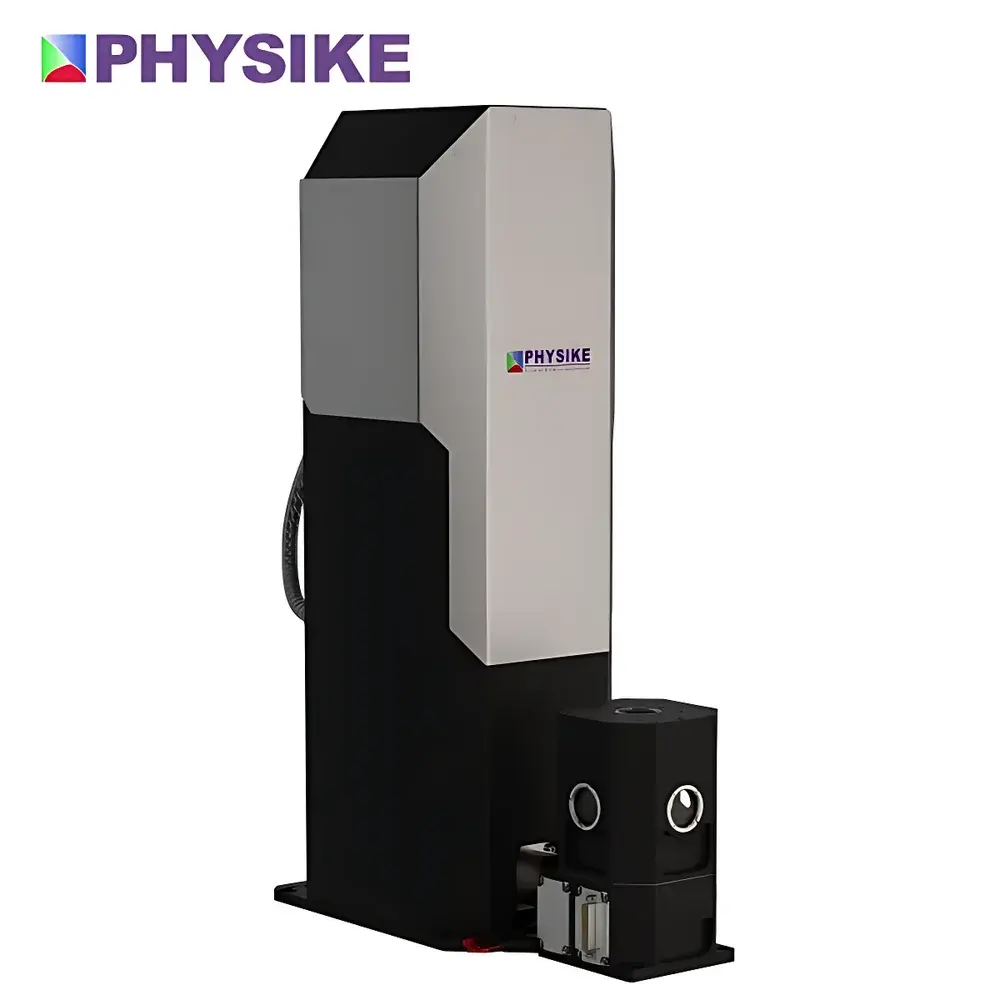
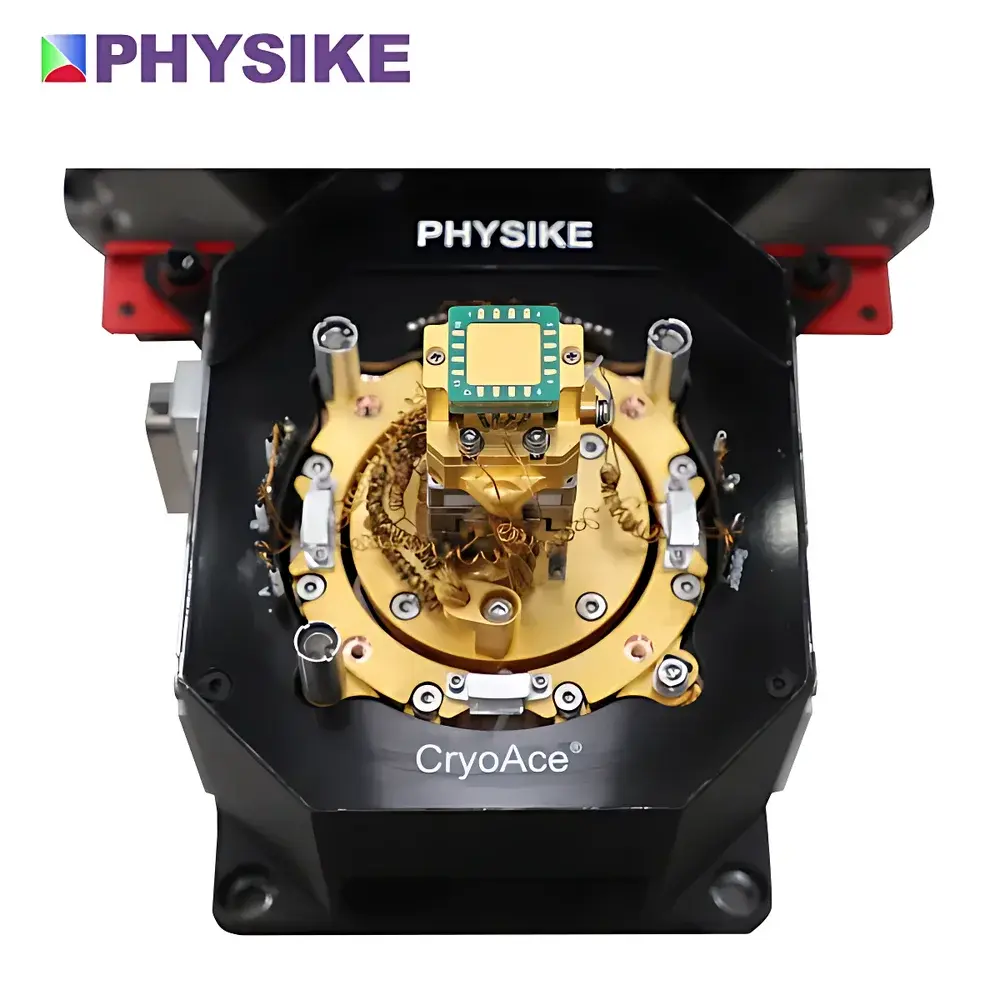
CryoAce-50 Cryogenic Optical Microscopy Thermostat by PHYSIKE
| Brand | PHYSIKE |
|---|---|
| Origin | Beijing, China |
| Manufacturer Type | Direct Manufacturer |
| Product Category | Domestic (China-Made) |
| Model | CryoAce-50 |
| Quotation | Upon Request |
| Vibration Stability | 10 nm |
| Circulating Medium | Helium Gas |
Overview
The CryoAce-50 Cryogenic Optical Microscopy Thermostat is a high-stability, desktop-integrated cryogenic platform engineered for nanoscale optical experiments requiring ultra-low temperatures and exceptional mechanical isolation. It operates on a closed-cycle helium refrigeration principle, utilizing a proprietary suspended cold-head vibration isolation architecture—patented by PHYSIKE—to suppress microvibrations inherent to conventional pulse-tube or GM cryocoolers. This multi-stage passive and active damping system achieves sub-12 nm RMS positional stability at the cold plate surface under operational vacuum conditions. The system reaches base temperatures between 2.4 K and 3.2 K, depending on cold plate diameter (5 cm to 20 cm), thermal load, and configuration—enabling quantum-limited measurements in solid-state quantum optics, single-emitter spectroscopy, and low-temperature scanning probe integration. Its compact, self-contained design eliminates dependency on external water-cooling infrastructure or three-phase power, making it compatible with standard laboratory electrical outlets (220 V AC, single-phase) and standard optical tables—no custom pit-mounted vibration isolation required.
Key Features
- Sub-12 nm vibration stability at cold plate surface, validated via interferometric metrology under operational vacuum and thermal load
- Base temperature range of 2.4–3.2 K, scalable across cold plate diameters (5 cm, 10 cm, 15 cm, 20 cm)
- Integrated helium gas circulation system with air-cooled compressor—no external chiller or water supply needed
- Onboard cryogenic adsorption pumps maintain high vacuum (<1×10⁻⁷ mbar) without continuous external pumping
- Modular optical access: Standard top-view and/or side-view optical windows; customizable spectral transmission (UV–Vis–IR–THz–X-ray–γ-ray)
- Pre-aligned mounting interface for commercial confocal microscopes, Raman spectrometers (e.g., Horiba LabRAM HR Evolution), and home-built optical setups
- Structural framework optimized for thermal contraction compensation and long-term dimensional stability below 4 K
Sample Compatibility & Compliance
The CryoAce-50 supports a wide range of low-temperature sample carriers—including PUCK, DIP, LCC, and optically transmissive sample holders—designed for electrical transport, photoluminescence, cathodoluminescence, and pump-probe measurements. It accommodates standard nanopositioning stages (e.g., Attocube ANPxyz series) and objective lenses with working distances down to 1 mm. All vacuum vessel materials comply with ASTM F889-17 (outgassing specifications for UHV components), and internal surfaces are electropolished stainless steel per ISO 14644-1 Class 4 cleanliness standards. The system is compatible with GLP/GMP-aligned experimental workflows: temperature calibration traceable to NIST-certified Pt resistance thermometers (included), full audit trail capability via optional software logging (see Software section), and vacuum integrity monitoring compliant with ISO 20483-2 for cryogenic vacuum systems.
Software & Data Management
PHYSIKE provides the CryoControl Suite—a cross-platform (Windows/Linux) application enabling real-time monitoring and closed-loop control of temperature (0.01 K resolution), vacuum pressure (10⁻⁹–10³ mbar range), helium flow rate, and compressor status. The software supports automated ramp-and-hold protocols, configurable alarm thresholds, and timestamped data export in HDF5 and CSV formats. Optional FDA 21 CFR Part 11 compliance package includes electronic signatures, user role-based access control, and immutable audit logs for regulated environments. Integration with LabVIEW, Python (via PyVISA), and MATLAB is supported through documented SCPI command sets and native API libraries.
Applications
- Single quantum dot and NV-center spin resonance under magnetic fields up to 12 T (with optional vertical extension)
- Low-temperature micro-photoluminescence and time-resolved PL spectroscopy of 2D materials (e.g., WSe₂, hBN)
- Cryogenic Raman mapping of phonon modes in superconductors and topological insulators
- Optical coupling to superconducting nanowire single-photon detectors (SNSPDs)
- In-situ cryo-optical characterization of catalytic nanoparticles and molecular crystals
- Integration with scanning tunneling microscopy (STM) and atomic force microscopy (AFM) platforms requiring 24 h
FAQ
What is the typical cooldown time from 300 K to 4 K?
Typical cooldown time is approximately 2.5–3.5 hours, depending on initial vacuum level, cold plate size, and ambient humidity.
Can the CryoAce-50 be operated continuously for extended periods (e.g., >72 h)?
Yes—integrated cryo-adsorption pumps and redundant pressure relief valves enable unattended operation for >168 h under stable thermal load and vacuum conditions.
Is electromagnetic interference (EMI) shielding available as an option?
Yes—optional mu-metal shielding and RF-tight feedthrough configurations (Triax BNC, SMA, 1.0 mm V-connectors) are available for microwave and spin-resonance applications.
Does the system support in-vacuum electrical measurements?
Yes—standard configurations include 12-channel low-noise flexible coaxial leads; optional cryogenic wiring harnesses support DC, AC, RF, and pulsed current up to 1 A at 4 K.
How is temperature calibrated and verified?
Each unit ships with a factory-calibrated Cernox™ CX-1050 sensor and a secondary calibrated Pt100 reference thermometer; calibration certificates are traceable to NIST SRM 1750a.



