
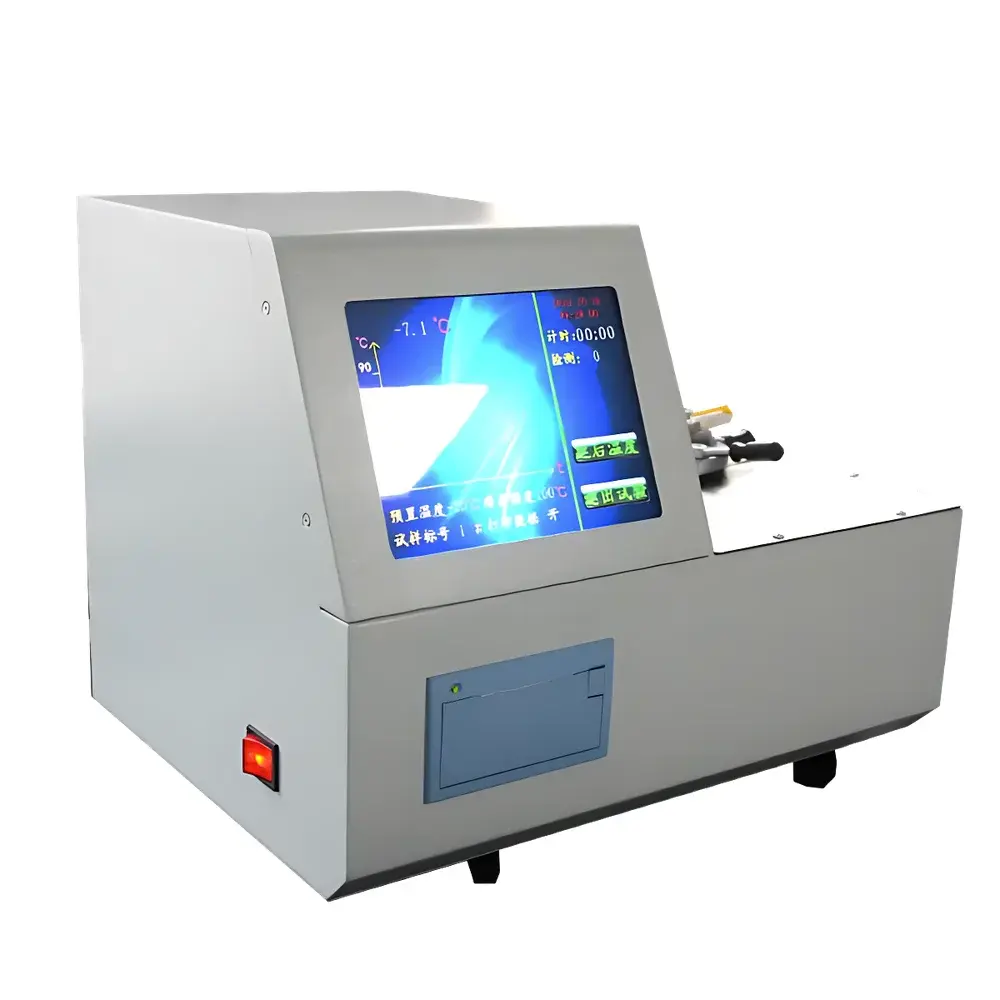
CSFriend FDT-0234 Automated Low-Temperature Closed-Cup Flash Point Tester
| Brand | CSFriend |
|---|---|
| Origin | Hunan, China |
| Model | FDT-0234 |
| Flash Point Range | -30 °C to 50 °C |
| Temperature Control Accuracy | ±0.5 °C |
| Measurement Precision | < 2 °C |
| Sample Volume | 2 mL (liquid), 4 mL (solid/semi-solid) |
| Ignition Method | Electronic spark igniter |
| Cooling System | Peltier thermoelectric cooling with external chilled water circulation |
| Power Supply | AC 220 V ±10 %, 50 Hz |
| Max. Power Consumption | ≤300 W |
| Operating Ambient | 5–30 °C, 30–80 % RH |
| Compliance | GB/T 5208 (Rapid Equilibrium Closed-Cup Method) |
Overview
The CSFriend FDT-0234 Automated Low-Temperature Closed-Cup Flash Point Tester is an engineered solution for precise and repeatable flash point determination of volatile petroleum products, solvents, and specialty chemicals operating in sub-ambient temperature regimes. It implements the rapid equilibrium closed-cup principle per GB/T 5208 — a method aligned with internationally recognized closed-cup test protocols such as ASTM D3828 and ISO 3679. Unlike traditional Pensky-Martens or Tag testers, the FDT-0234 employs active Peltier-based thermoelectric cooling combined with real-time vapor-phase equilibrium monitoring to achieve stable, low-temperature thermal control without mechanical compressors or refrigerants. This architecture enables reliable flash point measurements from –30 °C up to 50 °C, making it especially suitable for light distillates, biofuels, aviation turbine fuels, and cold-climate formulation screening where conventional instruments lack sufficient low-end range or thermal stability.
Key Features
- Integrated Peltier cooling system with external chilled water loop support ensures rapid, silent, and maintenance-free temperature ramping — eliminating compressor noise, oil leakage risks, and ambient heat load interference.
- Large backlit LCD interface with tactile membrane keypad provides intuitive navigation, real-time parameter visualization (temperature ramp, vapor concentration trend, ignition status), and on-device result review — no external PC required for routine operation.
- Fully automated sequence: auto-sample introduction (2 mL for liquids; 4 mL for semi-solids), closed-cup equilibration, programmed temperature ramping, electronic spark ignition, and automatic pass/fail detection based on observed flame propagation.
- High-reproducibility thermal management: digital PID-controlled heating/cooling stage maintains ±0.5 °C setpoint stability during equilibrium phase, critical for meeting GB/T 5208 repeatability requirements (≤2 °C).
- Embedded thermal calibration traceability: built-in reference sensor verification protocol supports periodic in-house validation against NIST-traceable standards — essential for GLP-compliant laboratories.
Sample Compatibility & Compliance
The FDT-0234 accommodates liquid hydrocarbons, oxygenated blends (e.g., ethanol-gasoline mixtures), synthetic lubricants, and semi-solid samples including waxy distillates and bituminous cutbacks. Its sealed test chamber design minimizes sample oxidation and vapor loss, preserving compositional integrity throughout analysis. The instrument is fully compliant with GB/T 5208 and technically compatible with ASTM D3828 (Small Scale Closed-Cup Tester) and ISO 3679 methodologies. While not certified to UL 94 or IECEx for hazardous area installation, its intrinsically safe ignition circuitry and non-sparking enclosure meet general laboratory safety requirements for Class I, Division 2 environments. Routine operation satisfies internal QA/QC documentation needs under ISO/IEC 17025-accredited testing workflows.
Software & Data Management
Data output is delivered via built-in thermal printer (standard) for immediate hard-copy reporting, including date/time stamp, sample ID, measured flash point, test method reference (GB/T 5208), and operator ID. Optional RS-232 or USB-to-serial interface enables integration with LIMS or laboratory data aggregation platforms. All measurement logs are stored onboard with timestamped metadata (start time, final equilibrium temp, ignition event count, deviation alerts). Audit trail functionality includes user-access logging and parameter-change history — supporting alignment with FDA 21 CFR Part 11 principles when paired with validated third-party data capture software. No proprietary cloud service or vendor-hosted platform dependency is introduced.
Applications
- Quality control of jet fuel (Jet A-1, JP-8) and diesel fractions requiring low-temperature volatility verification prior to cold-weather deployment.
- R&D screening of bio-derived solvents (e.g., limonene, ethyl lactate) where flash point behavior below 0 °C influences handling classification and transport regulation (UN TDG, ADR/RID).
- Regulatory compliance testing for industrial cleaning formulations subject to CLP/GHS hazard communication requirements (H225: Highly flammable liquid and vapor).
- Refinery intermediate stream monitoring to detect light ends carryover into heavier cuts — enabling early process adjustment before off-spec product generation.
- Contract testing laboratories serving petrochemical clients requiring ISO/IEC 17025 traceable flash point data with documented uncertainty budgets.
FAQ
Does the FDT-0234 support ASTM D93 or ISO 2719 testing methods?
No — it is specifically designed for rapid equilibrium closed-cup testing per GB/T 5208, which corresponds most closely to ASTM D3828 and ISO 3679. ASTM D93 (Pensky-Martens) and ISO 2719 require different cup geometry, stirring, and ignition timing protocols incompatible with this instrument’s hardware architecture.
Is external chiller mandatory for operation at –30 °C?
Yes. While the Peltier module provides primary cooling, achieving and sustaining –30 °C requires connection to an external recirculating chiller capable of delivering coolant at ≤5 °C and ≥1.5 L/min flow rate. Ambient air cooling alone cannot maintain thermal equilibrium at the lowest end of the specified range.
Can the instrument be calibrated using certified reference materials?
Yes. Certified flash point standards (e.g., NIST SRM 2721 series or equivalent traceable to national metrology institutes) may be used for performance verification. Calibration intervals should follow internal SOPs aligned with ISO/IEC 17025 clause 6.5 and manufacturer-recommended frequency (typically every 90 days or per 100 tests, whichever occurs first).
What maintenance is required for the electronic igniter?
The solid-state spark generator requires no consumables or periodic replacement. However, the electrode tip must be cleaned weekly with lint-free swab and isopropyl alcohol to prevent carbon buildup that could impair spark intensity or timing accuracy.
Is the printed report compliant with GLP documentation standards?
The embedded printer output includes all minimum GLP elements: unique test ID, analyst name/ID, instrument serial number, date/time, environmental conditions (recorded manually or via optional ambient sensor input), and raw result. For full GLP compliance, laboratories must supplement with controlled document procedures, version-controlled SOPs, and independent equipment qualification (IQ/OQ/PQ) records.




