
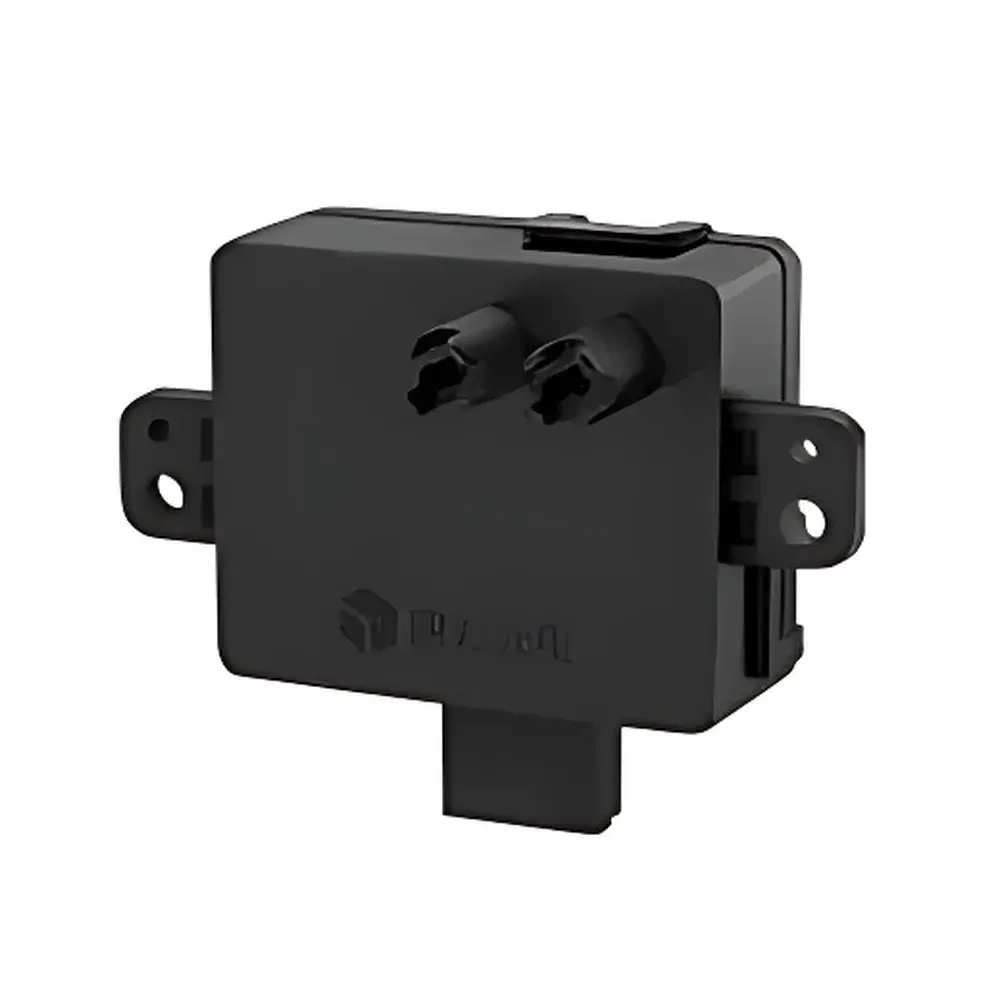
Cubic AAG-1000 Automotive Negative Ion Generator
| Brand | Cubic |
|---|---|
| Origin | Hubei, China |
| Manufacturer Type | Authorized Distributor |
| Country of Origin | China |
| Model | AAG-1000 |
| Negative Ion Output | ≥ 3 × 10⁶ pcs/cm³ |
| Residual Ozone Concentration | ≤ 0.05 ppm |
| Operating Voltage | 21–27 V DC |
| Operating Current | ≤ 30 mA |
| Output High Voltage | –3.5 ± 0.5 kV (1 G) |
| Protection Impedance | 20 ± 2 MΩ |
| Dielectric Withstand Voltage | ≥ 3750 V AC |
| Dimensions | 67.8 × 44.9 × 22 mm (W × H × D) |
| EMC Compliance | ISO 11452-4 & ISO 16750-2 |
Overview
The Cubic AAG-1000 Automotive Negative Ion Generator is an engineered electrostatic air purification module designed for integration into automotive cabin ventilation systems. It operates on the principle of corona discharge from precision-engineered carbon-based sharp-tipped electrodes energized by a regulated negative high-voltage DC source (–3.5 kV ± 0.5 kV). This controlled ionization process generates a stable flux of small air ions (O₂⁻, CO₃⁻, OH⁻) at a minimum output density of 3 × 10⁶ ions per cm³ under standard test conditions (25 °C, 50 % RH, 1 m distance from emitter tip). These mobile negative ions electrostatically interact with airborne particulates—including PM₁₀, PM₂.₅, pollen, dust, and microorganisms—inducing charge-driven agglomeration and subsequent deposition onto nearby surfaces or filtration media. The device is not a standalone air cleaner but functions as a complementary ionization stage within OEM or aftermarket vehicle HVAC architectures, enhancing particulate removal efficiency without mechanical filtration or fan-assisted airflow.
Key Features
- Corrosion- and oxidation-resistant dual-tip electrode assembly fabricated from high-purity carbon composite, ensuring long-term operational stability in humid, saline, and thermally variable cabin environments.
- Integrated overvoltage protection circuitry compliant with ISO 16750-2 transient surge requirements, safeguarding against load-dump events and battery voltage spikes up to 35 V.
- Electromagnetic compatibility validated per ISO 11452-4 (bulk current injection) and ISO 11452-2 (radiated immunity), confirming non-interference with CAN bus communication, infotainment systems, and ADAS sensors.
- Wide-input voltage architecture (21–27 V DC) accommodating nominal 24 V commercial vehicle electrical systems, including those subject to cold-cranking or alternator ripple.
- Low residual ozone generation (≤ 0.05 ppm measured per ISO 11358-1 static chamber protocol), well below WHO and EU OSHA occupational exposure limits (0.1 ppm, 8-hr TWA).
- Compact form factor (67.8 × 44.9 × 22 mm) optimized for under-dash, HVAC duct, or headliner mounting with minimal spatial footprint and thermal dissipation (< 1.2 W).
Sample Compatibility & Compliance
The AAG-1000 is intended for use in enclosed vehicular environments where ambient temperature ranges from –40 °C to +85 °C and relative humidity spans 5 % to 95 % non-condensing. It interfaces exclusively with 24 V DC automotive power buses and requires no external signal conditioning or digital control lines. The unit complies with ISO 16750-2 (electrical loads), ISO 11452-4 (EMC immunity), and ECE R10 (electromagnetic compatibility for vehicles). While not certified to UL 867 or IEC 60335-2-65 for consumer appliance use, its design adheres to functional safety principles aligned with ISO 26262 ASIL-A for non-safety-critical cabin comfort systems. No regulatory approval is required for OEM integration; however, end-product vehicle certification remains the responsibility of the Tier 1 supplier or OEM.
Software & Data Management
The AAG-1000 is a hardware-only analog ion generation module with no embedded firmware, microcontroller, or data interface. It does not support CAN, LIN, or UART communication, nor does it provide real-time ion concentration feedback or diagnostic telemetry. Its operation is fully autonomous and stateless—activation occurs upon application of valid input voltage, with no configuration or calibration required. For system-level monitoring, OEMs may integrate external particle counters (e.g., PMS5003, SDS011) or ozone sensors (e.g., Alphasense OX-B431) upstream/downstream of the emitter to validate performance in validation test benches per ISO 16000-31 (indoor air quality testing protocols).
Applications
- OEM integration into HVAC modules of light-duty commercial vehicles, coaches, and electric buses requiring passive particulate mitigation between filter stages.
- Aftermarket cabin air enhancement kits targeting fleets with high occupant turnover (e.g., ride-hailing, rental, shuttle services) where rapid decontamination of airborne bioaerosols is operationally prioritized.
- Supplemental ionization for vehicles operating in high-PM urban corridors or industrial zones, where electrostatic precipitation augments mechanical filtration efficiency without increasing pressure drop.
- Research platforms evaluating ion-mediated pathogen inactivation kinetics (e.g., SARS-CoV-2, influenza A) under simulated cabin airflow and thermal boundary conditions per ASTM E2149-20.
FAQ
Does the AAG-1000 require periodic maintenance or consumable replacement?
No. The carbon-tip electrode has no scheduled service life under normal operating conditions; degradation is monitored via OEM validation testing rather than user-serviceable metrics.
Can the AAG-1000 be used outside automotive applications?
It is not rated for continuous indoor residential or medical use due to lack of UL/IEC certification for unattended operation and absence of ozone monitoring interlocks.
Is ion output adjustable or controllable via external signal?
No. Output is fixed and determined solely by input voltage and internal regulation—no PWM, analog dimming, or digital command interface is provided.
What safety certifications does the unit hold?
It carries no standalone safety certification (e.g., UL, CE Low Voltage Directive); compliance is demonstrated at the vehicle system level per ISO 16750 and ISO 11452 series standards.
How is dielectric integrity verified during production?
Each unit undergoes 100 % dielectric withstand testing at 3750 V AC for 60 seconds per IEC 60664-1, with leakage current monitored and rejected if exceeding 10 µA.
Related Products







