
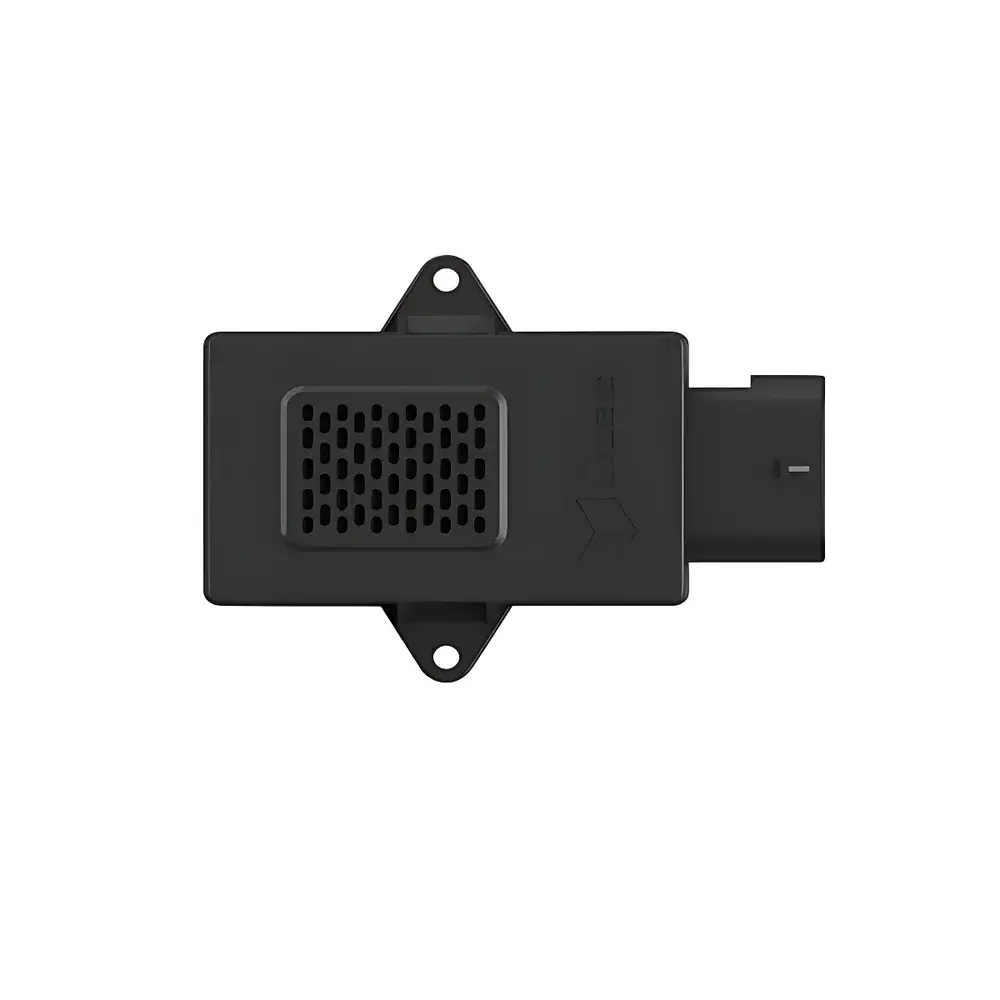
Cubic ACDS-1001 Automotive CO₂ Sensor
| Brand | Cubic |
|---|---|
| Origin | Hubei, China |
| Model | ACDS-1001 |
| Detection Principle | Dual-channel NDIR (Non-Dispersive Infrared) |
| Gas Measured | CO₂ |
| Measurement Range | 0–10,000 ppm (extended capability up to 40,000 ppm) |
| Resolution | 1 ppm |
| Accuracy | ±(50 ppm + 5% of reading) |
| Response Time (T90) | ≤25 s |
| Data Refresh Rate | ≤1 s |
| Output Interface | LIN bus |
| Operating Temperature | −40 °C to +85 °C |
| Storage Temperature | −40 °C to +95 °C |
| Relative Humidity Range | 0–99% RH (non-condensing) |
| Operating Pressure | 80–120 kPa |
| IP Rating | IP54 |
| Supply Voltage | 9–16 VDC (nominal 12 VDC) |
| Average Current Consumption | ≤100 mA @ 12 VDC |
| Standby Current | <100 µA |
| Design Lifetime | 15 years |
| Compliance | AEC-Q200 qualified circuit architecture, automotive-grade EMI/EMC robustness |
Overview
The Cubic ACDS-1001 is an automotive-grade carbon dioxide (CO₂) sensor engineered for integration into vehicle HVAC systems and thermal management architectures. It employs dual-channel non-dispersive infrared (NDIR) spectroscopy—a proven, physics-based optical absorption technique—to quantify CO₂ concentration in real time within cabin air streams. Unlike electrochemical or metal-oxide semiconductor sensors, NDIR offers inherent selectivity for CO₂ due to its characteristic absorption band at 4.26 µm, minimizing cross-sensitivity to common interferents such as CO, NOₓ, ethanol, or humidity fluctuations. The dual-channel design—comprising an active measurement channel and a reference channel—compensates for optical drift, aging effects, and environmental perturbations, ensuring long-term stability without field recalibration. Designed specifically for OEM and Tier-1 deployment, the ACDS-1001 supports demand-controlled ventilation (DCV) logic by feeding real-time CO₂ data to the vehicle’s climate control unit via standardized LIN communication, enabling dynamic modulation of fresh-air intake to maintain occupant comfort and indoor air quality (IAQ) in accordance with ISO 16798 and SAE J2722 guidelines.
Key Features
- Dual-channel NDIR architecture with temperature-compensated optical path, delivering high specificity and repeatability across extended operating life
- Extended detection range: 0–10,000 ppm (with over-range capability up to 40,000 ppm), suitable for both cabin IAQ monitoring and refrigerant leak detection in CO₂-based heat pump systems
- T90 response time ≤25 seconds under standard airflow conditions (1 L/min), enabling rapid feedback for closed-loop HVAC control
- Ultra-low power consumption: <100 µA in deep sleep mode; ≤100 mA average during active measurement—optimized for 12 VDC automotive electrical architecture
- AEC-Q200-informed circuit design, including conformal coating, shock/vibration tolerance (up to 30 g), and transient voltage protection per ISO 7637-2
- IP54-rated mechanical housing, resistant to dust ingress and water splashing—validated for under-dash, glovebox, and HVAC duct mounting positions
- Full operational specification validated across −40 °C to +85 °C ambient and 0–99% RH (non-condensing), meeting GMW3172 and Ford WSS-M99P1111-A requirements
Sample Compatibility & Compliance
The ACDS-1001 is intended for continuous sampling of ambient cabin air or recirculated HVAC stream without filtration or pre-conditioning. Its diffusion-based inlet geometry ensures compatibility with low-velocity airflows typical in automotive ducts and headliner-mounted installations. No consumables, catalysts, or periodic calibration gases are required. The sensor complies with key automotive functional safety and reliability standards: circuit-level qualification per AEC-Q200 Rev H; EMC performance aligned with CISPR 25 Class 5 and ISO 11452-2; and environmental stress testing per ISO 16750-4. While not a standalone safety device, its output may feed into ASIL-B–compatible control chains when integrated with appropriate system-level diagnostics per ISO 26262 Part 5.
Software & Data Management
The sensor communicates exclusively via LIN 2.2A protocol (PID-based frame structure), supporting standard diagnostic services (UDS over LIN) for readout of measured CO₂ value, internal temperature, supply voltage, and diagnostic trouble codes (DTCs). Raw output is delivered as a 16-bit unsigned integer representing ppm × 10 (e.g., 800 ppm = 0x0320). No embedded firmware update capability is provided; configuration is fixed at manufacture to ensure deterministic behavior in safety-critical contexts. Data logging and trend analysis must be performed externally by the host ECU or gateway module. The LIN interface inherently supports audit-ready timestamping and message counters when implemented with compliant transceivers—facilitating traceability in GLP-aligned validation workflows.
Applications
- Cabin air quality management in passenger vehicles, EVs, and autonomous shuttles—enabling adaptive fresh-air intake based on real-time occupancy estimation
- Leak detection and fault monitoring for R744 (CO₂) refrigerant circuits in next-generation heat pump HVAC systems
- Occupant detection auxiliary input for ADAS-linked energy optimization strategies
- IAQ monitoring in rail transit environments—including metro cars and high-speed train compartments—where ventilation control must adapt to variable passenger density
- Integration into vehicle telematics platforms for fleet-level indoor air health analytics (e.g., aggregated CO₂ exposure metrics)
FAQ
Is the ACDS-1001 certified to ISO 14000 or ISO 50001?
No—these standards pertain to organizational environmental management systems and energy management frameworks, respectively. The ACDS-1001 is a component-level sensing device, not a system certification subject.
Can it be used in battery electric vehicle (BEV) thermal management loops?
Yes—its extended 40,000 ppm range and fast T90 response make it suitable for detecting R744 refrigerant leaks in high-pressure CO₂ heat pump circuits, provided physical mounting avoids direct refrigerant contact.
Does the sensor require periodic zero-point calibration in-field?
No—dual-channel NDIR architecture and factory calibration eliminate the need for user-initiated zeroing or span adjustment over its 15-year design lifetime.
What LIN identifiers (IDs) does it use for CO₂ data transmission?
Default frame ID is 0x2A (decimal 42); CO₂ concentration is transmitted in Data Byte 1–2 (LSB first) as a scaled 16-bit integer per LIN specification.
Is the device compliant with REACH and RoHS directives?
Yes—material declarations confirm full compliance with EU Directive 2011/65/EU (RoHS 2) and Regulation (EC) No. 1907/2006 (REACH), including SVHC screening.







