
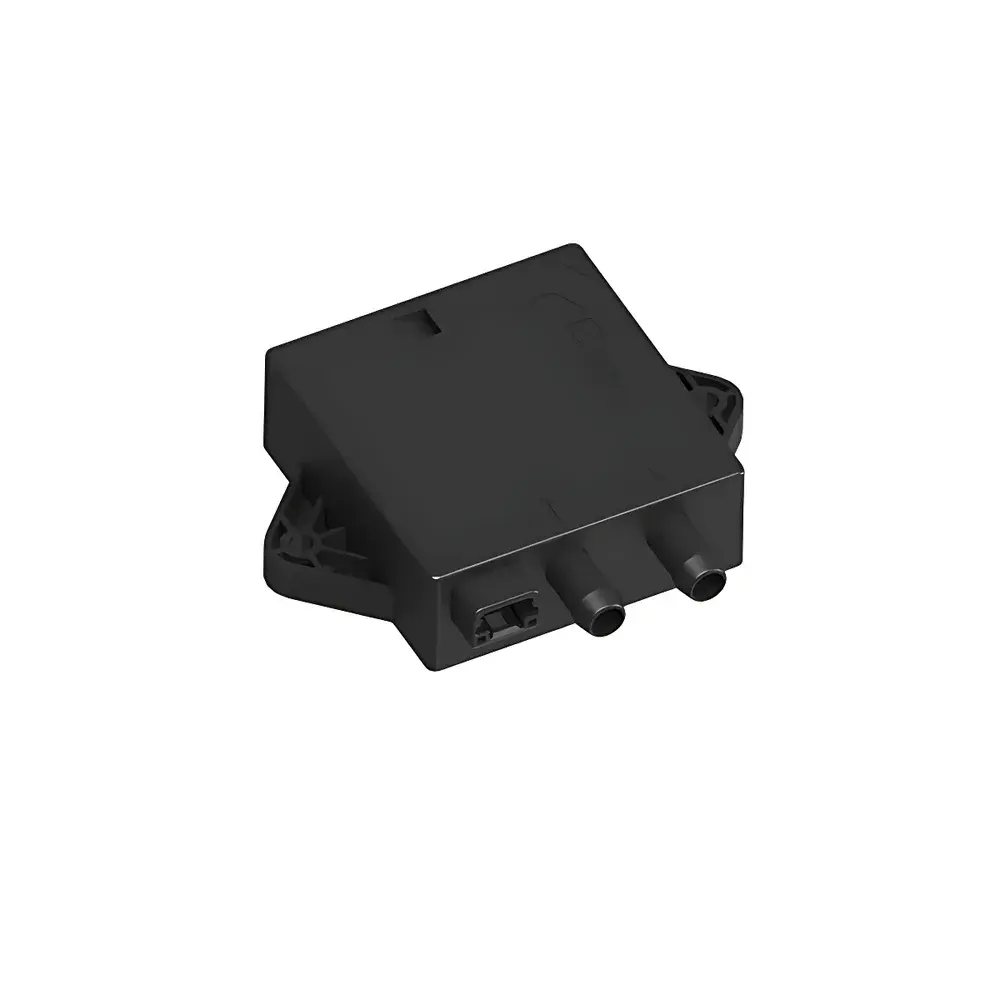
Cubic AIS-3200 Automotive Integrated PM2.5 and CO₂ Sensor
| Brand | Cubic |
|---|---|
| Origin | Hubei, China |
| Model | AIS-3200 |
| Detection Gases | PM2.5 (0–1000 µg/m³), CO₂ (400–10,000 ppm) |
| PM2.5 Principle | Laser Scattering |
| CO₂ Principle | Single-Source NDIR with Dual-Channel Detection |
| PM2.5 Accuracy | ±15% of reading or ±15 µg/m³ (−20°C to +75°C, referenced to TSI 8530) |
| CO₂ Accuracy | ±100 ppm or ±10% (400–10,000 ppm, −20°C to +75°C) |
| PM2.5 Response Time (T90) | ≤12 s |
| CO₂ Response Time (T90) | ≤25 s |
| Warm-up Time | <10 s |
| Operating Temperature | PM2.5: −40°C to +75°C |
| CO₂ | −40°C to +85°C |
| Storage Temperature | −40°C to +95°C |
| IP Rating | IP65 |
| Dimensions | Compact, automotive-grade form factor |
Overview
The Cubic AIS-3200 Automotive Integrated PM2.5 and CO₂ Sensor is an engineered solution for real-time, in-cabin air quality monitoring in modern vehicles. Designed specifically for OEM and Tier-1 integration, the AIS-3200 employs dual physical measurement principles within a single compact housing: laser scattering photometry for particulate mass concentration (PM2.5) and single-source non-dispersive infrared (NDIR) spectroscopy with dual-channel referencing for carbon dioxide (CO₂). This co-located architecture eliminates cross-sensor calibration drift and ensures synchronized temporal resolution—critical for HVAC control logic, air recirculation decisions, and occupant health analytics. The sensor operates across the full automotive ambient envelope (−40°C to +85°C), maintaining metrological integrity without active thermal stabilization, thereby reducing system-level power demand and ECU computational load. Its optical design incorporates contamination-resistant optics and flow-optimized inlet geometry to sustain long-term repeatability under vibration, humidity cycling, and dust exposure typical of vehicle cabin environments.
Key Features
- Dual-parameter detection in a single, space-constrained module: PM2.5 (0–1000 µg/m³) and CO₂ (400–10,000 ppm)
- Laser scattering engine optimized for sub-2.5 µm aerosol detection with factory traceable calibration against NIST-traceable reference instruments (e.g., TSI AM510/8530)
- Single-source NDIR CO₂ measurement with dual-wavelength channel referencing to compensate for source aging, window fouling, and ambient IR background
- Validated accuracy across extended temperature ranges: PM2.5 ±15 µg/m³ or ±15% (−20°C to +75°C); CO₂ ±100 ppm or ±10% in nominal operating band
- Rapid response: T90 ≤12 s for PM2.5 and ≤25 s for CO₂—enabling dynamic feedback control loops in HVAC and air purification subsystems
- IP65-rated enclosure with automotive-grade connectors (e.g., USCAR-2) and vibration resistance compliant with ISO 16750-3 (Mechanical Loads)
- Optional integrated thermistor for cabin temperature monitoring (±0.5°C accuracy, −40°C to +85°C), supporting dew-point estimation and thermal comfort algorithms
Sample Compatibility & Compliance
The AIS-3200 is validated for continuous sampling of undiluted cabin air streams with typical velocity profiles (0.1–2.0 m/s) and relative humidity up to 95% non-condensing. It exhibits minimal sensitivity to common volatile organic compounds (VOCs) and does not require zero-gas calibration during service life. The sensor meets key automotive environmental standards including ISO 16750-4 (Climate Loads), ISO 10605 (Electrostatic Discharge), and AEC-Q200 Grade 2 qualification for passive components. While not a medical device, its measurement performance aligns with WHO indoor air quality guidelines and supports compliance with emerging regulatory frameworks such as UNECE R156 (Software Update Management System) when integrated into OTA-capable vehicle platforms. Data outputs are compatible with standard CAN FD (J1939/ISO 11898-1) and SENT protocols for seamless ECU integration.
Software & Data Management
The AIS-3200 delivers analog (0–5 V or 4–20 mA) and digital (UART or CAN FD) outputs with configurable reporting intervals (1–60 s). Firmware supports diagnostic registers—including optical path contamination index, signal-to-noise ratio (SNR) tracking, and internal temperature compensation status—for predictive maintenance logging. When deployed with Cubic’s optional Vehicle Air Quality Analytics (VAQA) SDK, raw sensor data can be time-aligned with OBD-II parameters (e.g., HVAC mode, blower speed, outside air temperature) to generate audit-ready logs compliant with GLP-aligned development workflows. No proprietary cloud dependency is required; all calibration coefficients and firmware updates are signed and verifiable per ISO/SAE 21434 cybersecurity guidelines.
Applications
- Automotive HVAC control systems for intelligent air recirculation and filter life estimation
- OEM-integrated cabin air purifiers with closed-loop PM2.5 feedback
- Driver wellness monitoring modules (e.g., drowsiness inference via CO₂-driven ventilation patterns)
- Aftermarket telematics units requiring certified air quality telemetry
- Electric vehicle battery thermal management interfaces where cabin CO₂ levels correlate with occupant metabolic load and HVAC energy demand
- Shared mobility fleet dashboards for real-time cabin hygiene scoring and maintenance scheduling
FAQ
Does the AIS-3200 require periodic zero/span calibration in-field?
No. The dual-channel NDIR architecture and factory-calibrated laser scattering chamber are designed for maintenance-free operation over 8,000 hours of continuous use. Field recalibration is not supported; replacement is recommended upon diagnostic flag activation.
Can the sensor operate reliably in high-humidity or condensing conditions?
It is rated for 95% RH non-condensing operation. Condensation on optical surfaces degrades PM2.5 accuracy; therefore, installation must avoid locations prone to direct moisture ingress (e.g., near evaporator drain lines).
Is the CO₂ measurement affected by alcohol or VOC exposure?
The single-source NDIR configuration with reference channel minimizes cross-sensitivity to ethanol, acetone, and formaldehyde at concentrations below 50 ppm—well above typical cabin exposure limits.
What is the expected lifetime under continuous automotive duty?
Based on accelerated life testing per ISO 16750-2, the median operational lifetime exceeds 10 years at 25°C ambient, with derating applied above 60°C case temperature.
Does the AIS-3200 support functional safety (ISO 26262) requirements?
The base sensor module complies with ASIL-B decomposition requirements when integrated with host ECU fault containment mechanisms. Full ASIL-B certification requires system-level validation by the vehicle integrator.
Related Products







