
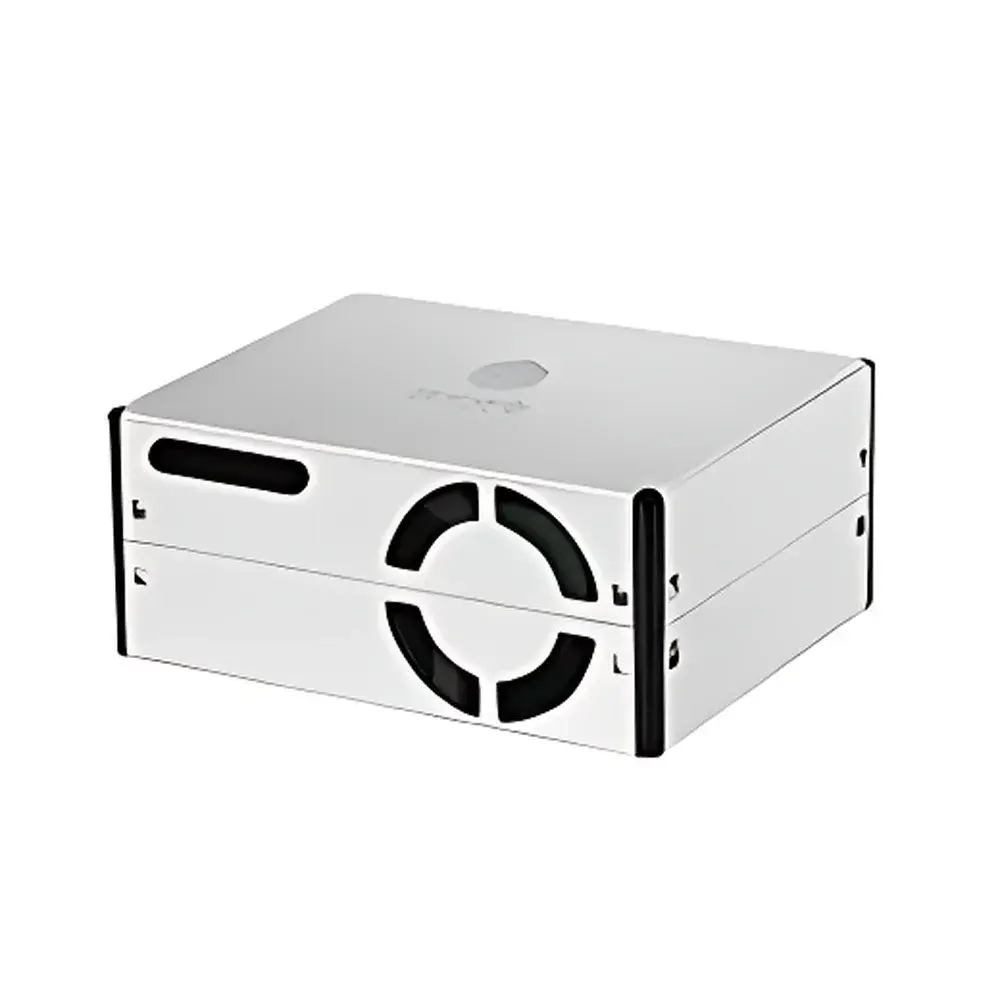
Cubic AM1002 Integrated Air Quality Module
| Brand | Cubic |
|---|---|
| Origin | Hubei, China |
| Model | AM1002 |
| Detection Principle | Laser Scattering (PM) / Metal Oxide Semiconductor (VOC) |
| PM Range | 0–5000 µg/m³ |
| VOC Range | 0–10 ppm |
| PM1.0/PM2.5 Accuracy | ±10 µg/m³ (0–100 µg/m³), ±10% reading (101–500 µg/m³) |
| PM10 Accuracy | ±25 µg/m³ (0–100 µg/m³), ±25% reading (101–500 µg/m³) |
| VOC Accuracy | ±15% (@0.3–1 ppm), ±25% (@30 ppm) |
| Warm-up Time | ≤180 s (VOC) |
| Data Refresh Rate | 1 Hz |
| Operating Temp. | −20–60 °C |
| Operating RH | 0–95% RH (non-condensing) |
| Storage Temp./RH | −40–80 °C / 0–95% RH |
| Supply Voltage | DC 5 V ±0.5 V (ripple <50 mV) |
| Interfaces | UART (3.3 V/5 V), I²C (3.3 V/5 V) |
| Dimensions | 38 × 35 × 12 mm |
Overview
The Cubic AM1002 Integrated Air Quality Module is a compact, multi-parameter environmental sensing solution engineered for OEM integration into HVAC systems, air purifiers, smart thermostats, and indoor air quality (IAQ) monitors. Combining laser scattering-based particulate matter detection with a calibrated metal oxide semiconductor (MOX) gas sensor, the AM1002 delivers concurrent, real-time measurements of PM1.0, PM2.5, PM10, and total volatile organic compounds (TVOC) — all within a footprint of just 38 × 35 × 12 mm. Its dual-sensing architecture eliminates the need for separate PM and VOC modules, reducing bill-of-materials cost and mechanical redesign effort. The module operates on a single 5 V DC supply and supports standard digital interfaces (UART and I²C), enabling seamless firmware-level integration without hardware modification. Designed for long-term field deployment, it incorporates temperature-compensated algorithms validated across −20–60 °C and 0–95% RH, ensuring metrological consistency in diverse climatic conditions.
Key Features
- Simultaneous, synchronized output of PM1.0, PM2.5, PM10, and TVOC concentration values via a unified digital interface
- Laser scattering photodetector optimized for high signal-to-noise ratio and low cross-sensitivity to humidity-induced optical artifacts
- Pre-calibrated MOX-based VOC sensor with factory-trimmed response curves for common IAQ-relevant compounds (e.g., formaldehyde, ethanol, toluene)
- Embedded thermal compensation logic ensuring stable accuracy across full operating temperature range (−20–60 °C)
- Low power consumption (<120 mW typical), supporting battery-operated or energy-constrained edge devices
- Rapid stabilization: VOC channel achieves functional readiness within ≤180 seconds after power-on; PM channel stabilizes in <30 s
- Robust mechanical design with sealed optical chamber and conformal coating for resistance to dust ingress and condensation
Sample Compatibility & Compliance
The AM1002 is designed for continuous monitoring of ambient indoor air and does not require sample conditioning (e.g., filtration, dilution, or heating) under standard residential and commercial ventilation conditions. It meets key requirements for CE-marked IAQ products under EN 50292 (carbon monoxide and smoke alarm compatibility) and aligns with measurement principles referenced in ISO 16000-26 (indoor air – determination of VOCs) and ASTM D6196 (selection of sorbents, sampling, and thermal desorption analysis). While not certified as a standalone safety device, its performance specifications support compliance with UL 2075 (gas and vapor detectors) when integrated into certified end-systems. No regulatory approval is required for OEM integration into non-life-safety consumer appliances.
Software & Data Management
The module outputs ASCII-formatted data packets over UART or register-mapped values via I²C, allowing direct parsing by microcontrollers without proprietary drivers. Cubic provides open-source reference firmware (C/C++ and Python) including calibration lookup tables, temperature/humidity correction routines, and outlier rejection logic based on signal variance thresholds. Raw sensor outputs are timestamped at 1 Hz resolution, supporting time-series logging compatible with MQTT, Modbus RTU, or custom edge analytics pipelines. All firmware updates are delivered via UART bootloader, eliminating the need for JTAG debug infrastructure during mass production. Audit trails and configuration logs can be implemented at the host system level to meet GLP-aligned internal QA protocols.
Applications
- OEM integration into wall-mounted IAQ monitors and smart home hubs requiring multi-pollutant awareness
- Embedded sensing in duct-mounted HVAC controllers for demand-controlled ventilation (DCV) logic
- Real-time feedback loop in HEPA + activated carbon air purifiers for adaptive fan-speed modulation
- Indoor environmental assessment tools used by industrial hygienists and building commissioning agents
- Edge-node deployment in dense sensor networks for spatial mapping of particulate and VOC gradients across office floors or schools
- Research-grade prototyping platform for studying occupant exposure correlation with ventilation rates and source activity
FAQ
Is the AM1002 suitable for outdoor deployment?
No — it is rated for indoor use only. The specified operating humidity range (0–95% RH, non-condensing) and lack of IP-rated enclosure preclude sustained outdoor exposure.
Does the module support automatic zero-point calibration?
It does not perform active zeroing; however, its MOX sensor includes baseline drift compensation derived from long-term statistical trending of low-exposure periods, minimizing manual recalibration frequency.
Can PM and VOC data be time-aligned at sub-second resolution?
Yes — both channels share a common internal clock and output synchronized readings at precisely 1 Hz; no external timestamp alignment is needed.
What is the expected service life under continuous operation?
Based on accelerated lifetime testing, the laser diode and MOX element maintain specification-compliant performance for ≥2 years at 25 °C and 50% RH; field replacement intervals are typically aligned with host product maintenance cycles.
Is firmware update capability available in production units?
Yes — all units ship with a UART-bootloader-enabled MCU, permitting field-upgradable firmware without hardware rework or soldering.
Related Products







