
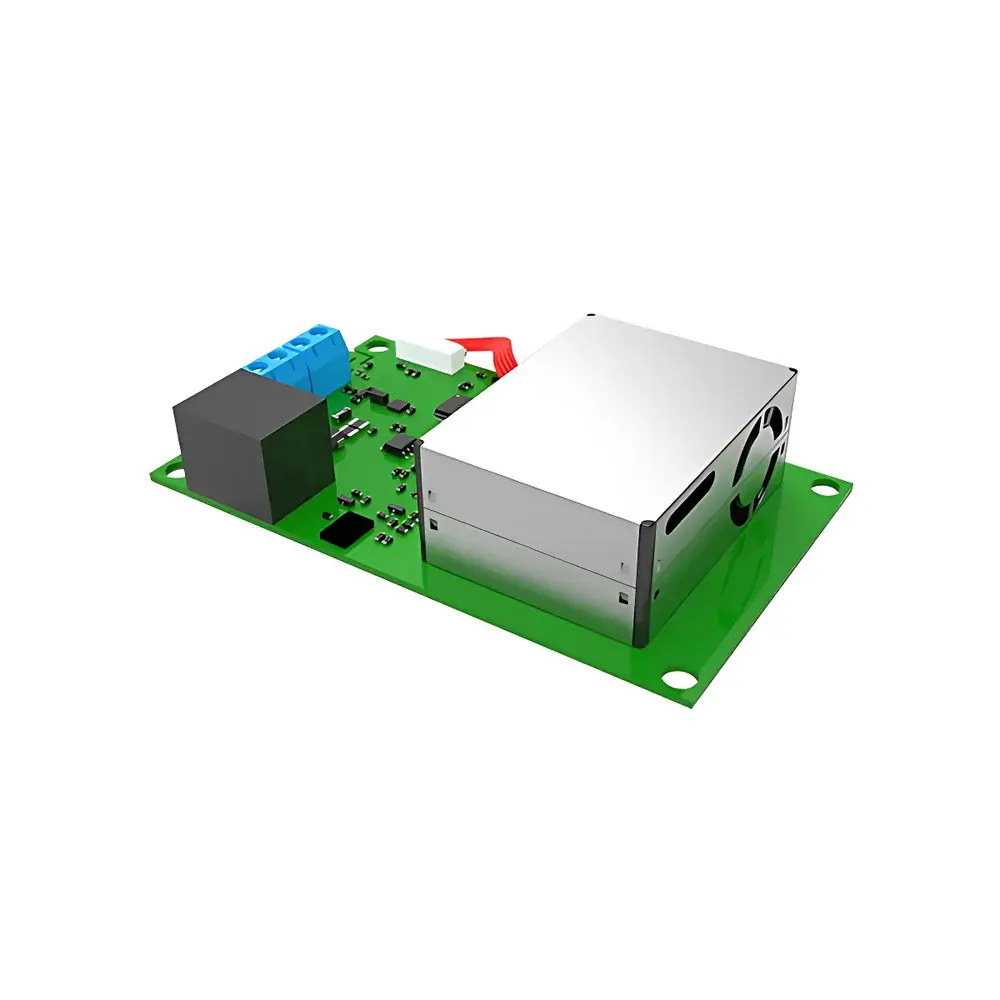
Cubic AM1009CN Integrated Air Quality Sensor Module
| Brand | Cubic |
|---|---|
| Origin | Hubei, China |
| Manufacturer Type | Authorized Distributor |
| Country of Origin | China |
| Model | AM1009CN |
| Detection Principles | Optical Scattering (PM2.5), Electrochemical/Semiconductor (CO), NTC Thermistor (Temperature) |
| Measurement Ranges | PM2.5: 0–5000 µg/m³ |
| CO | 0–1000 ppm |
| Temperature | −10–60 °C |
| Accuracy | PM2.5: ±20% of reading or ±200 µg/m³ |
| CO | ±30% of reading or ±40 ppm |
| Temperature | ±1 °C |
| Alarm Thresholds | PM2.5 ≥ 2000 µg/m³ |
| Data Update Interval | 1 s |
| Operating Conditions | −10–60 °C, 0–95% RH (non-condensing) |
| Storage Conditions | −30–70 °C, 0–95% RH (non-condensing) |
| Supply Voltage | DC 12 V ± 0.5 V, Ripple < 100 mV |
| Average Current Consumption | < 100 mA |
| Output Interface | Digital Switch Output (configurable for CAN bus upon request) |
| Dimensions | 100 × 60 × 24.5 mm (W × H × D) |
| Minimum Detectable Particle Size | 0.3 µm |
| Sampling Method | Constant-Flow Aspiration |
| Calibration | Auto-compensated CO baseline correction |
| Compliance | RoHS-compliant design |
Overview
The Cubic AM1009CN Integrated Air Quality Sensor Module is an engineered solution for continuous, multi-parameter environmental monitoring in confined and safety-critical energy infrastructure environments. Designed around a fused-sensor architecture, it simultaneously quantifies respirable particulate mass concentration (PM2.5), carbon monoxide (CO) gas concentration, and ambient temperature—three key indicators of thermal runaway precursors and off-gassing events in battery energy storage systems (BESS), hydrogen refueling cabinets, and automated battery-swapping stations. Its measurement core leverages industry-standard optical scattering for PM2.5 detection with a verified lower size limit of 0.3 µm, electrochemical or metal-oxide semiconductor transduction for CO (depending on configuration), and precision NTC thermistor-based thermal sensing. The module operates under a constant-flow aspiration principle to ensure representative sampling across variable airflow conditions, eliminating flow-dependent bias common in passive diffusion sensors.
Key Features
- Triple-parameter real-time output: PM2.5, CO, and temperature—all synchronized to a 1-second update interval for rapid event detection.
- Optimized mechanical footprint: Compact 100 × 60 × 24.5 mm form factor enables flush-mounting inside narrow cabinet ducts, battery module interstices, or thermal management plenums without compromising structural integrity.
- Intelligent CO baseline stabilization: Adaptive algorithm compensates for sensor drift under low-concentration exposure, reducing field recalibration frequency and supporting long-term unattended operation.
- Robust electrical interface: Dual-mode digital output—default TTL-level switch signals for immediate alarm triggering, with optional CAN 2.0B protocol support for integration into distributed control networks compliant with SAE J1939 or ISO 11898-2.
- Environmental resilience: Rated for continuous operation from −10 °C to 60 °C and up to 95% RH (non-condensing), validated per IEC 60068-2 environmental stress test profiles.
Sample Compatibility & Compliance
The AM1009CN is intended for integration into sealed or semi-sealed enclosures where air exchange is controlled—such as lithium-ion battery racks, hydrogen storage compartments, and modular energy conversion units. It does not require external sample conditioning (e.g., filtration or drying) under nominal operating conditions. While the module itself carries no intrinsic certification (e.g., UL 2034 or EN 50131), its RoHS-compliant construction and stable electrical characteristics enable OEMs to achieve system-level compliance with IEC 62443-3-3 for industrial cybersecurity and IEC 61508 SIL-2 when deployed within fault-tolerant architectures. Its performance envelope aligns with guidance in NFPA 855 (Standard for the Installation of Stationary Energy Storage Systems) for early-warning gas and particulate monitoring in BESS applications.
Software & Data Management
The module outputs discrete alarm states via open-collector or push-pull digital lines, enabling direct connection to PLCs, SCADA RTUs, or microcontroller-based supervisory logic without middleware dependency. For CAN-integrated variants, standardized message identifiers (CAN IDs) are assigned per parameter—allowing seamless ingestion into time-series databases (e.g., InfluxDB or TimescaleDB) via gateway firmware adhering to MQTT-SN or OPC UA PubSub. Audit-ready data logging requires external host-level implementation; however, the 1-second resolution supports granular trend analysis for root-cause investigation during thermal excursion events. No embedded storage or local UI is provided—consistent with industrial sensor modularity principles emphasizing centralized data governance and GLP-aligned traceability.
Applications
- Battery Energy Storage Systems (BESS): Early detection of electrolyte decomposition gases and thermal aerosol generation prior to thermal runaway propagation.
- Automated Battery Swapping Stations: Real-time air quality verification inside enclosed swap bays to prevent operator exposure and mitigate fire risk during high-cycle operations.
- Hydrogen Fueling Infrastructure: CO monitoring as a surrogate indicator for incomplete hydrogen combustion or catalyst degradation in PEM fuel cell support systems.
- Industrial Control Cabinets: Ambient condition monitoring for cooling efficiency validation and predictive maintenance of power electronics.
- Modular Microgrid Enclosures: Multi-point deployment for spatial mapping of particulate accumulation and localized CO ingress in ventilated enclosures.
FAQ
Does the AM1009CN support analog voltage or current output?
No. It provides only digital switch outputs (alarm-triggered) by default. Analog or I²C variants are not available in this series.
Can the alarm thresholds be reconfigured in the field?
Thresholds are fixed at factory calibration and cannot be modified via software or hardware jumpers. Custom threshold programming requires OEM-level firmware revision.
Is the PM2.5 measurement certified to ISO 25548-1 or EN 12341?
The module is not independently certified to these ambient air quality standards. It is calibrated against reference gravimetric and electrochemical methods per internal Cubic QA protocols for industrial enclosure use cases.
What is the expected service life under continuous operation?
Based on accelerated life testing at 40 °C and 60% RH, the optical particle sensor maintains ±20% accuracy for ≥18 months; CO sensing elements exhibit median functional lifespan of 24 months in low-ppm environments.
Does the module include built-in diagnostics or self-test capability?
Yes—it performs periodic internal continuity checks on heater circuits and photodiode bias paths, reporting fault status via dedicated diagnostic pin (active-low) during power-up and every 60 seconds thereafter.
Related Products







