
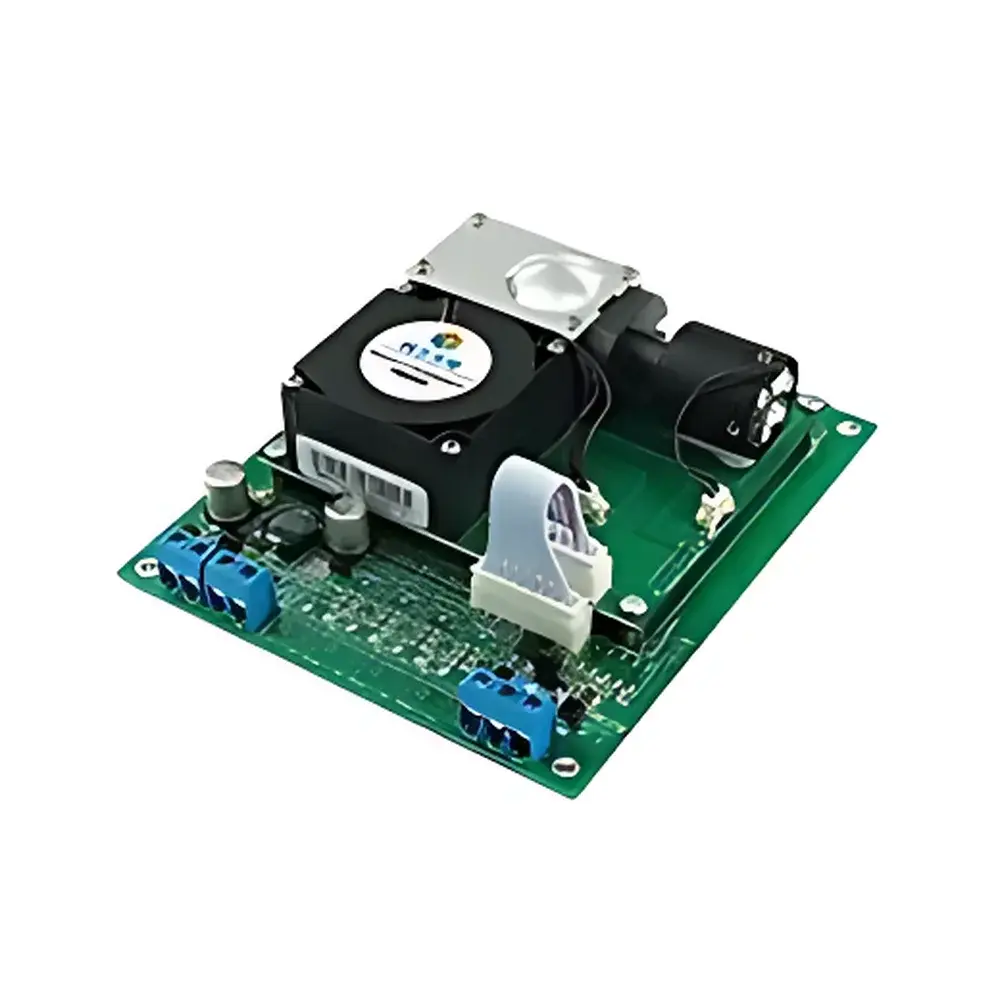
Cubic AM1050 Laser Particle Counting Sensor
| Brand | Cubic |
|---|---|
| Origin | Hubei, China |
| Model | AM1050 |
| Detection Range | ≥0.3 µm, 0–9,999,999 pcs/L |
| Output Channels | 0.3, 0.5, 1.0, 2.5, 5.0, 10.0 µm |
| Counting Efficiency | 50% @ 0.3 µm |
| Operating Temperature | −30°C to +70°C |
| Storage Temperature | −40°C to +85°C |
| Supply Voltage | DC 5 V ±0.1 V or DC 9–36 V |
| Current Draw | <500 mA @ 5 V, <300 mA @ 9 V, <100 mA @ 36 V |
| Communication Interface | RS-485 / 4–20 mA (customizable) |
| Dimensions | 100 × 115 × 40 mm (W × D × H) |
| Compliance | JJF 1190–2008 Calibration Specification for Airborne Particle Counters |
Overview
The Cubic AM1050 Laser Particle Counting Sensor is an industrial-grade optical particle counter engineered for continuous, real-time monitoring of airborne particulate matter in demanding environmental and process-critical applications. It operates on the principle of single-particle laser light scattering: a collimated semiconductor laser beam interrogates aerosol-laden air drawn through a precisely defined sensing volume by a high-reliability automotive-grade turbofan. Scattered light pulses from individual particles are captured via an optimized concave optical collector and converted into digital counts by a calibrated photodetector and signal processing circuitry. The sensor delivers simultaneous, independent concentration data across six discrete size channels—0.3, 0.5, 1.0, 2.5, 5.0, and 10.0 µm—with counting efficiency validated per JJF 1190–2008 (China’s national calibration specification for airborne particle counters), referencing TSI Model 9306 as the traceable standard under controlled metrological conditions (25±2°C, 50±10% RH). Its design targets long-term stability in unattended operation, making it suitable for integration into HVAC health monitoring systems, cleanroom environmental surveillance, industrial emission compliance tracking, and indoor air quality (IAQ) control platforms.
Key Features
- Industrial-grade linear laser diode with extended service life and thermal stability up to 70°C ambient—ensuring consistent beam profile and scattering signal fidelity over time
- Automotive-certified high-flow axial turbofan providing stable volumetric sampling at constant flow rate, minimizing pulsation-induced counting variance
- Optimized concave light-collecting optics enhancing photon capture efficiency and improving signal-to-noise ratio for sub-micron particle detection
- Dual power input architecture supporting both regulated 5 V ±0.1 V logic supply and wide-range 9–36 V DC industrial bus voltage—enabling deployment in diverse control infrastructure
- Constant-current sampling control circuitry maintaining precise airflow velocity regardless of inlet pressure fluctuations or filter loading
- Robust electromagnetic compatibility (EMC) design compliant with IEC 61000-6-2/6-4 standards, including surge, ESD, and radiated immunity testing
- RS-485 Modbus RTU interface as standard, supporting daisy-chain topology and transmission distances up to 1,200 meters without repeaters
Sample Compatibility & Compliance
The AM1050 is designed for sampling non-corrosive, non-explosive ambient air and process gases within specified temperature and humidity limits. It is not intended for use with sticky, oily, or highly hygroscopic aerosols that may contaminate the optical path or sampling nozzle. Calibration traceability follows JJF 1190–2008, which aligns methodologically with ISO 21501-4 and ASTM F328 for light-scattering particle counters. While not certified to UL/CSA intrinsic safety standards, its low-power operation and encapsulated construction support Class I, Division 2 (CID2) installation when integrated into appropriately rated enclosures. For regulatory reporting contexts—including occupational exposure assessments or municipal air quality networks—the sensor’s documented counting efficiency and channel resolution meet minimum requirements for PM1, PM2.5, and PM10 surrogate monitoring per GB/T 18883–2022 and EPA EQOA guidance.
Software & Data Management
The AM1050 outputs raw channel counts via ASCII or binary Modbus RTU frames, enabling seamless integration with SCADA, BMS, and cloud-based IoT platforms (e.g., AWS IoT Core, Siemens MindSphere). Cubic provides a Windows-based configuration utility for baud rate, slave ID, and output mode selection. When deployed in GxP-regulated environments—such as pharmaceutical clean utilities or medical device manufacturing—users may implement third-party middleware to enforce audit trails, electronic signatures, and 21 CFR Part 11–compliant data archiving. Firmware updates are performed via UART bootloader, and all operational parameters (including uptime, error logs, and self-diagnostic flags) are accessible through register mapping.
Applications
- Real-time particulate monitoring in HVAC ducts and AHUs for predictive maintenance and energy optimization
- Continuous verification of cleanroom classification (ISO 14644-1 Classes 5–8) during production cycles
- Stack emission pre-screening and fugitive dust tracking in cement, mining, and metal fabrication facilities
- Indoor air quality dashboards in smart buildings, schools, and healthcare facilities
- OEM integration into portable IAQ analyzers, air purifier feedback loops, and smart ventilation controllers
- Environmental research stations requiring ruggedized, low-maintenance particle sensors for field-deployed networks
FAQ
What is the calibration basis for the AM1050’s size-channel accuracy?
The sensor’s counting efficiency curve is verified against a NIST-traceable TSI 9306 reference instrument under JJF 1190–2008 test conditions (25±2°C, 50±10% RH); no factory recalibration is required for routine operation.
Can the AM1050 be used outdoors without environmental enclosure?
No—it lacks IP65+ ingress protection and requires mounting within a temperature- and humidity-controlled housing for reliable outdoor deployment.
Is analog 4–20 mA output available as standard or only upon customization?
4–20 mA is a configurable option; default delivery includes RS-485 Modbus RTU. Custom firmware and hardware variants supporting dual-output (RS-485 + 4–20 mA) are available under OEM agreement.
Does the sensor support automatic zero-check or background subtraction?
It does not perform active zero calibration; however, baseline drift compensation can be implemented externally using periodic clean-air purge intervals managed by host controller logic.
What is the recommended maintenance interval for optical path cleaning?
Under typical indoor air conditions, inspection and gentle lens cleaning with optical-grade isopropyl alcohol are advised every 6 months; frequency increases proportionally with ambient dust load.
Related Products







