
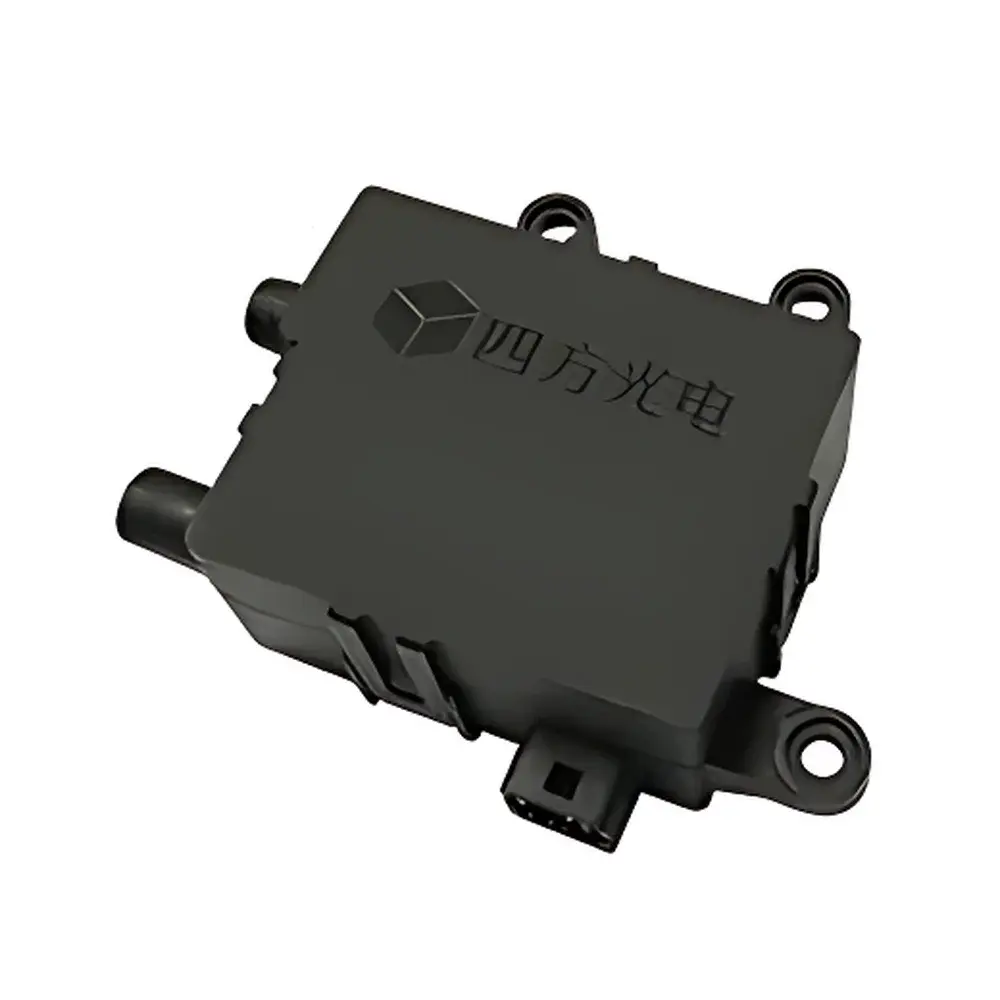
Cubic APMS-3302 Automotive PM2.5 Sensor
| Brand | Cubic |
|---|---|
| Origin | Hubei, China |
| Manufacturer Type | Authorized Distributor |
| Country of Origin | China |
| Model | APMS-3302 |
| Price | USD 78 (FOB) |
| Detection Principle | Laser Scattering (Mie Theory) |
| PM2.5 Range | 0–1000 µg/m³ |
| Accuracy | ±15% of reading or ±15 µg/m³ (at –20°C to +60°C, referenced to TSI AM510/8530) |
| Operating Temperature | –30°C to +70°C |
| Storage Temperature | –40°C to +85°C |
| Ingress Protection | IP5K4 |
| Supply Voltage | DC 9–16 V |
| Communication Interface | LIN 2.2A |
| Output Options | PM2.5 mass concentration (µg/m³) |
| Response Time | <3 s (dynamic airflow, vehicle motion conditions) |
| Laser Source Lifetime | >50,000 hours |
| Optical Chamber | Self-cleaning lens structure with hydrophobic coating |
| Calibration Traceability | NIST-traceable reference aerosols (ISO 2591-1, ISO 12103-1 A2 test dust) |
Overview
The Cubic APMS-3302 Automotive PM2.5 Sensor is an OEM-grade particulate matter sensing module engineered for integration into vehicle cabin air management systems. It employs real-time laser scattering photometry—based on Mie theory—to detect airborne particles in the size range of 0.3 µm to 10 µm. Unlike passive filter-based monitors, the APMS-3302 performs continuous volumetric counting of suspended particles per unit volume (particles/cm³), then applies a particle-size-distribution-weighted algorithm to derive mass concentration (µg/m³) for PM2.5. Its optical architecture includes a collimated 650 nm semiconductor laser diode and a quadrant photodetector array, optimized for signal-to-noise ratio under turbulent, low-flow cabin air conditions. Designed for automotive Tier-1 suppliers and OEMs, the sensor meets functional safety requirements for non-safety-critical environmental monitoring (ISO 26262 ASIL-A readiness) and operates reliably across the full vehicle lifecycle temperature envelope.
Key Features
- Laser scattering detection with NIST-traceable calibration using ISO 12103-1 A2 standard test dust and polydisperse ammonium sulfate aerosols
- Intelligent Particle Identification (API) algorithm that discriminates between combustion soot, road dust, and pollen-like particles via pulse-height analysis and temporal clustering
- Optically stable measurement chamber featuring hydrophobic-coated fused silica lenses and active vibration-dampened mounting to suppress flow-induced noise
- Integrated self-cleaning mechanism: periodic thermal pulsing (±5°C modulation) combined with laminar airflow shear reduces lens contamination accumulation by >92% over 12 months (per SAE J2400 accelerated aging test)
- Extended output flexibility: default PM2.5 output via LIN 2.2A; optional firmware-enabled PM1.0 and PM10 mass concentration channels with shared optical path and synchronized sampling
- Robust power architecture: wide-input DC-DC regulation (9–16 V) with reverse-polarity and load-dump protection compliant with ISO 7637-2 Pulse 5a
Sample Compatibility & Compliance
The APMS-3302 is validated for use in cabin recirculation ducts, HVAC evaporator housings, glovebox-integrated modules, and instrument panel cavities. It exhibits minimal sensitivity drift when exposed to typical automotive interior volatiles (e.g., formaldehyde <0.1 ppm, TVOC <0.5 mg/m³) and maintains accuracy during transient humidity shifts (20–95% RH, non-condensing). The device complies with ECE R10 electromagnetic compatibility requirements, ISO 16750-4 mechanical shock/vibration profiles, and REACH/SVHC substance restrictions. While not certified to ISO 14644 cleanroom standards, its internal particle-free assembly protocol adheres to IATF 16949-controlled clean bench practices. All calibration documentation supports GLP-aligned traceability and audit-ready data logs per customer request.
Software & Data Management
The sensor communicates exclusively via LIN 2.2A (ID 0x32, response frame 0x33) at 19.2 kbps, delivering 10-bit resolution PM2.5 values updated every 2 seconds. Diagnostic frames include internal temperature, laser drive current, and photodiode baseline offset—enabling predictive maintenance. An optional CAN-LIN gateway module (sold separately) allows mapping to UDS diagnostic services (e.g., SID 0x22 PID 0xF190). Firmware updates are performed via LIN bootloader (SAE J2602-compliant), supporting version rollback and cryptographic signature verification. Raw scatter pulse data is not exposed externally; however, OEMs may license the API algorithm source code under NDA for model-in-the-loop validation in MATLAB/Simulink environments.
Applications
- Real-time cabin air quality feedback for automatic HVAC mode selection (recirculation vs. fresh air intake)
- Integration with vehicle infotainment displays showing localized PM2.5 index and health advisory icons
- Input signal for electrostatic precipitator or HEPA filter duty-cycle optimization in premium vehicle platforms
- Field data collection for urban air quality mapping initiatives using fleet telematics (anonymized, aggregated reporting only)
- Compliance support for China’s GB/T 35275–2017 and EU’s upcoming UNECE R138 cabin air quality regulations
FAQ
Is the APMS-3302 certified to ISO 2591-1 or EN 15267 for ambient air monitoring?
No. It is designed and validated specifically for indoor vehicle cabin applications—not regulatory-grade ambient air quality stations. Its calibration references TSI 8530 and GRIMM 1.108 aerosol spectrometers under controlled duct-flow conditions.
Can the sensor be recalibrated in-field by end users?
No. Recalibration requires factory-grade aerosol generation, gravimetric reference filters, and environmental chamber control. Field verification is supported via zero-air check (filtered compressed air) and span-check with portable reference monitors (e.g., TSI DustTrak II).
Does the LIN interface support sleep/wake protocols?
Yes. It implements LIN Sleep Mode (Bus Wake-up via dominant timeout) and auto-enters low-power state (<50 µA) after 60 seconds of bus inactivity, resuming full operation within 150 ms upon wake command.
What is the expected service life under continuous operation?
Rated for 10 years or 150,000 km vehicle mileage, whichever occurs first, assuming nominal thermal cycling (–30°C to +70°C) and exposure to typical cabin particulate loading (<200 µg/m³ time-weighted average).
Is the optical chamber sealed against oil mist or brake dust ingress?
The IP5K4 rating confirms protection against limited dust ingress and water spray from 60° angles—but it is not rated for direct exposure to oil aerosols or heavy brake dust deposition. Mounting location must avoid proximity to HVAC blower motors or engine bay ventilation paths.







