
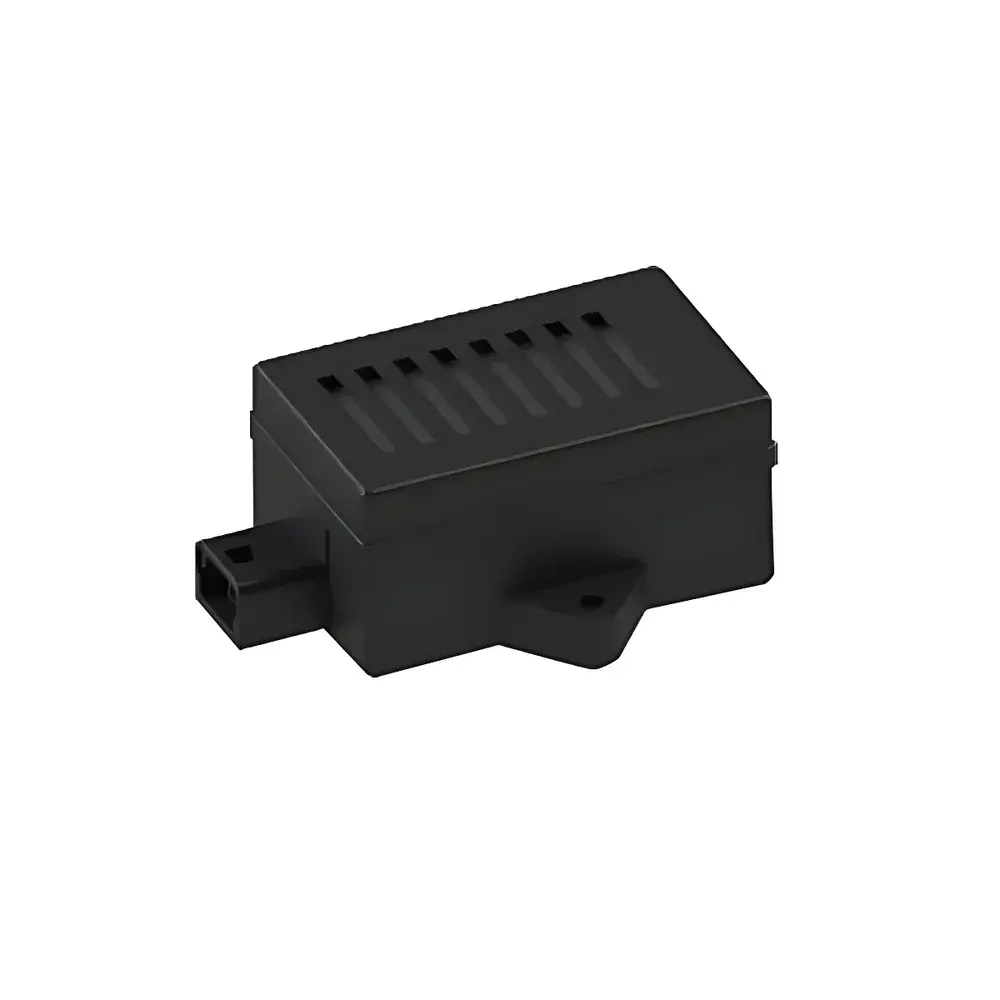
Cubic ARS-744 R744 (CO₂) Refrigerant Leak Detection Sensor
| Brand | Cubic |
|---|---|
| Origin | Hubei, China |
| Model | ARS-744 |
| Detection Range | 400–40,000 ppm CO₂ (R744) |
| Accuracy | ≤750 ppm: ±75 ppm |
| 750–5,000 ppm | ±10% of reading |
| 5,000–40,000 ppm | ±20% of reading |
| Operating Temperature | −40 °C to +85 °C |
| Storage Temperature | −40 °C to +95 °C |
| Supply Voltage | DC 9–16 V |
| Current Consumption | ≤100 mA |
| Output Interface | LIN bus |
| Zero Drift | Low, long-term stability optimized |
| Measurement Principle | Dual-source NDIR (Non-Dispersive Infrared) with temperature & pressure compensation |
Overview
The Cubic ARS-744 is a high-reliability, automotive-grade non-dispersive infrared (NDIR) gas sensor engineered specifically for real-time detection and quantification of carbon dioxide (CO₂) in its role as refrigerant R744. Designed for integration into next-generation vehicle air conditioning systems—particularly in battery electric vehicles (BEVs) and hybrid platforms—the ARS-744 enables precise, continuous monitoring of R744 leakage across the full operational envelope of modern automotive thermal management systems. Unlike generic CO₂ sensors, the ARS-744 incorporates dual-emitter NDIR architecture with integrated temperature and pressure compensation algorithms, ensuring measurement integrity under dynamic cabin conditions, rapid thermal transients, and variable ambient pressures encountered during altitude changes or HVAC cycling. Its robust mechanical design meets ISO 16750-4 (road vehicle environmental conditions) and supports functional safety requirements aligned with ISO 26262 ASIL-B readiness for system-level integration.
Key Features
- Dual-source NDIR optical architecture with reference and measurement channels, minimizing cross-sensitivity to humidity, vibration, and aging effects
- Full-range compensation for temperature (−40 °C to +85 °C) and barometric pressure (70–110 kPa), maintaining accuracy without external calibration hardware
- Wide detection span from 400 ppm to 40,000 ppm CO₂—covering trace leak detection thresholds (e.g., 30,000 ppm)
- Low zero-point drift (<±20 ppm/30 days typical) and excellent long-term repeatability (CV <2.5% over 12 months at 25 °C)
- LIN 2.2a compliant interface enabling direct connection to vehicle body control modules (BCMs) and HVAC controllers without gateway translation
- Automotive-qualified housing with IP6K9K-rated sealing and AEC-Q200 Class 2 stress testing compliance
Sample Compatibility & Compliance
The ARS-744 is validated for use in dry, non-corrosive, low-particulate airstreams typical of automotive cabin recirculation ducts and refrigerant loop proximity zones. It is not intended for direct exposure to liquid refrigerant, oil mist, or condensate. The sensor complies with RoHS Directive 2011/65/EU and REACH Regulation (EC) No. 1907/2006. Electromagnetic compatibility (EMC) performance meets CISPR 25 Class 3 and ISO 11452-2 (BCI) requirements. For functional safety applications, the device supports diagnostic reporting via LIN frame status bits—including sensor health, signal saturation, and internal temperature fault flags—facilitating ASIL-B decomposition in OEM system architectures.
Software & Data Management
The ARS-744 operates as a smart analog-to-digital node with embedded firmware that executes real-time baseline correction, outlier rejection, and linearization per ISO 14644-1 cleanroom data integrity principles. Raw sensor output is delivered via LIN message ID 0x3A (data frame) and 0x3B (diagnostic frame). OEMs may configure alarm thresholds, hysteresis windows, and response time constants using standardized LIN configuration frames (e.g., UDS-over-LIN services). All calibration coefficients are stored in write-protected EEPROM with CRC-16 checksum protection. While the sensor itself does not store historical data, its LIN protocol supports timestamped event logging when interfaced with an external ECU equipped with CAN FD or Ethernet AVB connectivity—enabling traceable leak incident records compliant with IATF 16949 audit requirements.
Applications
- R744 refrigerant leak detection in EV heat pump systems and CO₂-based mobile air conditioning units
- Cabin air quality monitoring for occupant presence detection post-ignition-off (e.g., child/pet left-behind alert systems per UNECE R141)
- Leak rate estimation for predictive maintenance in commercial refrigerated transport and stationary cold storage facilities
- Integration into ASHRAE-compliant demand-controlled ventilation (DCV) logic for automotive and light-duty fleet applications
- Secondary safety layer in high-voltage battery thermal management systems where R744 is used as dielectric coolant
FAQ
What refrigerant does the ARS-744 detect?
The ARS-744 is calibrated and optimized exclusively for carbon dioxide (CO₂) in its role as refrigerant R744. It is not cross-sensitive to R134a, R1234yf, or ammonia.
Does the sensor require field calibration?
No. The ARS-744 features factory calibration with NIST-traceable CO₂ standards and built-in compensation algorithms. Zero adjustment is not user-accessible; long-term stability eliminates need for periodic recalibration under normal operating conditions.
Can the ARS-744 be mounted directly on refrigerant lines?
No. It must be installed in the air stream adjacent to potential leak points—such as evaporator housings, expansion valve junctions, or cabin air intake ducts—to ensure representative sampling of leaked gas diluted in ambient air.
Is LIN the only communication interface available?
Yes. The ARS-744 uses LIN 2.2a exclusively. It does not support CAN, UART, or analog voltage output variants. System designers must allocate a dedicated LIN node within the vehicle’s existing LIN cluster.
How is sensor health monitored in real time?
Diagnostic frames report internal temperature, signal amplitude ratio (reference/measurement channel), and saturation status. These enable ECU-level fault tree analysis per ISO 26262 Annex G guidelines.
Related Products







