
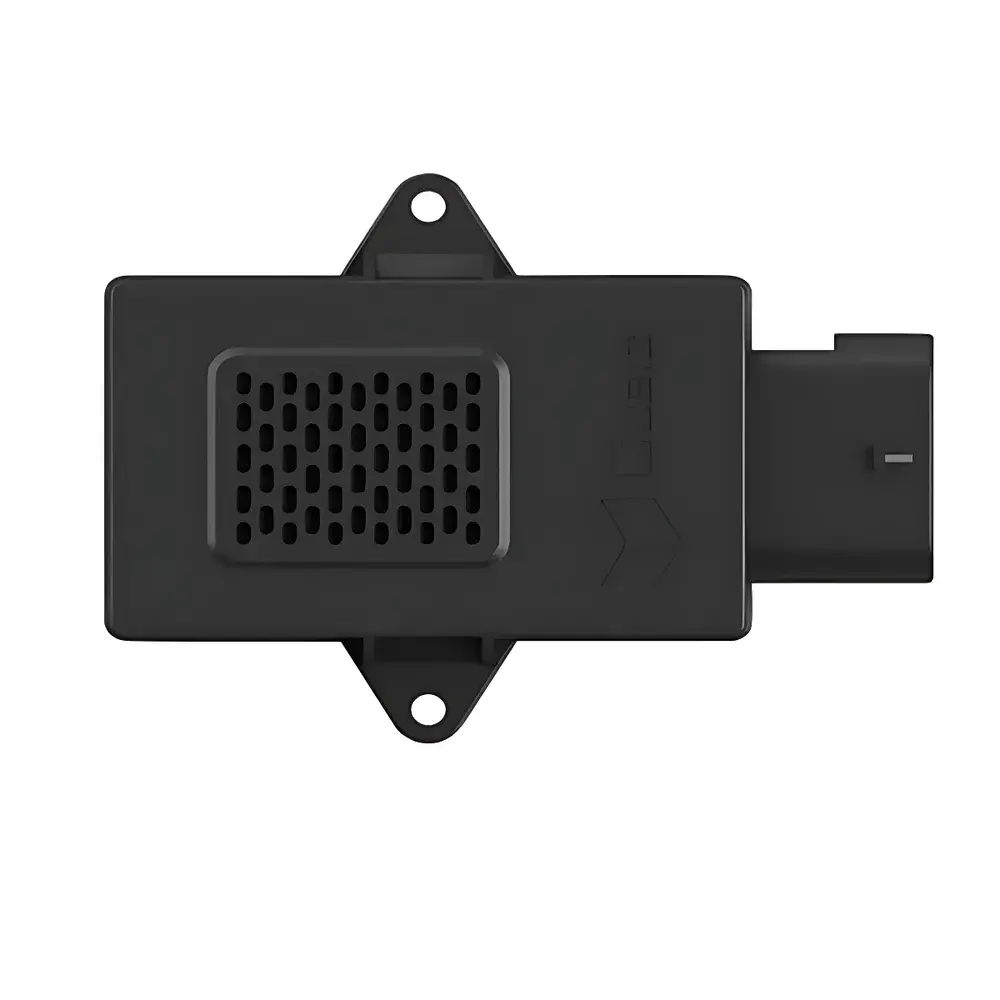
Cubic ATRS-1010-P Battery Thermal Runaway Pressure Sensor
| Brand | Cubic |
|---|---|
| Model | ATRS-1010-P |
| Detection Principle | MEMS-based Absolute Pressure Sensing |
| Measurement Range | 50–160 kPa |
| Full-Scale Peak Load | 600 kPa |
| Burst Pressure | 800 kPa |
| Resolution | 0.1 kPa |
| Accuracy | ≤ ±1.15 kPa (0–85 °C), ≤ ±1.725 kPa (−40–0 °C & 85–125 °C) |
| Response Time | <1 s (pressure anomaly detection & wake-up signal to BMS), <50 ms (first CAN frame after BMS wake-up) |
| Output Interface | CAN 2.0B, 500 kbps |
| Sampling Interval | 10 ms (normal mode), 1 s (low-power mode) |
| Power Supply | 9–16 VDC (nominal 12 VDC) |
| Operating Current | 20 mA (normal), <0.2 mA (low-power), <100 µA (sleep) |
| Operating Temperature | −40 to +105 °C |
| Storage Temperature | −40 to +125 °C |
| Humidity Range | 0–99% RH (non-condensing) |
| Enclosure Material | UL94 V-0 flame-retardant polymer |
| Ingress Protection | IP40 |
| Design Lifetime | >15 years |
Overview
The Cubic ATRS-1010-P Battery Thermal Runaway Pressure Sensor is an automotive-grade MEMS transducer engineered for early detection of incipient thermal runaway events in lithium-ion battery packs. Unlike conventional ambient pressure monitors, the ATRS-1010-P is specifically calibrated to detect subtle, rapid pressure transients—typically in the 50–160 kPa absolute range—that precede gas venting during cell-level exothermic decomposition. Its measurement principle relies on a high-stability silicon piezoresistive sensing element integrated with on-chip signal conditioning and temperature compensation algorithms compliant with AEC-Q100 Grade 2 reliability requirements. The sensor operates as a distributed node within the battery pack’s hierarchical monitoring architecture: it continuously samples pressure at 100 Hz in active mode, detects deviations exceeding defined thresholds, and triggers immediate wake-up signaling via CAN to the Battery Management System (BMS). This enables time-critical intervention—including contactor disengagement, thermal isolation activation, or HVAC emergency ventilation—before catastrophic propagation occurs.
Key Features
- Automotive-qualified MEMS pressure sensing core with built-in temperature compensation across −40 °C to +125 °C
- Dual-mode operation: high-speed sampling (10 ms interval) for real-time event capture; ultra-low-power sleep mode (<100 µA static current) for extended system standby
- Robust CAN 2.0B interface (500 kbps) supporting standardized message framing per ISO 11898-1, enabling seamless integration into OEM BMS firmware stacks
- High overpressure resilience: 600 kPa functional limit and 800 kPa burst rating ensure survivability during violent venting events
- UL94 V-0 rated housing and IP40 ingress protection meet under-hood mechanical and environmental durability expectations
- 15-year design lifetime validated through accelerated life testing per JEDEC JESD22-A108G (temperature cycling) and JESD22-A110 (highly accelerated stress test)
Sample Compatibility & Compliance
The ATRS-1010-P is designed for direct mounting inside module-level enclosures or adjacent to cell vent channels in prismatic, pouch, and cylindrical Li-ion configurations. It does not require calibration against specific gas chemistries, as its function is purely physical—monitoring absolute pressure rise resulting from rapid internal gas generation (CO, CO₂, H₂, hydrocarbons) during SEI layer breakdown and electrolyte decomposition. The device complies with ISO 6469-3:2020 (safety requirements for electrically propelled road vehicles – Part 3: Protection of persons against hazards from electrical energy), and supports traceable data logging required for UN GTR 20 (Global Technical Regulation on Electric Vehicle Safety) and GB/T 31467.3–2015 (Chinese national standard for electric vehicle battery system safety evaluation). Its CAN protocol implementation includes CRC checksumming and message timeout handling to satisfy ASAM MCD-2 MC functional safety constraints.
Software & Data Management
The sensor outputs standardized CAN frames containing raw pressure (kPa), compensated temperature (°C), diagnostic status bits (e.g., sensor health, power rail stability, memory integrity), and timestamped event flags (e.g., “pressure rate-of-change threshold exceeded”). OEMs may map these signals directly into existing BMS diagnostic trouble code (DTC) tables per SAE J1939-71 or UDS (ISO 14229-1) frameworks. No proprietary software or drivers are required; configuration is performed via CAN command sequences (e.g., sleep/wake control, filter coefficient adjustment). All operational parameters—including sampling rate, alert hysteresis, and wake-up sensitivity—are non-volatile and retain settings through power cycles. Audit-ready data streams support GLP-compliant validation protocols when used in certified test labs conducting IEC 62660-2 or UL 1642 thermal abuse evaluations.
Applications
- Early-warning subsystems in traction battery packs for EVs, E-buses, and commercial HEVs
- Functional safety layers (ASIL-B capable when integrated with redundant sensors per ISO 26262-9)
- Accelerated abuse testing rigs for cell/module qualification (thermal ramp, nail penetration, overcharge)
- Stationary energy storage systems (ESS) requiring NFPA 855-compliant fire mitigation logic
- Research instrumentation for quantifying gas evolution kinetics in next-generation solid-state and sodium-ion cells
FAQ
What pressure range is the ATRS-1010-P optimized for, and why is this range critical for thermal runaway detection?
The sensor operates with highest accuracy between 50–160 kPa absolute—covering ambient atmospheric pressure (~101 kPa) plus the 50–60 kPa overpressure typically observed 2–8 seconds prior to venting in 21700 and 4680-format cells. This narrow, high-resolution window avoids saturation while maximizing signal-to-noise ratio for sub-second transient detection.
Does the sensor require periodic recalibration in field use?
No. The MEMS die features on-wafer-trimmed resistors and factory-programmed temperature compensation coefficients stored in EEPROM. Long-term drift is specified at <0.15% FS/year under continuous operation at 85 °C, eliminating need for scheduled recalibration per ISO/IEC 17025 requirements.
How does the ATRS-1010-P interface with functional safety architectures?
It provides hardware-level fault signaling (dedicated diagnostic pin) and embedded self-test routines (power-on and periodic) that report status via CAN. When deployed with two ATRS-1010-P units in voting configuration, it supports ASIL-B compliance per ISO 26262-5 Annex D guidelines for pressure-based thermal runaway detection.
Related Products







