
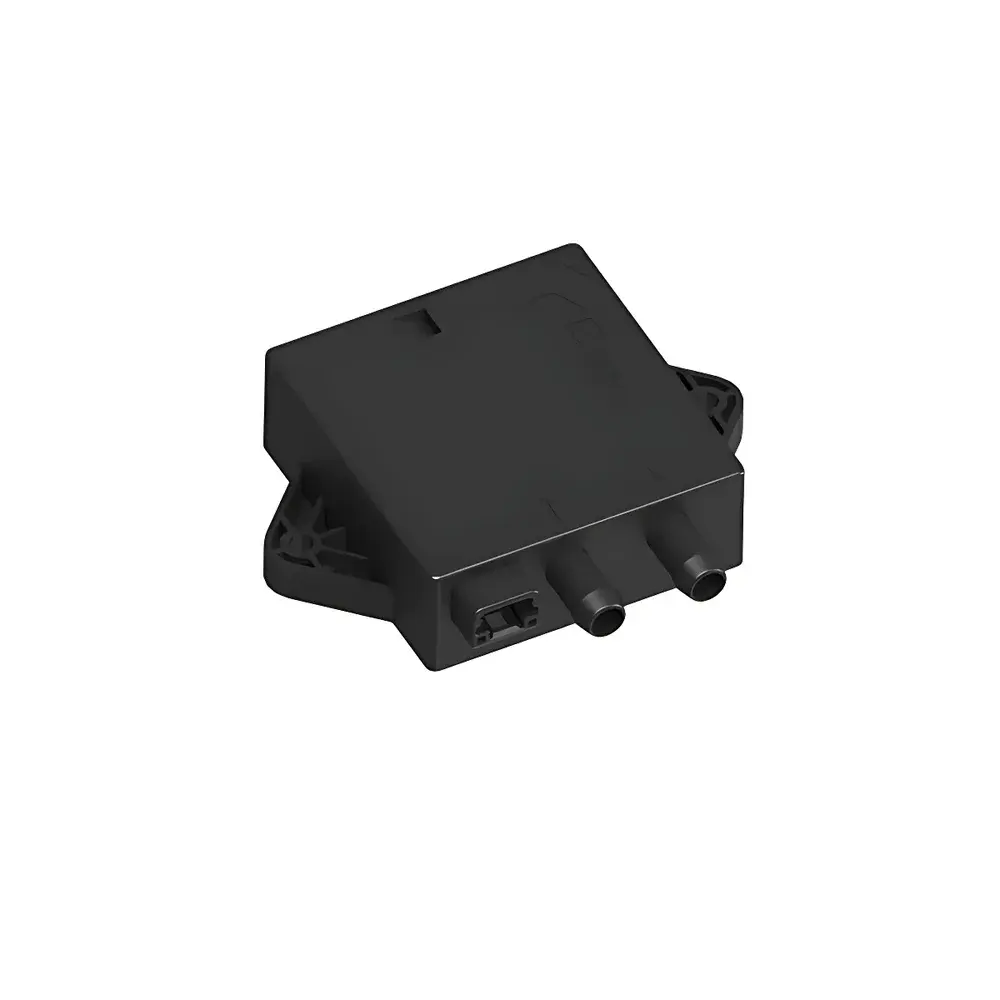
Cubic ATRS-1021 Battery Thermal Runaway Monitoring Sensor with Multi-Gas (CO₂, CO, HC, H₂), PM, Temperature & Pressure Detection
| Key | Brand: Cubic |
|---|---|
| Model | ATRS-1021 |
| Gas Detection Principle | CO₂ – NDIR |
| Measurement Ranges | CO₂: 0–10,000 ppm |
| CO/HC/H₂ | 1–1,000 ppm |
| PM | 0–5 mg/m³ |
| Pressure | 80–120 kPa |
| Temp | −40–125 °C |
| Accuracy | CO₂: ±(50 ppm + 5% of reading) |
| CO/HC/H₂ | ±40 ppm or ±30% of reading (whichever is greater) |
| PM | ≤100 µg/m³ → ±15 µg/m³, >100 µg/m³ → ±15% of reading |
| Pressure | ±0.1 kPa |
| Temp | ±2 °C |
| Resolution | CO₂/CO/HC/H₂: 1 ppm |
| PM | 1 µg/m³ |
| Pressure | 0.1 kPa |
| Temp | 0.1 °C |
| Response Time (T90) | CO₂ <15 s |
| Data Refresh Rate | ≤1 s |
| Output Interface | CAN (default), LIN, UART |
| Operating Temp | −40–85 °C |
| Humidity | 0–99% RH (non-condensing) |
| Power Supply | 9–16 VDC (nominal 12 VDC) |
| Avg. Current | ≤150 mA (normal), ≤50 mA (low-power mode), <100 µA (sleep) |
| Enclosure Rating | IP65 |
| Expected Service Life | ≥15 years (CO₂ & MOX sensors) |
Overview
The Cubic ATRS-1021 Battery Thermal Runaway Monitoring Sensor is an integrated, vehicle-grade environmental sensing module engineered for early-stage detection of thermal runaway precursors in lithium-ion and hydrogen-based energy storage systems. It simultaneously monitors five critical physical and chemical parameters—carbon dioxide (CO₂), carbon monoxide (CO), hydrocarbons (HC), hydrogen (H₂), particulate matter (PM), ambient temperature, and barometric pressure—within a single compact housing. Its measurement architecture combines non-dispersive infrared (NDIR) spectroscopy for CO₂, metal-oxide semiconductor (MOX) microelectromechanical systems (MEMS) for multi-gas selectivity, and proprietary laser scattering for PM quantification. Designed to interface directly with battery management systems (BMS) via CAN or LIN bus, the ATRS-1021 delivers time-synchronized, high-fidelity data streams with sub-second refresh rates—enabling real-time hazard classification, fault isolation, and automated safety response initiation per ISO 6469-3 and UN GTR No. 20 requirements.
Key Features
- Multi-parameter fusion architecture: Simultaneous acquisition of CO₂, CO, HC, H₂, PM2.5/PM10, temperature, and pressure—eliminating need for discrete sensor arrays and reducing system integration complexity.
- NDIR-based CO₂ detection: High-selectivity optical path with dual-wavelength compensation ensures minimal cross-sensitivity to water vapor and other IR-active gases; T90 <15 s enables rapid anomaly capture during early off-gassing phases.
- MEMS MOX gas array with electronic nose algorithm: Enables discrimination among CO, HC, and H₂ using pattern recognition on resistance-transient signatures—minimizing humidity-induced drift and supporting post-deployment calibration adaptation.
- Laser scattering PM sensor: Patented optical chamber design achieves 1 µg/m³ resolution and <8 s response, validated against reference gravimetric methods per ISO 29463-3 for aerosol monitoring in confined battery enclosures.
- Automotive-grade electronics: AEC-Q200-compliant circuitry, conformal coating, and extended thermal cycling tolerance (−40 °C to +85 °C) ensure stable operation under vibration, thermal shock, and high-humidity conditions typical of EV battery packs and stationary ESS racks.
- Low-power operational modes: Programmable duty cycling for PM and MOX elements reduces average current draw to ≤50 mA; sleep-state current <100 µA supports long-term deployment in always-on safety-critical applications.
Sample Compatibility & Compliance
The ATRS-1021 is optimized for direct installation within battery module housings, pack-level ducts, and containment chambers of traction battery systems, hydrogen fuel cell stacks, and grid-scale energy storage units. Its gas inlet geometry and internal flow path are designed to minimize particle deposition and condensation artifacts during continuous sampling. The sensor meets IP65 ingress protection requirements for dust and water resistance, and its materials comply with UL 94 V-0 flammability standards. All gas measurement algorithms adhere to ASTM D6207 (CO), ISO 8573-4 (hydrocarbon impurities), and IEC 62619 (secondary lithium cells for industrial applications) test protocols. Firmware supports configurable alarm thresholds and event logging aligned with ISO 26262 ASIL-B functional safety architecture.
Software & Data Management
Data output follows standardized CANopen DS-301 protocol (CAN ID mapping per SAE J1939-71 annex) and includes timestamped raw sensor values, diagnostic flags (e.g., sensor saturation, heater fault, optical window contamination), and health status registers. Optional firmware enables GLP/GMP-compliant audit trails with tamper-evident CRC-32 checksums and write-protected configuration memory. Integration SDK provides C/C++ libraries for Linux and RTOS environments, including CAN frame parsing utilities, baseline drift compensation routines, and MOX array calibration matrix loaders. All firmware updates are signed using X.509 certificates compliant with UNECE R155 CSMS cybersecurity management system requirements.
Applications
- Electric vehicle (EV) battery packs: Real-time monitoring of off-gas evolution during overcharge, mechanical abuse, or thermal propagation testing per UL 9540A and GB/T 36276.
- Hydrogen energy systems: Detection of H₂ leakage and combustion byproducts (CO, CO₂) in PEM fuel cell enclosures and hydrogen refueling infrastructure.
- Stationary energy storage systems (ESS): Early warning for thermal runaway in lithium iron phosphate (LFP), nickel-manganese-cobalt (NMC), and sodium-ion battery installations.
- Lab-scale battery safety research: Quantitative correlation of gas evolution kinetics with calorimetric data (ARC, DSC) and voltage/temperature transients during accelerated aging studies.
- OEM BMS development: Hardware-in-the-loop (HIL) validation of fault detection logic using traceable, multi-gas stimulus profiles generated via programmable gas mixing systems.
FAQ
What communication protocols does the ATRS-1021 support out-of-the-box?
Standard configuration includes CAN 2.0B at 500 kbps with customizable message IDs and DLC; LIN 2.2A and UART (TTL level) are available as factory-configurable options.
Is field recalibration required for CO₂ or MOX sensors?
No routine recalibration is needed—the NDIR CO₂ channel is factory-zeroed and span-calibrated using certified gas standards; MOX array utilizes adaptive baseline tracking and requires only periodic verification against known gas challenges per ISO 12099.
How does the sensor handle high humidity or condensation risk inside battery enclosures?
The optical path incorporates hydrophobic anti-fog coating on NDIR windows, and MOX elements operate at elevated temperatures (>200 °C) to prevent moisture adsorption; internal humidity compensation algorithms are embedded in all gas measurement firmware modules.
Can the ATRS-1021 be deployed in explosion-proof zones?
While not intrinsically safe certified (ATEX/IECEx), its maximum power consumption (<1.8 W) and absence of spark-prone components allow integration into Class I, Division 2 hazardous locations when installed within appropriately rated enclosures per NEC Article 500.
What is the recommended maintenance interval for optical window cleaning?
Under normal EV operating conditions, optical window inspection is advised every 24 months; cleaning with isopropyl alcohol and lint-free swabs restores full NDIR transmission without requiring revalidation.







